

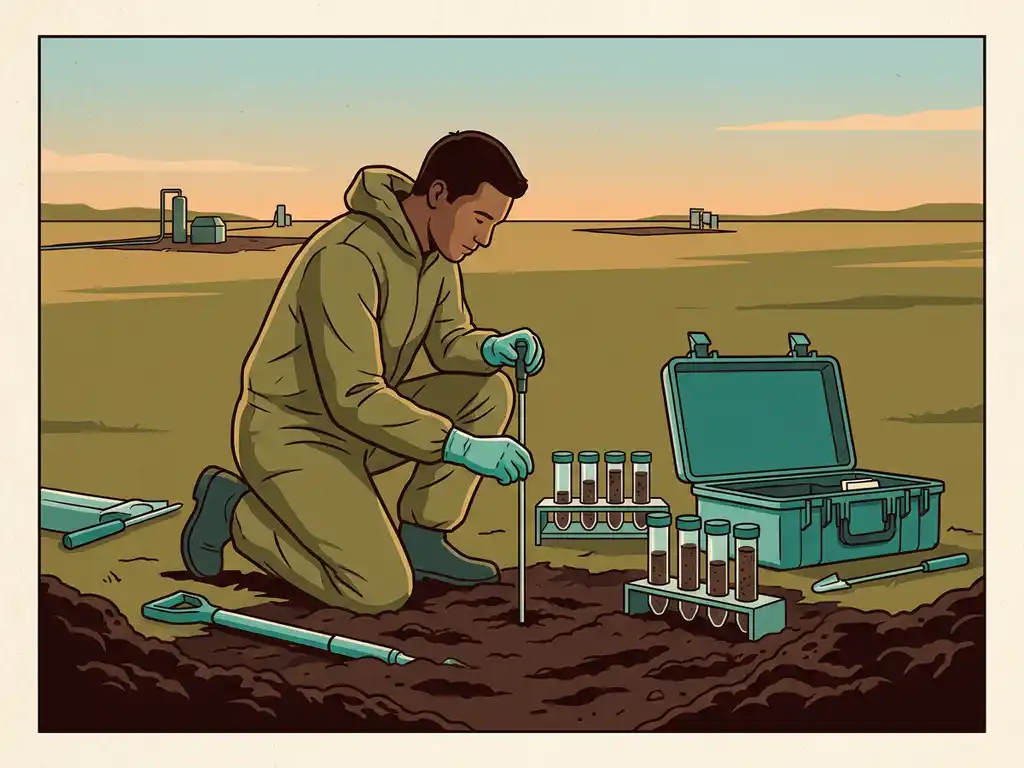
Soil remediation progress is monitored through a combination of chemical sampling, groundwater analysis, and biological activity measurements taken at regular intervals throughout the remediation period. The most effective monitoring programs do not rely on a single method – they layer chemical data with microbiological indicators to build a complete picture of what is happening in the subsurface. This article walks through the core questions site managers and project leads ask when overseeing a remediation program, from the tools available to the signals that tell you whether your strategy is working.
What methods are used to monitor soil remediation progress?
Soil remediation progress is monitored through groundwater sampling, soil core analysis, and biological activity measurements. Groundwater monitoring wells track contaminant concentrations over time, while soil samples confirm whether degradation is occurring in the target zone. For biological remediation approaches, microbiological analysis adds a third layer by measuring the organisms actually driving the cleanup.
The choice of monitoring method depends on the type of contamination and the remediation strategy in place. For chlorinated solvents such as volatile organochlorine compounds (VOCl), standard chemical analysis alone is often insufficient. These compounds undergo a stepwise degradation process, and intermediate breakdown products can accumulate if the microbial community is not functioning correctly. Measuring only the parent compound gives an incomplete and sometimes misleading picture of progress.
A well-structured monitoring program for a contaminated industrial site typically combines:
- Periodic groundwater sampling from monitoring wells to track contaminant plume behavior
- Soil gas measurements to detect volatile compounds migrating upward
- Geochemical indicators such as redox potential, pH, and dissolved oxygen to characterize subsurface conditions
- Microbiological analysis to confirm that degradation-capable organisms are present and active
For project leads managing biological soil remediation on sites where excavation is not feasible, this layered approach is essential. It provides the concrete data points that regulators and investors require, while also giving the remediation team the feedback needed to adjust their approach if conditions change.
Get in Touch
Let’s Talk Microbial Solutions
Book a conversation with Stijn, our CEO, or send us your request.
| Book an Appointment | Request Information |
How do molecular monitoring tools work in bioremediation?
Molecular monitoring tools work by detecting and quantifying specific microbial DNA or RNA sequences in soil and groundwater samples. Techniques such as quantitative PCR (qPCR) and amplicon sequencing allow scientists to identify which microorganisms are present, in what quantities, and whether they are actively expressing the genes responsible for contaminant degradation.
In practice, this means you can move beyond asking “is the contamination decreasing?” and instead ask “are the right microorganisms present, and are they doing their job?” For VOCl contamination, for example, specific bacterial groups carry out reductive dechlorination. Molecular tools can confirm whether these organisms are present at sufficient densities and whether the process is proceeding through all the necessary degradation steps to reach non-toxic end products.
This level of detail has real operational value. If molecular data shows that degradation is stalling at an intermediate compound, the remediation team can intervene before chemical monitoring would have flagged the problem. Avecom’s molecular soil analysis services, including qPCR and amplicon sequencing, are specifically designed to provide this kind of actionable diagnostic data throughout the remediation process, supporting both internal reporting and OVAM compliance documentation.
What does a microcosm test tell you before full-scale remediation?
A microcosm test tells you whether the native microbial community in a specific soil sample is capable of degrading the target contaminant under controlled laboratory conditions. It is a small-scale feasibility test that simulates subsurface conditions and measures whether biological degradation actually occurs, at what rate, and whether it needs support through bioaugmentation or nutrient amendment.
Before committing to a full-scale biological remediation program, a microcosm test answers the most important practical question: will this approach work for this specific soil matrix and contamination profile? Not every contaminated site has the microbial conditions needed to support natural attenuation or enhanced bioremediation. Soil chemistry, moisture, temperature, and the history of contamination all influence whether the right organisms are present.
The value of microcosm testing lies in the risk reduction it provides. Running a lab-scale test costs a fraction of what a failed field intervention would cost. If the test shows limited native degradation capacity, the team can evaluate whether bioaugmentation with a specialized microbial consortium would be effective, or whether a different remediation strategy is more appropriate for the site. This is the kind of early-stage diagnostic work that prevents expensive surprises later in the project.
How often should soil remediation sites be monitored?
Soil remediation sites should typically be monitored quarterly during active remediation phases, with the frequency adjusted based on site-specific factors such as contaminant mobility, proximity to sensitive receptors, and the stage of the remediation program. Regulatory frameworks such as VLAREBO in Belgium set minimum reporting requirements, but these represent a floor, not an optimal monitoring schedule.
In the early stages of a bioremediation project, more frequent monitoring is justified. The first months after bioaugmentation or in-situ treatment are when conditions are most dynamic, and early data helps confirm that the microbial community is establishing and that degradation is proceeding as expected. As the site stabilizes and contaminant concentrations trend consistently downward, monitoring intervals can often be extended without losing meaningful oversight.
Practical factors that influence monitoring frequency include:
- The mobility of the contaminant plume and the risk of off-site migration
- Seasonal variation in groundwater levels, which affects contaminant distribution
- The presence of sensitive land uses nearby, such as residential areas or water extraction points
- Regulatory milestones and reporting deadlines set by the competent authority
- The specific remediation technology in use and its expected response timeline
What are the signs that bioremediation is working?
The clearest signs that bioremediation is working are a measurable decrease in contaminant concentrations in groundwater and soil samples, combined with evidence of biological activity in the form of degradation byproducts and an established population of degradation-capable microorganisms. No single indicator is sufficient on its own – convergent evidence from chemical and biological data gives the most reliable confirmation.
For chlorinated solvent contamination, the degradation pathway produces a sequence of intermediate compounds. Detecting these intermediates in the expected pattern is actually a positive sign – it confirms that the biological process is progressing through the correct steps. If only the parent compound is decreasing without the expected intermediates appearing, it may indicate abiotic processes rather than true biological degradation.
Geochemical changes in the subsurface also signal active bioremediation. Reductive dechlorination, for example, consumes electron donors and alters the redox chemistry of the groundwater. Shifts in parameters such as dissolved oxygen, nitrate, and sulfate concentrations can confirm that the microbial community is metabolically active, even before contaminant concentrations show a clear trend.
Molecular monitoring adds the most direct confirmation. When qPCR data shows that the target degrading organisms are present at high cell densities and are expressing the relevant functional genes, this provides strong evidence that the remediation is proceeding as intended.
When should you adjust or escalate a remediation strategy?
A remediation strategy should be adjusted when monitoring data shows that contaminant concentrations are not declining within the expected timeframe, when degradation intermediates are accumulating without progressing further, or when the microbial community is not establishing at the target density. Escalation to a more intensive approach is warranted when these deviations persist across multiple monitoring rounds.
The decision to adjust or escalate is easier to make when the monitoring program has been designed to provide diagnostic information rather than just compliance data. If monitoring only measures the contaminant concentration, a flat trend tells you something is wrong but not why. If the program also includes molecular data and geochemical indicators, the team can usually identify the specific limiting factor, whether that is a lack of the right organisms, insufficient electron donor, or unfavorable pH conditions, and respond accordingly.
Common escalation triggers include:
- No measurable decrease in contaminant concentrations after two to three monitoring rounds following treatment
- Accumulation of a toxic intermediate compound without further degradation
- Molecular data showing low or declining populations of target degrading organisms
- Geochemical conditions shifting outside the range that supports the target microbial process
- Contaminant plume expansion toward a sensitive receptor or property boundary
When a biological approach has not delivered expected results, the question is rarely whether to abandon biological remediation entirely. More often, the data points to a specific adjustment, such as bioaugmentation with a more robust microbial consortium, amendment of electron donors, or pH correction. The team at Avecom works through exactly this kind of diagnostic process, using lab- and pilot-scale testing to identify what is limiting field performance before recommending a revised approach.
For site managers dealing with persistent VOCl contamination where standard approaches have not delivered results, the combination of microcosm testing, molecular monitoring, and targeted bioaugmentation provides a structured pathway from uncertainty to measurable progress. If you are managing a contaminated site and need to determine whether a biological approach is viable, contact Avecom for a preliminary screening before committing to a full remediation design.