

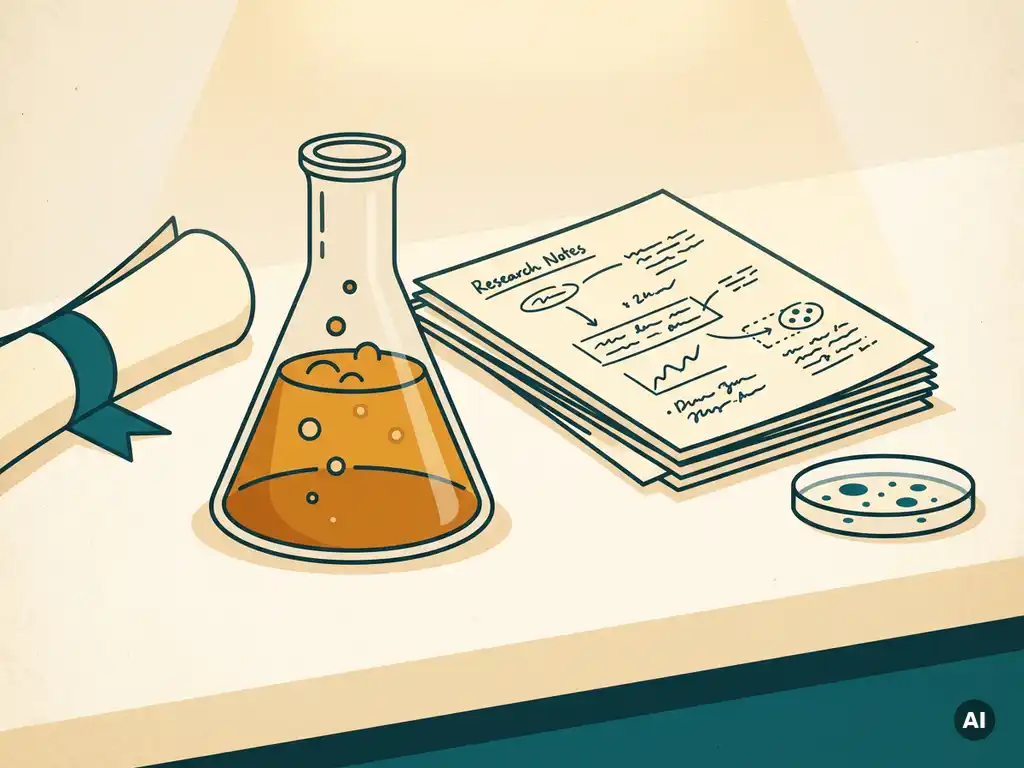
Fermentation R&D results translate into patent applications by converting documented experimental findings into legally defensible claims about a novel process, microorganism, composition, or product. The key is that raw data alone does not create IP protection; structured documentation, clear novelty arguments, and timely filing do. This article unpacks the most common questions R&D teams face when moving from bench results to a granted patent.
What types of fermentation results are actually patentable?
A fermentation result is patentable when it is novel, inventive, and industrially applicable. In practice, this covers four main categories: a new microbial process (the method of fermentation itself), a new product produced by fermentation, a novel microbial strain or consortium, and a new use of an existing fermentation process for a different application. Not every experimental finding qualifies; the result must represent a non-obvious step beyond what is already publicly known.
In microbial fermentation specifically, patentable subject matter often includes optimized process conditions (temperature, pH, substrate ratios, feeding strategies) that produce a measurably superior outcome, or a defined microbial community that performs a function no prior art describes. Results that are purely confirmatory, showing that an existing process works as expected, are not patentable, even if they represent significant engineering effort.
One area that is frequently underestimated is the patentability of mixed microbial cultures. Because most academic and industrial IP focuses on genetically modified pure strains, a well-characterized and functionally defined microbial consortium can represent genuinely novel intellectual property, provided the composition and its function are documented with sufficient precision.
How does lab-scale data support a patent claim?
Lab-scale data supports a patent claim by providing the experimental evidence that the invention works as described, a requirement known as “enablement” or “sufficiency of disclosure.” Patent offices require that a skilled person reading your application could reproduce the invention based on your description. Lab results, including yields, conversion rates, process conditions, and analytical characterizations, form the factual backbone of that reproducibility argument.
The quality of documentation matters as much as the results themselves. Notebooks, batch records, analytical reports, and method descriptions must be detailed enough to reconstruct the experiment. Vague claims like “high yield was achieved” without defined conditions and measurements will weaken or invalidate a claim during examination.
Lab-scale data also defines the scope of the claims. If your results only demonstrate a process working under a narrow set of conditions, broad claims covering a wide range of parameters are likely to be challenged. Conversely, systematic variation of conditions at lab scale, testing pH ranges, substrate types, or inoculum concentrations, creates the evidential basis for broader, more defensible claims. This is one reason why structured feasibility studies, rather than opportunistic experiments, produce stronger patent dossiers.
Get in Touch
Let’s Talk Microbial Solutions
Book a conversation with Stijn, our CEO, or send us your request.
| Book an Appointment | Request Information |
When should a fermentation company file a patent application?
A fermentation company should file a patent application before any public disclosure of the invention, including conference presentations, academic publications, grant applications with public summaries, or commercial discussions without a non-disclosure agreement in place. In most jurisdictions, any public disclosure before filing destroys novelty and makes the invention unpatentable. Filing a provisional application early, even with incomplete data, establishes a priority date while allowing twelve months to build the full application.
The practical tension for R&D teams is between filing early (to protect priority) and filing late (to include more supporting data). The standard approach is to file a priority application as soon as the core concept and at least one working example are documented, then use the twelve-month priority window to generate additional data that strengthens the claims before filing internationally under the PCT system.
In the context of scale-up biotechnology, timing also intersects with investor milestones. A filed patent application, even a provisional one, signals to investors that the IP is being actively protected. Waiting until pilot-scale validation is complete before filing is a common and costly mistake, particularly when the lab-scale concept has already been discussed in pitch decks or at industry events.
What’s the difference between process patents and product patents in fermentation?
A process patent protects the method of producing something, the specific steps, conditions, and microbial systems used in fermentation. A product patent protects the output itself, the compound, biomass, or formulation produced. The two are legally distinct and provide different types of protection. A process patent prevents competitors from using your method even if they arrive at the same product by a different route; a product patent prevents anyone from making, selling, or importing that product regardless of how it was made.
In fermentation, process patents are often more achievable because the product itself (an amino acid, an enzyme, a single-cell protein) may already be known. The novelty lies in how it is produced, the microbial system, the substrate, the operational conditions, or the downstream processing steps. Product patents are more powerful when the output is genuinely novel, such as a new bioactive compound or a structurally distinct biomass fraction.
Many strong fermentation IP portfolios combine both types. A process patent filed early protects the method during development; a product patent, if the output qualifies, adds a second layer of protection that is harder for competitors to design around. Understanding which type applies to your results early in the R&D process shapes both the documentation strategy and the filing timeline.
How do you protect fermentation IP developed during contract R&D?
Fermentation IP developed during contract R&D is protected primarily through the contractual agreement established before work begins. The contract must explicitly define who owns foreground IP (inventions made during the project), who retains rights to background IP (pre-existing knowledge each party brings), and how joint inventions are handled. Without clear contractual terms, ownership disputes are common and can block commercialization entirely.
Standard provisions in a well-structured contract R&D agreement include confidentiality obligations, IP assignment or licensing terms, publication rights, and rights to improvements. For companies working with an external fermentation partner, it is important to distinguish between the partner’s general know-how (which remains theirs) and specific inventions arising from your project (which should be assigned or exclusively licensed to you).
Non-disclosure agreements alone are not sufficient. An NDA protects confidential information from being disclosed, but it does not automatically assign ownership of inventions made by the service provider. A separate IP agreement, or IP clauses embedded in the service contract, is required to ensure that the client company can file patents on results generated during the collaboration. Reputable contract fermentation partners address this transparently at the outset, because ambiguity over IP ownership undermines the relationship for both sides.
What are the most common reasons fermentation patent applications get rejected?
The most common reasons fermentation patent applications are rejected are lack of novelty, lack of inventive step, and insufficient disclosure. Novelty rejections occur when the examiner identifies prior art, published papers, earlier patents, or public disclosures, that already describes the claimed invention. Inventive step rejections occur when the examiner argues that the invention would have been obvious to a skilled person based on existing knowledge, even if no single prior art document describes it exactly.
Insufficient disclosure rejections are particularly common in microbial fermentation because the complexity of biological systems makes reproducibility harder to demonstrate. If the application does not describe the microbial system, process conditions, and analytical methods with enough precision for a skilled person to replicate the results, the claims will be challenged on enablement grounds.
Additional common rejection reasons include:
- Overly broad claims that are not supported by the experimental data provided
- Deposit requirement failures when a novel microorganism is claimed but has not been deposited in a recognized culture collection
- Inconsistent terminology between the claims and the description, creating ambiguity about what is actually being protected
- Late filing after a public disclosure has already occurred, destroying novelty before the application is submitted
Addressing these risks starts in the laboratory, not in the patent attorney’s office. Systematic documentation, careful control of public disclosures, and structured experimental design that tests the boundaries of the invention all reduce the likelihood of rejection. For companies without in-house IP expertise, working with a fermentation partner that provides scientific reporting aligned with patent requirements, including methodology documentation and analytical characterization, can significantly strengthen the application before it reaches the examiner.
Avecom’s fermentation R&D services include scientific reporting structured to support subsidy applications, investor dossiers, and patent filings, built on the same methodological rigor that patent examiners look for when evaluating sufficiency of disclosure.
Related Articles
- What are mixed microbial cultures and why are they valuable?
- How serious is contamination found on an industrial site?
- How do you stabilize a biological reactor with recurring sludge issues?
- How does temperature affect sludge behavior in biological treatment?
- Why is my wastewater treatment plant not working properly?