

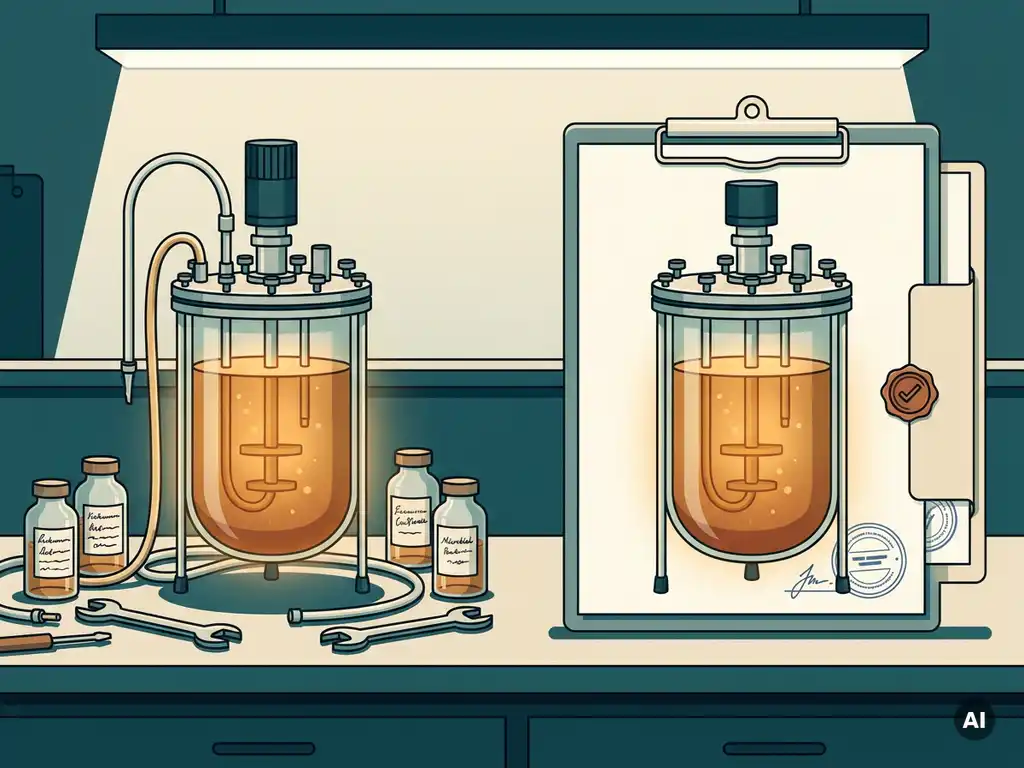
Fermentation optimization and process validation are two distinct phases of bioprocess development that serve fundamentally different purposes. Optimization is about finding the best conditions for a microbial process to perform consistently and efficiently. Validation is about proving, with documented evidence, that those conditions reliably produce the intended outcome within defined specifications. The two phases are sequential, not parallel, and confusing them is one of the most common reasons fermentation scale-up projects stall or fail. The sections below unpack each phase, explain when one ends and the other begins, and address the practical decisions companies face when moving a fermentation concept toward production.
How does fermentation optimization actually work?
Fermentation optimization is the iterative process of adjusting and refining process parameters, such as temperature, pH, dissolved oxygen, nutrient feeds, and inoculation conditions, to maximize the performance of a microbial system in terms of yield, productivity, or product quality. It is fundamentally exploratory: the goal is to understand how the process behaves and what drives its performance.
In practice, optimization begins at lab scale, where variables can be tested quickly and cheaply. Engineers and microbiologists run systematic experiments, often using design-of-experiments (DoE) approaches, to identify which parameters have the greatest influence on the outcome. For processes involving mixed microbial cultures, this phase also includes community profiling, using molecular tools such as amplicon sequencing and qPCR, to understand which organisms are active under different conditions and why the process responds the way it does.
The output of optimization is not a single perfect recipe. It is a defined operating window: a range of conditions within which the process performs acceptably. This window becomes the foundation for the next phase. Without it, validation has nothing to validate.
What does process validation involve in fermentation?
Process validation in fermentation is the structured, documented demonstration that a defined process consistently produces a product meeting predetermined specifications. Where optimization asks “what works best?”, validation asks “does this defined process work reliably, every time, under real production conditions?” Validation is not about discovering new information. It is about confirming what optimization has already established.
A typical bioprocess validation program involves running the process multiple times, often three or more consecutive runs, under fixed, controlled conditions and demonstrating that key performance indicators, such as titer, purity, yield, and microbial profile, fall within accepted limits across all runs. Deviations are documented, investigated, and either resolved or accepted within a defined risk framework.
Validation also generates the documentation that regulatory bodies, customers, or investors require before a process can be transferred to commercial production. For animal feed applications, for example, Feed Chain Alliance (FCA) certification requires validated evidence that the production process consistently meets safety and quality standards. This documentation cannot be produced during optimization, because optimization, by definition, is still changing things.
Get in Touch
Let’s Talk Microbial Solutions
Book a conversation with Stijn, our CEO, or send us your request.
| Book an Appointment | Request Information |
Why can’t optimization and validation happen at the same time?
Optimization and validation cannot happen simultaneously because they operate on opposing principles. Optimization requires changing variables to learn from the process. Validation requires holding variables fixed to prove the process is under control. Running both at once produces data that is scientifically uninterpretable and legally unusable.
If a process parameter is still being adjusted during validation runs, any variability in the output cannot be attributed to the process itself versus the intentional changes being made. This undermines the statistical basis of validation entirely. Regulators, auditors, and quality systems require that the process being validated is frozen: no changes to critical parameters, raw materials, equipment, or procedures are permitted during the validation campaign.
This is also why premature validation is a costly mistake. Companies under time pressure sometimes attempt to validate a process before optimization is complete, only to find that the process performs inconsistently across runs. The validation fails, and the team is forced to return to optimization, losing both time and credibility with stakeholders.
What triggers the move from optimization to validation?
The transition from fermentation optimization to process validation is triggered when the process has reached a defined state of control: the operating window is established, the critical process parameters are identified, the process consistently hits target performance within that window, and the team has sufficient mechanistic understanding to predict how the process will behave if conditions drift slightly.
In practical terms, this means several things need to be true before validation begins:
- The microbial system is stable and reproducible across multiple lab or pilot runs
- Critical quality attributes, such as biomass concentration, product titer, or microbial composition, are consistently within specification
- Raw material specifications and inoculum preparation protocols are locked
- Analytical methods for measuring process performance are themselves validated or, at minimum, qualified
- The target scale for validation is defined and the equipment has been qualified
A common mistake is treating a single successful run as proof that the process is ready for validation. One good run demonstrates possibility. Validation requires demonstrated reproducibility, which means the process needs to have performed consistently across multiple independent runs under the defined conditions before validation formally begins.
How does scale-up affect both optimization and validation?
Scale-up introduces new process dynamics that can invalidate optimization work done at a smaller scale, which is why fermentation scale-up is treated as a distinct technical challenge rather than a simple enlargement. Mixing efficiency, oxygen transfer rates, heat dissipation, and shear stress all behave differently in larger vessels, and a microbial community that performs well in a 10-liter bioreactor may respond very differently in a 500-liter system.
Scale-up and optimization
When moving from lab to pilot scale, the optimization phase often needs to be partially repeated. Engineers use scale-up rules, such as maintaining constant volumetric power input or constant dissolved oxygen set points, to translate conditions from one scale to another. But these rules are approximations, and for complex microbial systems, especially mixed cultures, the community composition and metabolic activity may shift in ways that require re-optimization of key parameters at the new scale.
Scale-up and validation
Validation is always scale-specific. A process validated at pilot scale is not automatically validated at production scale. If the process is transferred to a larger vessel, a new validation campaign is required at that scale. This is why it is important to define the intended commercial scale early in the development program: optimizing and validating at a scale that is significantly smaller than the intended production scale delays the overall timeline and may require substantial rework.
When should a company outsource fermentation optimization or validation?
A company should consider outsourcing fermentation optimization or validation when it lacks the specialized infrastructure, analytical capabilities, or microbial expertise to execute these phases reliably in-house, or when the time and capital required to build that capability internally would delay the project beyond what investors or customers will accept.
For many biotech scale-ups and industrial companies, building a pilot-scale fermentation facility with the necessary bioreactors, downstream processing equipment, and molecular analytics is neither practical nor strategically sensible. The capital cost is high, the lead time is long, and the expertise required to operate such a facility is specialized. Partnering with a contract fermentation R&D organization that already has this infrastructure in place is often the faster and more cost-effective path to a validated process.
Outsourcing is particularly well-suited to situations where:
- The internal lab can handle early-stage screening but lacks pilot-scale bioreactors for scale-up work
- The process involves complex mixed microbial cultures that require specialized microbiome monitoring
- Proof of concept needs to be demonstrated within a defined window for investors or regulatory submission
- The company needs scientific documentation, such as technical reports or data packages, to support patent applications or subsidy dossiers
The key criterion for selecting an outsourcing partner is not just equipment availability. It is whether the partner can function as a genuine technical extension of the internal R&D team, contributing scientific judgment and process understanding rather than simply running experiments to a protocol. Avecom, for example, operates as that kind of embedded partner, working across microbial fermentation R&D from initial feasibility through pilot-scale validation, with the analytical depth to understand why a process behaves the way it does, not just whether it hits a target number.
Get in Touch
Let’s Talk Microbial Solutions
Book a conversation with Stijn, our CEO, or send us your request.
| Book an Appointment | Request Information |
Related Articles
- How do fermentation R&D results translate into patent applications?
- How do you select a fermentation partner that understands your industry?
- How do you reduce time-to-market for a fermentation-based product?
- How does organic loading rate affect sludge quality?
- What should you do when your wastewater plant misses discharge limits?