

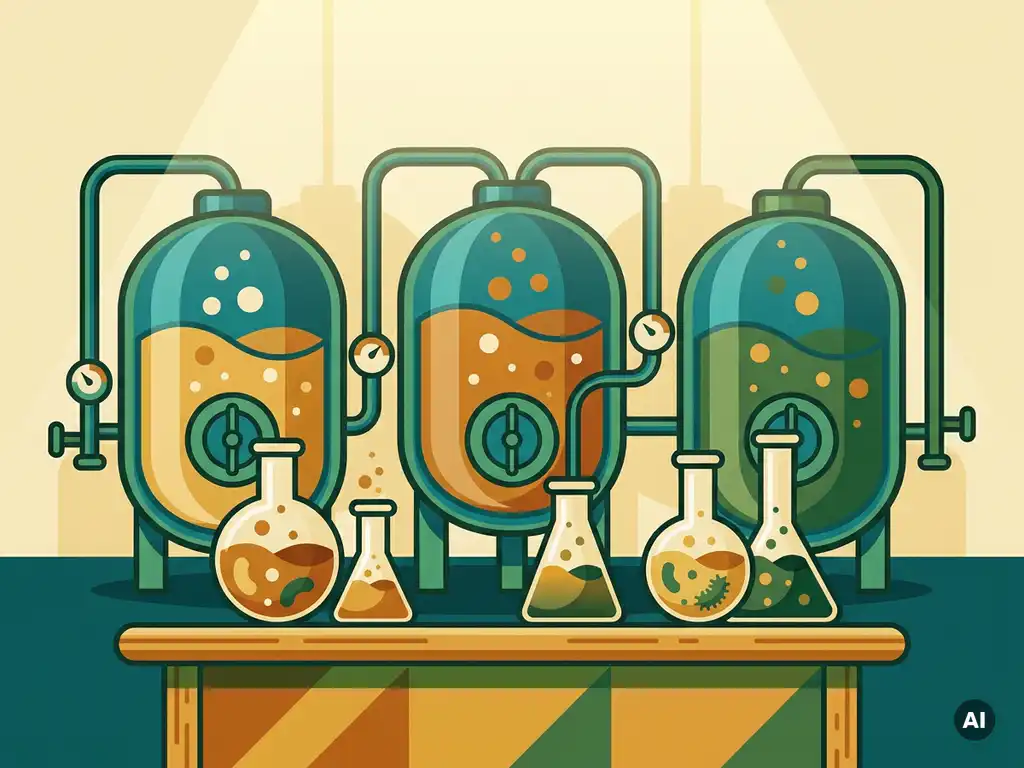
The most widely used fermentation processes in food ingredient production are submerged liquid fermentation and solid-state fermentation, each suited to different microbial systems and end products. Submerged fermentation dominates large-scale industrial output, while solid-state fermentation remains essential for specific enzyme, flavour, and functional ingredient applications. The choice of process depends on the target ingredient, the microbial system involved, and the scale of production. The sections below unpack each process type, how they compare to chemical synthesis, and what scaling from lab to pilot actually involves.
Which fermentation types are most common in food ingredient manufacturing?
The two dominant fermentation processes in food ingredient manufacturing are submerged fermentation (SmF) and solid-state fermentation (SSF). Submerged fermentation, where microorganisms grow in a liquid nutrient medium inside a bioreactor, accounts for the majority of industrial food ingredient production. Solid-state fermentation, where microorganisms grow on moist solid substrates with little to no free water, is used for specific enzyme classes, fermented flavourings, and functional food components.
Beyond these two, fed-batch and continuous fermentation are operational modes rather than distinct types, but they significantly affect process economics and product quality. Fed-batch fermentation, where nutrients are added incrementally during the run, is widely used to control metabolite accumulation and improve yield. Continuous fermentation maintains a steady state by simultaneously adding fresh medium and removing culture fluid, which suits high-volume commodity ingredient production.
The microbial systems involved span bacteria, yeasts, filamentous fungi, and mixed microbial communities. Each brings different metabolic capabilities, and the selection of the right organism or consortium is often the most consequential technical decision in developing a food ingredient fermentation process.
How does submerged fermentation produce food ingredients?
In submerged fermentation, microorganisms are suspended in a liquid medium inside a controlled bioreactor, where they convert substrates such as sugars, organic acids, or protein-rich side streams into target compounds. The process allows precise control over temperature, pH, dissolved oxygen, and nutrient supply, making it the preferred format for producing amino acids, organic acids, vitamins, enzymes, and microbial proteins at industrial scale.
The bioreactor provides a homogeneous environment that supports consistent product quality and reproducibility across batches. Aeration and agitation systems maintain oxygen transfer rates for aerobic processes, while anaerobic variants operate under controlled gas conditions. Downstream processing, including centrifugation, filtration, and pasteurisation, separates and purifies the target ingredient from the fermentation broth.
Submerged fermentation is also the format used in microbial biomass fermentation, where the cell mass itself is the product rather than a secreted metabolite. This is the basis for single-cell protein production, where microbial biomass grown on food processing side streams is harvested as a protein-rich ingredient for animal or human nutrition.
Get in Touch
Let’s Talk Microbial Solutions
Book a conversation with Stijn, our CEO, or send us your request.
| Book an Appointment | Request Information |
What is solid-state fermentation used for in food production?
Solid-state fermentation is used in food production primarily to manufacture enzymes, fermented flavourings, and functional ingredients where filamentous fungi or specific bacterial strains require a low-moisture, solid substrate environment to express their metabolic potential. Traditional applications include koji fermentation for soy sauce and miso production, as well as the manufacture of enzymes such as amylases, proteases, and lipases used in baking, dairy, and brewing.
The low water activity in solid-state systems creates conditions that favour certain fungal species, particularly Aspergillus and Rhizopus strains, which produce high concentrations of extracellular enzymes when grown on substrates like wheat bran, rice bran, or agricultural residues. This makes solid-state fermentation well suited to valorising agro-industrial side streams into high-value functional ingredients.
Compared to submerged fermentation, solid-state systems are harder to scale and more difficult to monitor in real time. Heat and mass transfer limitations become significant at larger volumes, and process control is less straightforward. These challenges mean that solid-state fermentation is typically reserved for products where the substrate or microbial system genuinely requires it, rather than as a default choice for scale-up.
How does fermentation differ from chemical synthesis for food ingredients?
Fermentation and chemical synthesis differ fundamentally in how they produce food ingredients: fermentation uses living microorganisms to carry out biochemical conversions under mild, aqueous conditions, while chemical synthesis relies on chemical reactions, often at high temperatures or pressures and using organic solvents or catalysts. For many food ingredient applications, fermentation offers superior stereoselectivity, producing the specific molecular forms that biological systems recognise and metabolise.
This stereoselectivity matters particularly for amino acids, vitamins, and flavour compounds, where the biological activity of a molecule depends on its three-dimensional configuration. Chemical synthesis frequently produces racemic mixtures of both forms, requiring additional separation steps. Fermentation, by contrast, produces the biologically active form directly.
From a regulatory and consumer acceptance standpoint, fermentation-derived ingredients often qualify as natural under food labelling frameworks, while chemically synthesised equivalents may not. This distinction has become commercially significant as food manufacturers respond to clean-label demand. Fermentation also tends to generate less hazardous waste than chemical routes, though the management of fermentation broth and biomass residues requires its own environmental considerations.
The trade-off is productivity and process simplicity. Chemical synthesis can achieve very high volumetric yields in compact reactors, while fermentation requires careful management of living systems that respond to environmental stress, contamination, and nutrient imbalances. This is precisely where process expertise and robust monitoring become critical.
What role do mixed microbial cultures play in fermentation-based ingredients?
Mixed microbial cultures, where two or more microbial species or strains operate together in a single fermentation system, play an important role in food ingredient production because they can perform metabolic tasks that no single organism accomplishes efficiently alone. Natural microbial communities are often more robust and adaptable than pure cultures, particularly when the substrate is complex or variable, as is common with food processing side streams and agricultural residues.
In traditional fermented foods, mixed cultures are the norm: sourdough relies on lactic acid bacteria and wild yeasts, cheese ripening involves complex fungal and bacterial communities, and vinegar production depends on the sequential activity of yeasts and acetic acid bacteria. These communities produce flavour profiles, textures, and functional properties that are difficult to replicate with single-strain systems.
In industrial ingredient production, the use of defined mixed cultures is gaining traction for applications such as microbial protein production, where complementary metabolic functions within a consortium can improve substrate conversion efficiency and product quality. The challenge is controlling the relative composition of the community over time, which requires molecular monitoring tools such as amplicon sequencing and qPCR to track population dynamics and detect unwanted shifts before they affect product consistency.
Avecom’s core expertise centres on exactly this area: steering and optimising mixed microbial cultures for industrial applications, using high-throughput molecular techniques to maintain process control in systems that would be unmanageable without that analytical depth.
How is fermentation for food ingredients scaled from lab to pilot?
Scaling fermentation for food ingredient production from lab to pilot involves systematically transferring a process developed at bench scale, typically in volumes of one to ten litres, into pilot bioreactors of fifty to two thousand litres, while maintaining the microbial performance and product quality achieved at small scale. The core challenge is that many process parameters do not scale linearly: oxygen transfer rates, mixing dynamics, heat dissipation, and pH gradients all behave differently as vessel volume increases.
Key parameters that must be re-optimised at pilot scale
- Oxygen transfer rate (OTR): Agitation and aeration strategies that work in a lab fermenter rarely translate directly to larger vessels. Impeller geometry, aeration rate, and back pressure all require re-optimisation.
- pH and temperature control: Larger volumes have greater thermal mass and slower mixing, meaning pH and temperature gradients can develop that do not exist at lab scale.
- Feeding strategies: Nutrient feed profiles developed at lab scale may need adjustment to account for different mixing times and substrate gradients in larger reactors.
- Foam management: Foaming behaviour often intensifies at pilot scale and requires antifoam strategies that do not interfere with downstream processing or product quality.
The role of process understanding in successful scale-up
Scale-up failures most often occur not because the microbial system is wrong, but because the process parameters driving performance at lab scale were not fully understood before the transition. A process that appears robust in a two-litre fermenter may collapse at two hundred litres if the oxygen transfer coefficient was never measured, or if the pH control strategy was not characterised across a range of conditions.
This is why structured pilot-scale validation, with systematic parameter mapping and real-time monitoring, is the standard approach for reducing scale-up risk. For companies without their own pilot infrastructure, working with a specialist contract fermentation partner provides access to the equipment and analytical capability needed to generate the process understanding that makes scale-up predictable rather than speculative.
Related Articles
- What is the cost of building internal fermentation infrastructure versus outsourcing?
- What are the hidden costs of in-house fermentation pilot infrastructure?
- What does a soil contamination assessment involve?
- How do you choose the right remediation method for your site?
- What are the environmental costs of poor sludge management?