

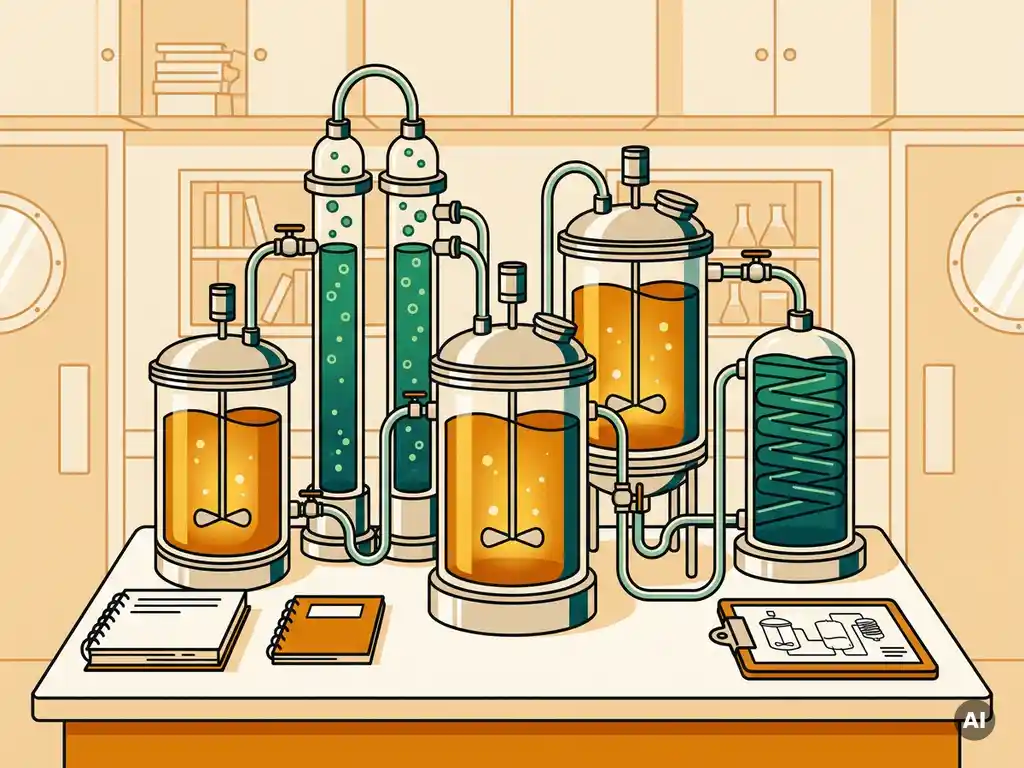
Industrial fermentation R&D relies on several core bioreactor types, each suited to different microbial processes, product targets, and scale requirements. The most common designs include stirred tank bioreactors, bubble column reactors, airlift reactors, and fixed-bed or packed-bed systems. Choosing the right bioreactor type is not a one-size-fits-all decision; it depends on the organism, the oxygen demand, the product, and where you are in the development process. The sections below address the most important questions around bioreactor selection for industrial fermentation.
How do different bioreactor designs affect fermentation outcomes?
Bioreactor design directly determines how well a microbial culture receives oxygen, nutrients, and heat, and how efficiently metabolic waste products are removed. These physical parameters shape cell growth rates, product yields, and process stability. A poorly matched bioreactor design can cause oxygen limitation, shear stress damage to cells, or poor mixing, all of which translate into lower productivity and unpredictable results at scale.
The geometry of the vessel, the agitation mechanism, and the aeration strategy each influence the mass transfer coefficient, which is a key indicator of how efficiently gases and nutrients reach the microbial cells. For aerobic processes, a high oxygen transfer rate is often critical. For anaerobic processes, preventing oxygen ingress becomes the priority. Beyond gas transfer, temperature gradients, pH uniformity, and foam control all behave differently depending on the bioreactor configuration chosen. Getting these parameters right early in fermentation R&D prevents costly surprises during scale-up.
What are the main types of bioreactors used in industrial fermentation?
The four most widely used bioreactor types in industrial fermentation are stirred tank bioreactors, bubble column reactors, airlift reactors, and fixed-bed or packed-bed reactors. Each has a distinct operating principle and is suited to specific process conditions.
- Stirred tank bioreactor (STR): The most common design in industrial fermentation R&D. Mechanical impellers provide mixing and gas dispersion, offering precise control over agitation speed, aeration, pH, and temperature. STRs are highly versatile and work for both aerobic and anaerobic processes.
- Bubble column reactor: Aeration is achieved by sparging gas from the bottom of a vertical vessel with no mechanical agitation. Lower shear stress makes these suitable for shear-sensitive organisms. They are simpler and cheaper to operate but offer less control over mixing.
- Airlift reactor: A variation of the bubble column where internal or external draft tubes create a defined circulation loop driven by gas flow. This improves mixing without mechanical agitation and is well suited to filamentous organisms or cultures sensitive to impeller shear.
- Fixed-bed or packed-bed reactor: Microorganisms are immobilized on a solid support material through which the substrate flows. Common in wastewater treatment and some bioconversion processes, these systems allow high cell densities and continuous operation.
The stirred tank bioreactor remains the workhorse of industrial fermentation because of its flexibility and the depth of operational knowledge built around it. However, for specific applications, particularly those involving mixed microbial communities or shear-sensitive organisms, alternative designs often outperform the STR.
Get in Touch
Let’s Talk Microbial Solutions
Book a conversation with Stijn, our CEO, or send us your request.
| Book an Appointment | Request Information |
What’s the difference between aerobic and anaerobic bioreactor configurations?
Aerobic bioreactors are designed to maximize oxygen transfer to the culture, while anaerobic bioreactors are engineered to exclude oxygen entirely. This fundamental difference drives nearly every aspect of the design: vessel sealing, gas sparging systems, agitation strategy, and monitoring equipment.
In aerobic configurations, the oxygen transfer rate is a central design parameter. Impeller speed, sparger design, and vessel pressure are all tuned to ensure adequate dissolved oxygen levels throughout the culture. Foaming is a common challenge and requires antifoam systems or mechanical foam breakers.
Anaerobic configurations prioritize gas-tight sealing and the removal of oxygen from the headspace and feed streams. These systems typically operate with different gas management strategies; for example, capturing and recirculating biogas in anaerobic digestion processes. Temperature control remains important in both configurations, but anaerobic processes often run at different temperature optima (mesophilic at around 35°C or thermophilic at around 55°C), which influences reactor insulation and heating requirements.
Some processes require switching between aerobic and anaerobic phases within the same bioreactor, which demands more sophisticated instrumentation and control systems. This is particularly relevant for certain wastewater treatment applications and mixed-culture fermentation processes.
Which bioreactor type is best for mixed microbial cultures?
Stirred tank bioreactors and bubble column or airlift reactors are generally the most appropriate for mixed microbial cultures because they support diverse community dynamics without imposing the selective pressures that can destabilize a consortium. Fixed-bed reactors are also used where biofilm-forming communities are an asset rather than a problem.
Mixed microbial cultures present specific challenges that pure-culture fermentation does not. Community composition can shift over time in response to changes in substrate, pH, temperature, or dissolved oxygen, and the bioreactor design either supports or undermines community stability. Gentle mixing, consistent nutrient distribution, and reliable monitoring are more important than achieving maximum volumetric productivity in a single organism.
Working with mixed cultures also requires more sophisticated process monitoring. Molecular tools such as amplicon sequencing and qPCR allow researchers to track community composition in real time, which is essential for understanding whether the desired microbial balance is being maintained. This kind of microbiome monitoring is not standard in most fermentation facilities, but it is central to the work done at Avecom, where mixed microbial consortia are a core area of expertise rather than an edge case.
How do lab-scale bioreactors differ from pilot-scale and production-scale systems?
Lab-scale bioreactors typically range from 0.1 to 20 liters and are used for process development, parameter screening, and feasibility testing. Pilot-scale systems range from roughly 20 liters to several hundred liters and are used to validate that lab findings hold at larger volumes. Production-scale systems operate from hundreds to tens of thousands of liters and are optimized for cost efficiency and output consistency.
The critical challenge in moving between scales is that many physical parameters do not scale linearly. Oxygen transfer rates, mixing times, and heat removal behave differently in a 2-liter vessel compared to a 200-liter vessel. A process that performs well at lab scale can fail at pilot scale if the scale-up strategy does not account for these differences, a problem that is far more common than many development teams anticipate.
Pilot-scale fermentation is where the majority of scale-up failures are caught and corrected. It is also where the cost of failure is still manageable. Skipping the pilot stage to move directly from lab to production is a significant technical risk, particularly for complex processes involving mixed cultures or novel substrates.
When should a company use contract fermentation R&D instead of building in-house bioreactor capacity?
Contract fermentation R&D makes sense when a company needs access to fermentation infrastructure and expertise that would take years and significant capital to build internally, and when the timeline for proof of concept is measured in months rather than years. For most scale-ups and industrial companies without an existing fermentation division, contract R&D is faster, lower-risk, and more cost-effective than building in-house capacity.
The decision to build in-house bioreactor capacity is justified when fermentation is a permanent, high-volume core process and when the company has the scientific staff to operate and develop it continuously. For companies at the concept validation or pilot stage, those conditions rarely exist yet. The infrastructure investment, reactors, analytical equipment, trained operators, quality systems, is substantial, and it takes time to develop the institutional knowledge to use it effectively.
Contract fermentation partners bring ready-to-use infrastructure, established protocols, and process expertise that would otherwise take years to develop. For companies facing investor timelines or regulatory milestones, this matters. A specialized partner also brings domain knowledge that reduces the risk of scale-up failure, particularly when the process involves mixed microbial cultures, novel substrates, or non-standard operating conditions. Fermentation R&D services from an experienced external partner can function as a direct extension of an internal R&D team, without the overhead of building and staffing a facility from scratch.