

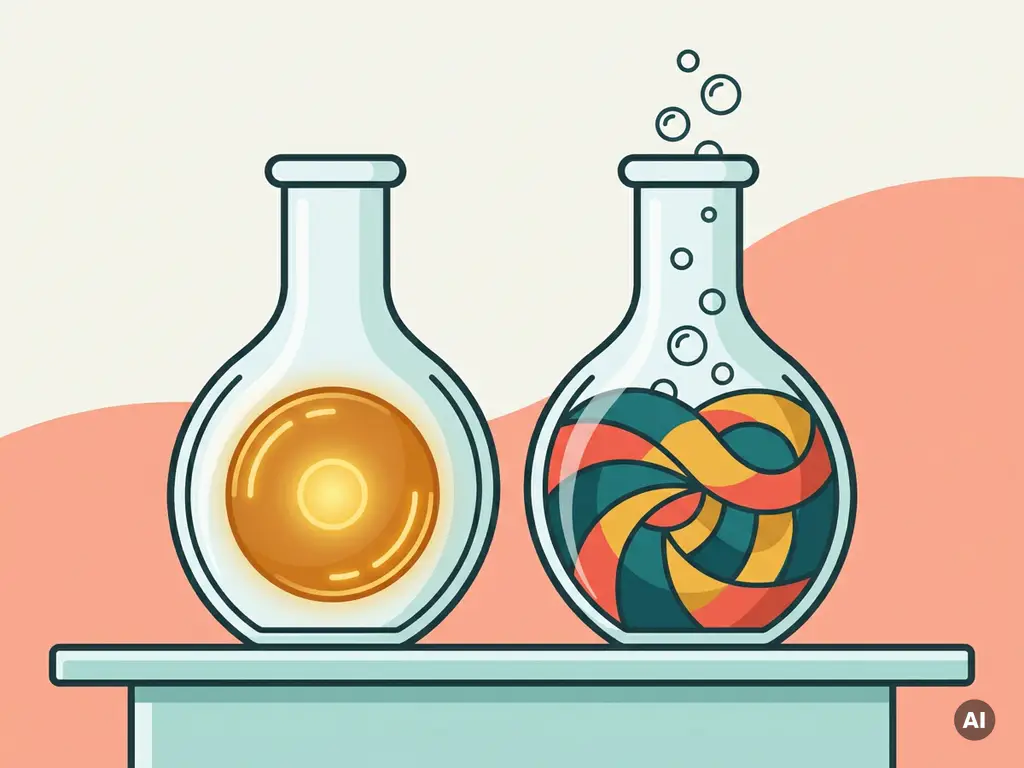
Pure culture fermentation uses a single, defined microbial species under sterile conditions, while mixed culture fermentation relies on a community of microorganisms working together. The key distinction is not just biological but strategic: pure cultures offer precision and predictability, while mixed cultures offer resilience and metabolic breadth. Which approach fits your process depends on your product, your scale, and how much process complexity you can manage.
Both approaches are well-established in industrial fermentation, but they serve different purposes and come with different trade-offs. The sections below work through the most common questions engineers and R&D teams face when choosing between them.
Which fermentation approach is more robust at industrial scale?
Mixed culture fermentation is generally more robust at industrial scale. Because the microbial community contains multiple species with overlapping functions, the process can absorb fluctuations in feedstock composition, temperature, and pH without collapsing. Pure culture fermentation, by contrast, depends on maintaining a single organism in optimal condition, which becomes harder and more expensive as scale increases.
At lab scale, pure cultures are easy to control. But moving to pilot or production scale introduces variability that a monoculture has little tolerance for. A shift in substrate quality, a brief temperature excursion, or minor contamination can derail the entire batch. Mixed microbial cultures, by their nature, are self-correcting to a degree: if one organism is stressed, others compensate. This functional redundancy is one of the main reasons mixed culture systems tend to perform more consistently in real industrial environments rather than idealized laboratory conditions.
That said, robustness is not the same as performance. A mixed culture may sustain productivity under stress, but a well-optimized pure culture will often outperform it under stable, controlled conditions. The question is how reliably you can maintain those conditions at scale.
What are the main advantages of mixed culture fermentation?
The main advantages of mixed culture fermentation are metabolic flexibility, process resilience, lower sterility requirements, and lower feedstock costs. Mixed microbial consortia can break down complex or variable substrates that no single organism could handle alone, making them well suited to industrial waste streams, agricultural side streams, and other heterogeneous inputs.
Beyond resilience, mixed cultures open up conversion pathways that are simply not accessible to pure cultures. A consortium can carry out sequential biochemical steps in a single reactor, with one organism’s waste product becoming another’s substrate. This is the basis of processes like anaerobic digestion, composting, and certain fermented food production.
From a cost perspective, mixed culture systems typically require less energy-intensive sterilization, tolerate lower-grade feedstocks, and need less precise environmental control. For companies working with biomass fermentation or side stream valorisation, this can translate into meaningfully lower operating costs compared to an equivalent pure culture process.
Finally, mixed cultures are often more amenable to continuous operation. Because the community self-regulates to some extent, it can maintain productivity over long run times without the periodic reinoculation that pure culture systems sometimes require.
Get in Touch
Let’s Talk Microbial Solutions
Book a conversation with Stijn, our CEO, or send us your request.
| Book an Appointment | Request Information |
When does pure culture fermentation outperform mixed culture?
Pure culture fermentation outperforms mixed culture when the product requires high specificity, regulatory traceability, or a defined molecular profile. Pharmaceuticals, food-grade enzymes, and certain specialty chemicals depend on knowing exactly which organism produced them and under what conditions. In these contexts, a mixed culture introduces too much biological variability.
Pure cultures also excel when the target molecule is produced by a single well-characterized organism and the fermentation environment can be tightly controlled. High-value products like monoclonal antibodies, specific amino acids, or recombinant proteins are almost always made with pure cultures because the organism’s genetics can be engineered precisely and its output can be validated batch to batch.
Regulatory approval is another driver. Many food and pharmaceutical applications require full documentation of the producing organism, and a mixed culture makes that documentation significantly more complex. If your product needs to meet those standards, pure culture fermentation is usually the more practical path, regardless of its higher process demands.
How do contamination risks differ between the two approaches?
Pure culture fermentation carries a higher contamination risk because the entire process depends on maintaining a single organism in the absence of competitors. Any foreign microorganism that enters the system can outcompete or inhibit the production strain, often ruining the batch. This is why pure culture processes require rigorous sterilization of equipment, media, and air supplies.
Mixed culture fermentation is inherently more tolerant of microbial intrusion. Because the system already contains a diverse community, a small influx of environmental organisms is less likely to destabilize the process. In some cases, the existing community actively suppresses unwanted microorganisms through competition for nutrients or the production of inhibitory compounds.
However, mixed cultures are not immune to contamination problems. Certain pathogens or highly competitive organisms can still disrupt a mixed culture if they enter in sufficient numbers or find a selective advantage. The risk profile is different rather than absent. Monitoring the community composition using molecular tools such as amplicon sequencing allows operators to detect early shifts before they become process failures, which is especially important in continuous mixed culture systems running over extended periods.
What types of products are made with mixed culture fermentation?
Mixed culture fermentation is used to produce a wide range of products, particularly where the input material is complex or the conversion pathway requires multiple microbial steps. Common examples include biogas and biomethane through anaerobic digestion, compost and biostimulants, fermented animal feeds, single-cell protein from organic waste streams, and certain organic acids and biosurfactants.
Traditional fermented foods, including many cheeses, fermented vegetables, and sourdough bread, also rely on mixed microbial communities. In these cases, the complexity of the community is precisely what creates the desired flavor, texture, and preservation properties.
In industrial biotechnology, mixed culture processes are increasingly applied to the valorisation of food processing water and agricultural residues. Avecom, for example, holds a patent for a biotechnological process that converts food processing water into microbial protein using mixed microbial cultures, a product category that would be difficult to produce economically with a pure culture approach given the heterogeneity of the input stream.
The common thread across all these applications is that the product either benefits from the metabolic diversity of a community or is economically viable only because the mixed culture approach reduces input and operating costs.
How do you choose between pure and mixed culture fermentation for a new process?
Choosing between pure and mixed culture fermentation starts with three questions: How defined does your product need to be? How variable is your feedstock? And how much process control can you realistically maintain at your target scale? The answers to these questions usually point clearly in one direction.
If your product is a specific molecule with a defined molecular structure, regulatory requirements, or a narrow quality specification, pure culture fermentation is almost certainly the right starting point. If your input stream is complex or variable, or if your product is biomass, a functional mixture, or a commodity chemical where cost efficiency matters more than molecular precision, mixed culture fermentation is worth serious consideration.
Scale ambitions also matter. If you are planning to move from lab to pilot to production within a defined timeline, the operational demands of maintaining sterile pure culture conditions at each stage add real cost and risk. Mixed culture processes tend to be more forgiving during scale-up, which is one reason R&D teams working under time pressure often find them easier to validate quickly.
In practice, the choice is rarely made in the abstract. It is made by running feasibility tests at lab scale, understanding where the process breaks down, and iterating from there. Working with a partner that has experience across both approaches, and the analytical tools to characterize what is actually happening in the fermenter, shortens that learning curve considerably. Avecom’s fermentation R&D services cover both pure and mixed culture systems, with molecular monitoring tools that give R&D teams a clear picture of process behavior before committing to a scale-up strategy.