

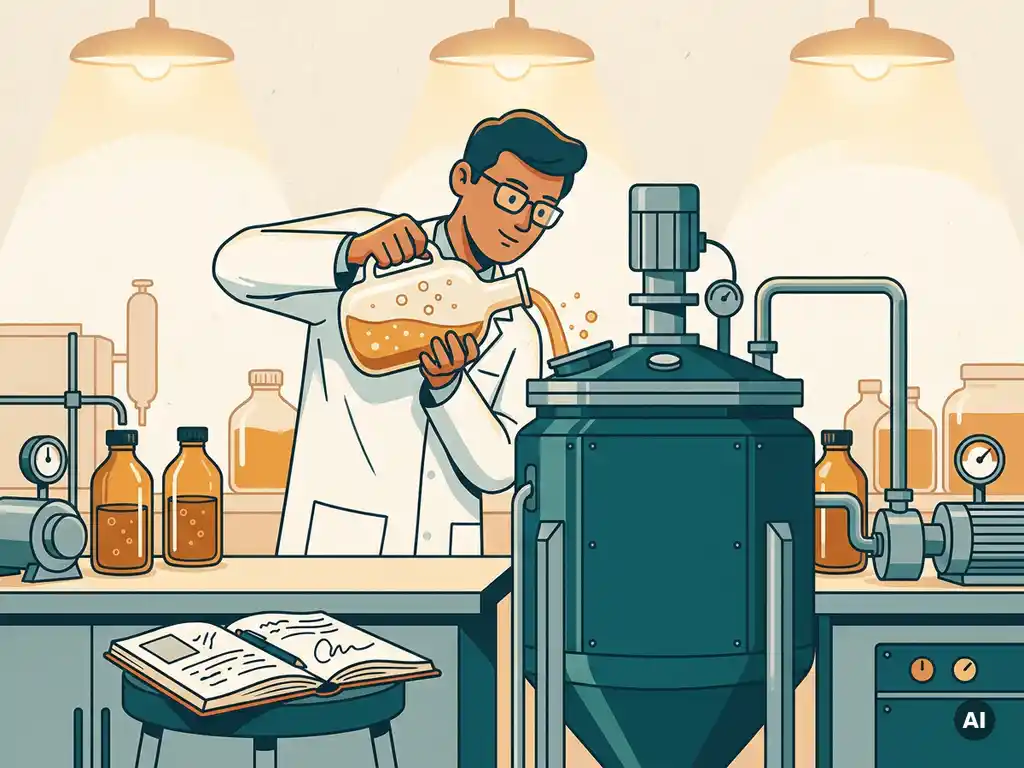
A company should outsource fermentation R&D to a specialist when it lacks the infrastructure, process expertise, or time to validate and scale a fermentation concept internally. This applies most directly to scale-ups and industrial companies that have a strong product idea but no access to controlled bioreactors, pilot plants, or the analytical tools needed to understand what is actually happening inside the fermenter. The sections below unpack the specific situations, risks, and practical decisions that make outsourcing the smarter path.
What are the risks of scaling fermentation in-house without specialist infrastructure?
Scaling fermentation in-house without the right infrastructure introduces significant technical and financial risk. The most common failure mode is not a bad concept; it is a process that works at bench scale but breaks down when moved to larger volumes, because the underlying parameters were never properly characterized. This gap between lab and production is where most fermentation projects stall.
At lab scale, variables like oxygen transfer, mixing dynamics, pH gradients, and heat dissipation are relatively easy to control. In a larger vessel, these same variables behave differently. Without the analytical tools and engineering experience to understand those differences, teams often spend months troubleshooting problems that a specialist would recognize immediately.
There are also hidden costs. Building out even a modest pilot-scale fermentation facility requires capital investment in bioreactors, downstream processing equipment, environmental controls, and qualified personnel. For a company under investor pressure to deliver proof-of-concept within six to twelve months, that timeline is rarely compatible with building infrastructure from scratch. The risk is not just technical failure; it is losing momentum at a critical stage of development.
What does a fermentation contract R&D partner actually do?
A fermentation contract R&D partner takes a client’s process concept and advances it through defined technical stages, from initial feasibility testing at lab scale through to validated pilot-scale operation, using their own infrastructure, equipment, and scientific expertise. The client retains ownership of the concept; the partner provides the capability to test and refine it.
In practice, this means running controlled fermentation experiments in instrumented bioreactors, adjusting process parameters systematically, and using molecular tools to monitor what the microbial community is actually doing at each stage. For processes involving mixed microbial cultures, this kind of microbiome monitoring, using techniques such as amplicon sequencing and qPCR, is essential for understanding stability and reproducibility.
A contract R&D partner also produces structured scientific documentation: experimental reports, process descriptions, and data packages that support subsidy applications, patent filings, and investor conversations. This is not a minor detail. For a scale-up seeking funding, a well-documented R&D dossier backed by credible external science carries considerably more weight than internal lab notes.
Some partners, like Avecom’s fermentation services, extend this further into small-scale contract manufacturing, producing defined quantities of a microbial product under controlled, certified conditions when a client needs material for market testing or regulatory submissions.
{div style=”box-sizing: border-box !important; margin: 32px 0 !important; padding: 28px 32px !important; background-color: #004070 !important; background-image: linear-gradient(135deg, #004070 0%, #003057 100%) !important; border: none !important; border-left: 4px solid #36a9e1 !important; font-family: ‘Exo’, sans-serif !important; text-align: center !important; line-height: normal !important;”}
{p style=”margin: 0 0 6px 0 !important; padding: 0 !important; font-family: ‘Exo’, sans-serif !important; font-size: 12px !important; font-weight: 500 !important; color: #36a9e1 !important; text-transform: uppercase !important; letter-spacing: 1.5px !important; line-height: 16px !important;”}Get in Touch{/p}
{p style=”margin: 0 0 8px 0 !important; padding: 0 !important; font-family: ‘Exo’, sans-serif !important; font-size: 20px !important; font-weight: 500 !important; color: #ffffff !important; line-height: 26px !important;”}Let’s Talk Microbial Solutions{/p}
{p style=”margin: 0 0 20px 0 !important; padding: 0 !important; font-family: ‘Exo’, sans-serif !important; font-size: 14px !important; font-weight: 300 !important; color: #ffffff !important; line-height: 20px !important;”}Book a conversation with Stijn, our CEO, or send us your request.{/p}
{table style=”border-collapse: collapse !important; border-spacing: 0 !important; margin: 0 auto !important; padding: 0 !important; width: auto !important;” cellpadding=”0″ cellspacing=”0″ role=”presentation”}
{tr style=”margin: 0 !important; padding: 0 !important;”}
{td style=”margin: 0 !important; padding: 0 6px 0 0 !important; white-space: nowrap !important;”}
{a href=”https://avecom.be/contact-2/” style=”display: inline-block !important; box-sizing: border-box !important; margin: 0 !important; padding: 11px 24px !important; background-color: #95c11f !important; color: #ffffff !important; font-family: ‘Exo’, sans-serif !important; font-size: 14px !important; font-weight: 500 !important; text-transform: uppercase !important; text-decoration: none !important; border: none !important; line-height: 18px !important; letter-spacing: 0.3px !important; white-space: nowrap !important;”}Book an Appointment{/a}
{/td}
{td style=”margin: 0 !important; padding: 0 !important; white-space: nowrap !important;”}
{a href=”https://avecom.callista.be/contactus” style=”display: inline-block !important; box-sizing: border-box !important; margin: 0 !important; padding: 9px 24px !important; background-color: transparent !important; color: #ffffff !important; font-family: ‘Exo’, sans-serif !important; font-size: 14px !important; font-weight: 500 !important; text-transform: uppercase !important; text-decoration: none !important; border: 2px solid #ffffff !important; line-height: 18px !important; letter-spacing: 0.3px !important; white-space: nowrap !important;”}Request Information{/a}
{/td}
{/tr}
{/table}
{/div}
When does outsourcing fermentation R&D make financial sense?
Outsourcing fermentation R&D makes financial sense when the cost of building or accessing specialist infrastructure in-house exceeds the cost of the contract work, or when internal delays carry a higher business cost than the outsourcing fee. For most scale-ups and mid-sized industrial companies, this threshold is reached sooner than expected.
The comparison is rarely straightforward, because internal infrastructure costs are often underestimated. A single instrumented pilot-scale bioreactor, properly equipped and maintained, represents a significant capital outlay before a single experiment is run. Add to that the cost of specialist personnel, analytical equipment, and the time needed to establish validated protocols, and the internal route becomes expensive quickly.
Outsourcing microbial fermentation R&D converts that capital expenditure into a defined project cost. The company pays for outcomes, feasibility data, process parameters, a validated protocol, rather than for equipment that may sit idle between projects. For organizations that need fermentation capability at specific stages of development rather than continuously, this is a structurally more efficient model.
There is also a speed argument. A partner with established infrastructure and experienced teams can begin meaningful experiments within weeks. Building equivalent capability internally typically takes months to years. When investor timelines or market windows are a factor, that difference in speed has direct financial value.
How do you protect IP when sharing a fermentation process with an external partner?
IP protection when outsourcing fermentation R&D rests on three practical foundations: a well-drafted non-disclosure agreement before any technical exchange begins, a clear contractual definition of who owns what is developed during the engagement, and a partner with a demonstrated culture of discretion and scientific integrity.
The NDA should be signed before the first technical conversation, not after. It should cover not just the process concept itself but also any background IP, experimental data, and results generated during the collaboration. Ownership of foreground IP, new knowledge created during the project, needs to be explicitly assigned in the contract, as default rules vary by jurisdiction and can create ambiguity if left unaddressed.
Beyond legal instruments, the choice of partner matters. A specialist that works across multiple industries and client relationships has strong institutional incentives to maintain confidentiality; their reputation depends on it. It is reasonable to ask a prospective partner directly about their confidentiality practices, how data is stored and segregated between clients, and whether they have experience supporting patent applications. A partner that has helped clients through patent filings understands the sensitivity of process information and is better positioned to handle it appropriately.
What should you look for in a fermentation R&D partner?
The most important qualities in a fermentation R&D partner are relevant technical depth, appropriate infrastructure, and a working style that fits your project stage. A partner that is excellent at optimizing established industrial processes may not be the right fit for early-stage concept validation, and vice versa.
On the technical side, look for demonstrated experience with the type of fermentation your process involves, aerobic or anaerobic, batch or continuous, defined medium or complex substrate. If your process relies on mixed microbial cultures rather than a single defined strain, confirm that the partner has specific experience with microbiome management and the analytical tools to monitor community dynamics over time.
Infrastructure matters as much as expertise. The partner should have bioreactors at the scale you need for your current project phase, downstream processing capability relevant to your product type, and the analytical equipment to generate data you can actually use. Facilities certified for feed or food applications add value if your end product falls under those regulatory frameworks.
Finally, consider how the partner communicates and documents their work. A partner that produces rigorous scientific reports, not just summary slides, gives you material that holds up in investor due diligence, regulatory submissions, and patent proceedings. Avecom’s background as a Ghent University spin-off reflects the kind of scientific rigor that makes external R&D documentation credible in those contexts.
Which fermentation challenges are best solved by a specialist rather than in-house?
Fermentation challenges that are best handled by a specialist fall into three broad categories: scale-up failures where the root cause is poorly understood, processes that involve complex or undefined microbial communities, and situations where analytical depth exceeds what an internal team can reasonably maintain.
- Scale-up from lab to pilot: This transition is where most fermentation projects encounter unexpected problems. Mass transfer, mixing, and microbial behavior all change at larger volumes in ways that require systematic characterization rather than trial and error. A specialist with pilot-scale infrastructure and experience across many different processes can identify and resolve these issues far more efficiently than a team encountering them for the first time.
- Mixed microbial culture processes: Processes that rely on natural microbial consortia rather than pure strains are inherently more complex to control and monitor. They require molecular tools and interpretive expertise that most internal R&D teams do not have. Specialists who work specifically with mixed cultures bring both the analytical capability and the process intuition needed to make these systems reliable.
- Novel substrate or side stream valorization: Converting an industrial side stream or food processing byproduct into a valuable microbial product involves significant process development work. The microbial system needs to be selected and optimized for a substrate that may be variable in composition. This is exploratory R&D that benefits from a partner with broad fermentation experience and the flexibility to test multiple approaches systematically.
- Regulatory or certification requirements: If the end product requires certification, for animal feed, for example, working with a partner that already holds the relevant accreditations removes a significant compliance burden from the client’s side.
In each of these cases, the specialist’s value is not just technical knowledge but accumulated practical experience with problems that look unique to each client but follow recognizable patterns across many projects. That pattern recognition is what makes specialist fermentation contract research genuinely faster and more reliable than solving the same problems from scratch internally.