

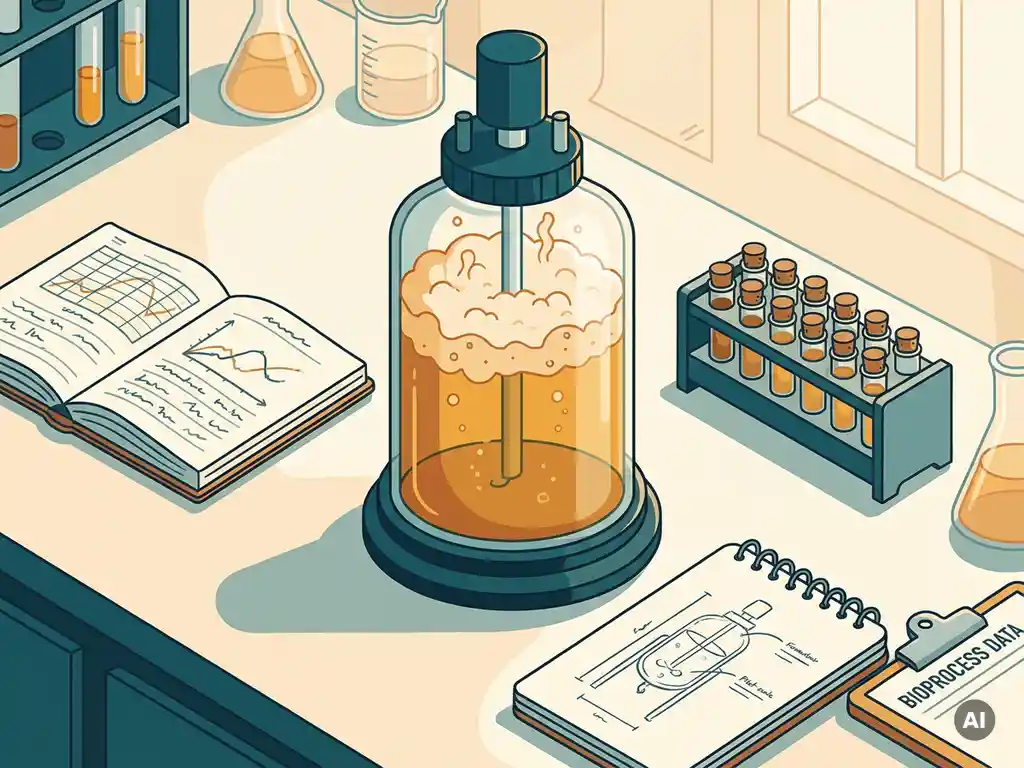
A feasibility study for a fermentation process is a structured experimental investigation that determines whether a given microbial process is technically viable under defined conditions. It tests whether the right microorganisms can perform the intended conversion, whether yields are sufficient, and whether the process can be controlled reliably enough to justify further development. The sections below answer the most common questions companies ask before committing to full-scale fermentation development.
What does a feasibility study for fermentation actually test?
A fermentation feasibility study tests whether a target biological conversion is achievable under controlled conditions. This includes confirming that suitable microorganisms are present or can be selected, that the substrate can be metabolized efficiently, and that key process parameters such as pH, temperature, dissolved oxygen, and nutrient balance can be managed to produce a consistent, measurable output.
More specifically, a well-designed fermentation process validation study will address several core questions at once. Can the microbial community or strain perform the desired reaction at meaningful yields? What are the minimum and maximum operating boundaries for the process? Are there inhibitory compounds in the feedstock that would prevent stable performance? And critically, is the process selective enough to produce the target product without excessive by-products?
For processes involving mixed microbial cultures rather than pure strains, the feasibility phase also includes community profiling. Molecular tools such as amplicon sequencing and qPCR allow researchers to identify which organisms are driving the conversion and whether the community composition remains stable over time. This kind of microbiome-level insight is often what separates a robust industrial process from one that works once in the lab and fails under real conditions.
How long does a fermentation feasibility study take?
A lab-scale fermentation feasibility study typically takes between four and twelve weeks, depending on the complexity of the process, the growth rate of the microorganisms involved, and the number of experimental conditions being tested. Slower-growing anaerobic communities, for example, require longer observation windows than fast-growing aerobic bacteria.
The timeline is often the most pressing concern for R&D teams under investor pressure to deliver proof of concept within six to twelve months. A focused feasibility study with clearly defined success criteria can be designed to produce decision-relevant data within that window, provided the scope is realistic. Trying to answer too many questions simultaneously is one of the most common reasons feasibility timelines overrun.
The study design itself has a significant impact on duration. Batch experiments with a single set of conditions are faster but provide less information. Systematic variation of parameters, run in parallel, takes longer but produces a much clearer picture of the process envelope and its limits, which is essential before moving into pilot-scale fermentation.
Get in Touch
Let’s Talk Microbial Solutions
Book a conversation with Stijn, our CEO, or send us your request.
| Book an Appointment | Request Information |
What’s the difference between a lab-scale and pilot-scale feasibility study?
A lab-scale feasibility study works at volumes typically ranging from one to twenty liters and is designed to confirm whether a fermentation concept is biologically sound. A pilot-scale study operates at volumes of hundreds to thousands of liters and is designed to confirm whether the process is technically and economically viable under conditions that more closely resemble industrial production.
Lab-scale: proving the biology
At lab scale, the primary goal is to establish that the desired microbial conversion occurs reliably and that process parameters can be identified and controlled. Equipment is relatively accessible, experiments can be run in parallel, and adjustments can be made quickly. This is where hypotheses are tested and eliminated before significant resources are committed.
Pilot-scale: proving the process
Pilot-scale fermentation introduces a different set of challenges. Mixing dynamics, heat transfer, oxygen distribution, and foam management all behave differently at larger volumes. A process that appears stable in a two-liter bioreactor may become unstable in a five-hundred-liter vessel if these engineering factors are not accounted for. Pilot-scale work also generates the process data needed to model production costs and assess whether the process is commercially viable, which is what investors and procurement teams ultimately need to see.
The gap between these two scales is where many fermentation scale-ups encounter problems, which is why the transition should be treated as its own validation stage rather than a straightforward linear progression.
Why do fermentation scale-ups fail after a successful lab study?
Fermentation scale-ups fail after successful lab studies most often because the physical environment of a larger vessel is fundamentally different from a small bioreactor, and the microbial community responds to those differences. A lab result proves biological feasibility; it does not automatically prove that the process is robust to the engineering realities of scale.
The most common failure modes include poor mixing leading to concentration gradients within the vessel, insufficient oxygen transfer in aerobic processes, inadequate temperature control across larger volumes, and the accumulation of inhibitory metabolites that are diluted away in small-scale systems. Each of these factors can shift the microbial community composition or suppress activity in ways that were not visible at lab scale.
Another frequent cause of failure is the feedstock itself. Lab studies often use clean, standardized substrates. At pilot scale, real industrial feedstocks are introduced, and these commonly contain variable concentrations of compounds that inhibit microbial activity. A feasibility study that does not test with representative real-world feedstock is providing an incomplete answer.
Understanding why scale-up fails is one reason that microbial fermentation expertise matters as much as infrastructure. Identifying which parameters are scale-sensitive early in the process, and designing the lab study to generate data on those specific variables, is what allows a pilot campaign to succeed rather than repeat the lab phase at greater cost.
When should a company outsource its fermentation feasibility study?
A company should outsource its fermentation feasibility study when it lacks the specialized infrastructure, analytical capability, or microbial expertise to run the study reliably internally. This is most often the case for biotech scale-ups, food ingredient producers, and agrochemical companies that have a strong concept but no access to controlled bioreactors, pilot plants, or the molecular tools needed to characterize microbial performance.
Outsourcing contract fermentation R&D is also the faster and more cost-effective path when the internal team’s time is better spent on product development, regulatory preparation, or investor engagement. Building fermentation infrastructure from scratch takes years and significant capital. Engaging an external partner with existing facilities means the feasibility study can begin within weeks rather than after a major investment cycle.
Confidentiality is a legitimate concern in this decision. A credible contract R&D partner operates under strict non-disclosure agreements and understands that the intellectual property generated during a feasibility study belongs to the client. Companies that are sensitive about their process concept should treat the partner’s approach to IP and discretion as a qualifying criterion alongside technical capability.
Avecom, as a Ghent University spin-off with over thirty years of experience in microbial process development, works as an extension of a client’s internal R&D team, providing the infrastructure and expertise without requiring the client to build either.
What outputs should a fermentation feasibility study deliver?
A fermentation feasibility study should deliver a clear, documented assessment of whether the process is viable, what conditions are required to make it work, and what the critical uncertainties are before scaling up. The output is not simply a yes-or-no answer, but a technical foundation for the next decision in the development process.
Specifically, a well-executed study should produce the following:
- Process performance data: Yield, conversion rate, productivity, and selectivity measured under defined conditions
- Operating window definition: The range of pH, temperature, substrate concentration, and other parameters within which the process performs acceptably
- Microbial community characterization: For mixed-culture processes, identification of the key functional organisms and an assessment of community stability
- Risk assessment: Identification of the factors most likely to cause problems at pilot scale, including feedstock variability, inhibition thresholds, and scale-sensitive parameters
- Go or no-go recommendation: A clear technical conclusion with the reasoning behind it, including what additional work would be needed if the outcome is conditional
- Scientific reporting: Documentation sufficient to support subsidy applications, patent filings, or investor due diligence
The quality of the reporting matters as much as the quality of the experiments. R&D teams that need to present results to investors, apply for innovation funding, or support a patent application require documentation that meets scientific standards, not just internal lab notes. A partner with an academic track record and publication history can provide reporting that carries weight in those contexts.
Related Articles
- When should a company outsource fermentation R&D to a specialist?
- What are the hidden costs of in-house fermentation pilot infrastructure?
- What is the difference between sludge bulking and sludge foaming?
- Why does sludge bulking happen in activated sludge systems?
- What happens when industrial wastewater treatment stops working?