

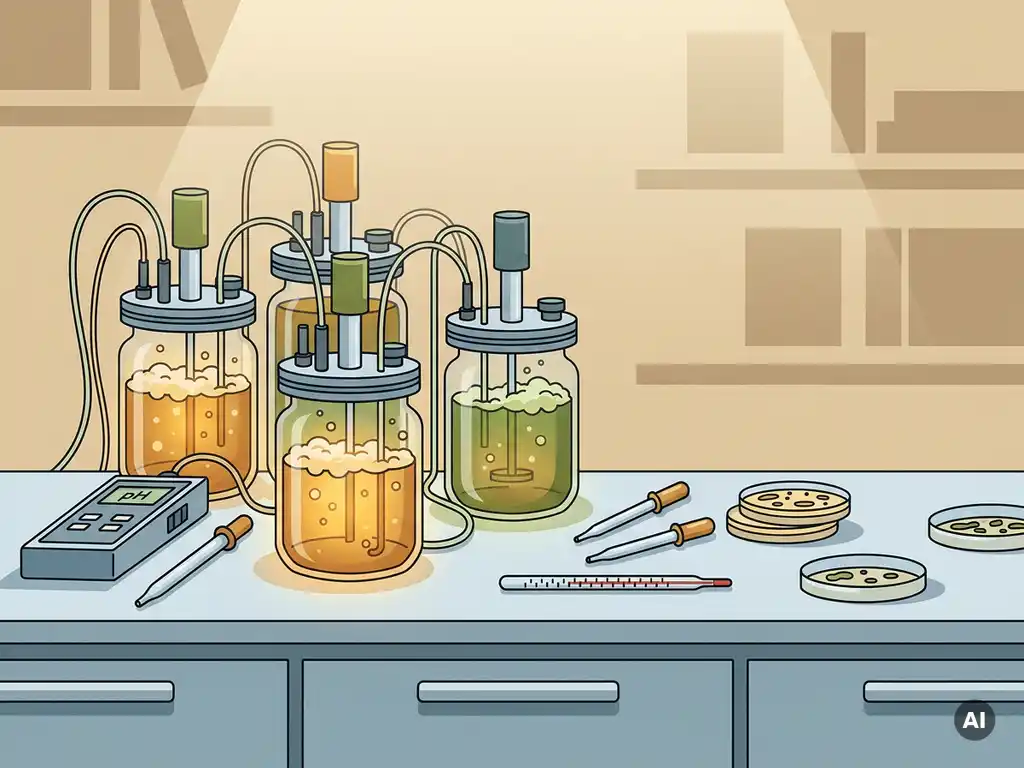
Fermentation R&D is the systematic process of developing, testing, and optimizing microbial fermentation processes before committing to full-scale production. It covers everything from selecting the right microorganism and growth conditions to validating that a process performs consistently at increasing volumes. Companies invest in fermentation research and development when they need to turn a biological concept into a reliable, reproducible industrial process.
The path from an initial idea to a working fermentation process involves multiple stages of testing, failure analysis, and refinement. Each stage answers a specific technical question about whether the process will hold up under real-world conditions. The sections below address the most common questions companies face when entering a fermentation R&D project for the first time.
What happens during a fermentation R&D project?
A fermentation R&D project moves through a structured sequence of phases: feasibility testing at lab scale, process optimization, scale-up validation, and finally, process transfer to production. Each phase answers a different question, first whether the process works at all, then whether it works consistently, and finally whether it works at volume. The goal is to reduce technical risk at each step before committing more resources.
The project typically starts with a feasibility study. Small-scale bioreactors are used to test whether the target microorganism or microbial community can produce the desired compound under controlled conditions. Variables such as pH, temperature, oxygen transfer, and nutrient composition are systematically adjusted to find conditions that support both microbial growth and product formation.
Once a working set of conditions is identified, the focus shifts to optimization. This means improving yield, reducing input costs, and building process robustness, ensuring the fermentation performs reliably even when conditions vary slightly. Analytical tools such as qPCR and amplicon sequencing are increasingly used at this stage to monitor microbial community dynamics in real time, particularly when working with mixed cultures rather than single strains.
The final phase of an R&D project is scale-up validation, where the process is tested at pilot scale to confirm that the parameters established in the lab translate to larger reactors. This is where many projects encounter unexpected challenges, which is why experienced partners treat scale-up as its own distinct research phase rather than a simple volume increase.
What’s the difference between lab-scale and pilot-scale fermentation?
Lab-scale fermentation uses small bioreactors, typically ranging from one to twenty liters, to test and optimize process conditions under tightly controlled circumstances. Pilot-scale fermentation operates at volumes between roughly 50 and 2,000 liters and is designed to validate whether a process behaves the same way when physical and engineering factors change with size. The key difference is not just volume, it is the introduction of real-world engineering constraints.
At lab scale, researchers have fine-grained control over every parameter. Mixing is uniform, oxygen transfer is easy to achieve, and temperature gradients are minimal. These conditions make it straightforward to study microbial behavior in isolation from engineering complexity. However, they can also create a misleading picture of how the process will behave in a larger vessel.
At pilot scale, factors like mixing time, mass transfer coefficients, and heat distribution change significantly. A microbial culture that thrives in a two-liter flask may struggle in a 500-liter reactor because dissolved oxygen levels fluctuate, nutrient gradients develop, or shear stress from agitation affects cell physiology. Pilot-scale work is therefore essential for identifying these discrepancies and adjusting process parameters accordingly before moving to production.
For companies without their own pilot infrastructure, accessing a facility that already operates at both scales is a practical way to compress the development timeline. Avecom’s fermentation services span lab to pilot scale, with aerobic and anaerobic bioreactors up to 2,000 liters, which allows process parameters to be tested and refined without the capital cost of building dedicated infrastructure.
Get in Touch
Let’s Talk Microbial Solutions
Book a conversation with Stijn, our CEO, or send us your request.
| Book an Appointment | Request Information |
Why do fermentation processes fail when scaling up?
Fermentation scale-up fails most often because physical parameters that are easy to control at small volumes become difficult to maintain in larger reactors. The most common causes are inadequate oxygen transfer, poor mixing homogeneity, heat accumulation, and the emergence of concentration gradients that did not exist at lab scale. These factors change microbial behavior in ways that are not always predictable from small-scale data alone.
Oxygen transfer is particularly critical in aerobic fermentation. As reactor volume increases, the surface-area-to-volume ratio decreases, and dissolved oxygen can drop in zones of the reactor where agitation is less effective. Microorganisms in oxygen-limited zones may shift their metabolism, reducing yield or producing unwanted byproducts.
Mixing is a related challenge. In a small bioreactor, nutrients and pH adjustments distribute rapidly throughout the culture. In a large vessel, it can take seconds or even minutes for a pH correction to reach all parts of the reactor. During that time, localized pH extremes can inhibit microbial activity or damage sensitive cell populations.
A less obvious but equally important cause of scale-up failure is an incomplete understanding of the microbial system itself. If a process has been optimized for a single, well-characterized strain, small genetic drifts or contamination events that are inconsequential at lab scale can destabilize the culture at pilot scale. Mixed microbial cultures, by contrast, often show greater resilience to these perturbations because the community has built-in functional redundancy.
Preventing scale-up failure requires systematic process characterization at each scale transition, not just replication of the same protocol at higher volume. This means defining critical process parameters, establishing acceptable operating ranges, and monitoring the microbial community closely throughout the transition.
What types of microorganisms are used in industrial fermentation R&D?
Industrial fermentation R&D uses a broad range of microorganisms depending on the target product and process requirements. The most common include bacteria such as Lactobacillus, Bacillus, and Corynebacterium species, yeasts such as Saccharomyces cerevisiae, filamentous fungi, and increasingly, complex mixed microbial communities drawn from natural environments. The choice of organism is driven by the product, the feedstock, and the desired process conditions.
Pure cultures of well-characterized strains are widely used because they are predictable, well-documented, and relatively straightforward to control. Genetically modified strains have expanded the range of products that can be produced through fermentation, enabling the biosynthesis of compounds that do not occur naturally in high concentrations in wild-type organisms.
However, pure cultures also have limitations. They can be metabolically fragile, sensitive to contamination, and expensive to maintain under strict aseptic conditions. For many industrial applications, particularly those involving complex feedstocks or environmental matrices, mixed microbial cultures offer a more robust and cost-effective alternative. A community of microorganisms can collectively perform metabolic functions that no single strain could accomplish alone, and the community structure can adapt to fluctuations in feedstock composition.
Avecom’s approach, rooted in its origins as a Ghent University spin-off, focuses specifically on mixed microbial cultures and natural microbial communities. This positions the company to address fermentation challenges where standard pure-culture approaches have already been tried and found insufficient.
When should a company use contract fermentation R&D instead of building in-house?
A company should consider contract fermentation R&D when it lacks the specialized infrastructure, analytical capabilities, or microbial expertise to develop or validate a fermentation process internally within the available timeframe and budget. Building a pilot fermentation facility from scratch typically requires significant capital investment, regulatory compliance work, and years of operational learning. For most scale-ups and mid-sized industrial companies, contracting that capability is faster and more capital-efficient.
The decision becomes particularly clear when the internal team has strong product knowledge but limited fermentation process expertise. Fermentation development is a specialized discipline that sits at the intersection of microbiology, biochemical engineering, and process control. Companies that are expert in their end product but not in the fermentation process itself will often reach proof of concept faster by working with an external partner who already has the equipment, methods, and experience in place.
Time pressure is another decisive factor. Investors and internal stakeholders frequently require proof of concept within six to twelve months. Establishing in-house fermentation infrastructure within that window is rarely feasible. A contract R&D partner with ready-to-use bioreactors and established analytical protocols can begin experimental work almost immediately.
Contract fermentation R&D also makes sense when the process involves regulatory complexity, such as the production of animal feed ingredients or food-grade biomass, where certification requirements add another layer of technical and administrative burden that an experienced partner is better positioned to navigate.
How is IP protected during a contract fermentation R&D project?
Intellectual property in a contract fermentation R&D project is protected primarily through confidentiality agreements, clearly defined IP ownership clauses in the service contract, and careful management of what information is shared and when. Before any experimental work begins, both parties should have a signed non-disclosure agreement and a contract that explicitly states who owns the results, the process improvements, and any inventions that arise during the collaboration.
The most important distinction to establish upfront is between background IP and foreground IP. Background IP refers to knowledge, methods, and tools that each party brings into the project independently. Foreground IP refers to new knowledge generated during the project itself. A well-structured contract fermentation agreement will specify that the client retains ownership of foreground IP related to their product concept, while the service provider retains ownership of any generic process improvements or analytical methods that were developed independently of the client’s specific application.
In practice, reputable contract R&D partners operate under strict confidentiality protocols as a matter of standard practice. Project data, experimental results, and client-specific process parameters are kept separate from other client work and are not disclosed to third parties. Laboratory notebooks, data systems, and staff access controls all contribute to maintaining this separation.
Companies considering a contract fermentation partnership should also assess the partner’s track record with IP-sensitive projects and their experience supporting patent applications. A partner with a scientific publication history and patent portfolio of their own understands the value of IP and is better equipped to help document inventions in a way that supports future patent filings.