

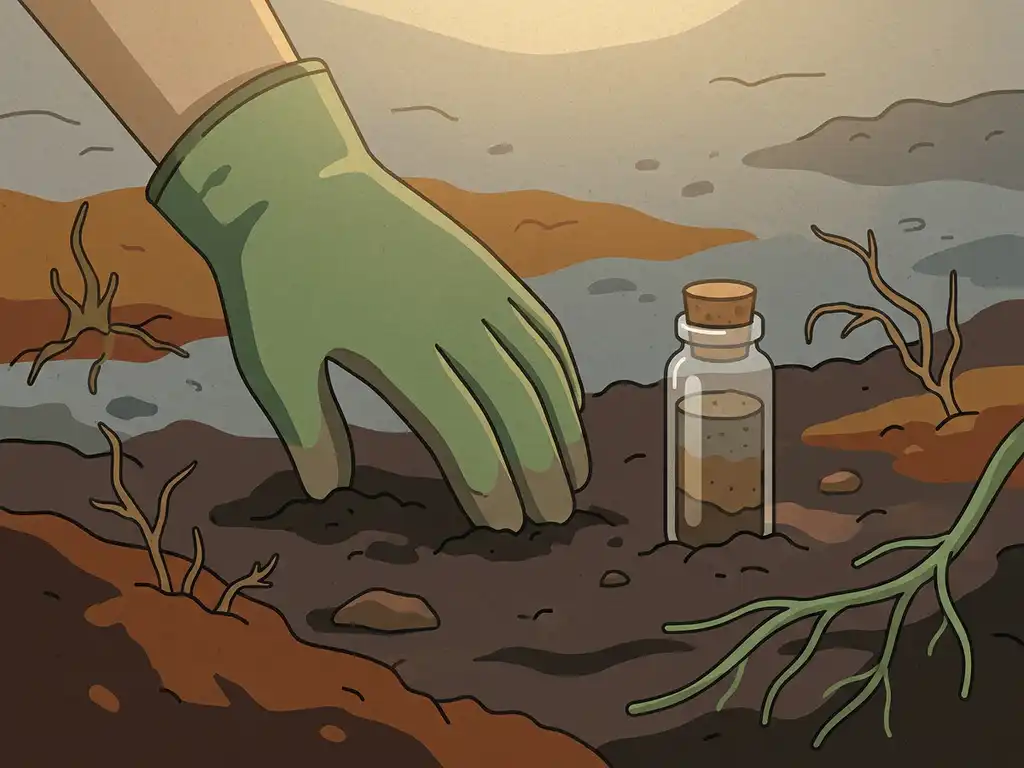
You can tell if your soil is contaminated by looking for visible warning signs such as discolored earth, unusual odors, dying vegetation, or a history of industrial activity on the site. However, visual indicators alone are not reliable. Official confirmation requires laboratory analysis of soil and groundwater samples, interpreted against regulatory thresholds set by bodies such as OVAM in Belgium.
Many contaminated sites show no obvious symptoms at all, particularly when pollutants have migrated deep into the subsurface or dissolved into groundwater. For anyone responsible for a brownfield, industrial property, or development site, understanding the full picture matters both for regulatory compliance and for making sound decisions about remediation.
The sections below address the most common questions that arise once contamination is suspected or confirmed, from identifying the problem to choosing the right approach for cleaning it up.
What are the most common signs of soil contamination?
The most common signs of soil contamination include unusual discoloration of the earth (dark staining, rust-colored patches, or oily sheens), a persistent chemical or petroleum-like odor, unexplained die-off of vegetation, and a documented history of industrial or chemical use on the site. None of these signs is conclusive on its own, but any combination warrants formal investigation.
In practice, many of the most serious contaminants leave no visible trace at the surface. Chlorinated solvents, for example, are colorless, migrate readily through soil, and can reach groundwater without producing any smell or staining detectable from above ground. This is why site history is often the most reliable early indicator. If a property was previously used as a dry cleaner, metal workshop, chemical storage facility, or fuel depot, the risk of subsurface contamination is significant regardless of how the surface looks today.
Other indirect signs include:
- Groundwater or surface water with a chemical taste or unusual color near the site
- Unexplained corrosion of underground pipes or infrastructure
- Vegetation that grows poorly or shows patchy die-off in areas with no obvious cause
- Neighboring properties with known contamination issues
For project managers and environmental coordinators, a site’s land use history is the starting point for any risk assessment. Regulatory frameworks like VLAREBO in Flanders use this history to determine whether a soil investigation is mandatory before any change of use or construction can proceed.
Get in Touch
Let’s Talk Microbial Solutions
Book a conversation with Stijn, our CEO, or send us your request.
| Book an Appointment | Request Information |
What types of contaminants are most commonly found in soil?
The most commonly found soil contaminants are petroleum hydrocarbons (from fuel storage and leaks), heavy metals (from industrial processes and mining), chlorinated solvents, also known as volatile organochlorine compounds or VOCl (from dry cleaning and metal degreasing), pesticides and herbicides (from agricultural use), and polycyclic aromatic hydrocarbons or PAHs (from combustion and coal tar). The type of contaminant found typically reflects the historical use of the site.
Among these, chlorinated solvents such as trichloroethylene (TCE) and perchloroethylene (PCE) deserve particular attention. They are dense, meaning they sink through the soil profile and can reach deep groundwater layers. They are also persistent, resisting natural breakdown without the right microbial conditions. Sites contaminated with VOCl are among the most technically challenging to remediate, and conventional excavation often cannot fully address them because the source zone lies too deep or beneath existing structures.
Heavy metals such as lead, cadmium, zinc, and arsenic are common in former industrial zones and do not degrade over time. Petroleum contamination from underground storage tanks is widespread and can be addressed through biological processes when conditions are right. PAH contamination is frequently found at former gasworks sites and coal storage areas.
Understanding the specific contaminant profile of a site is essential before any remediation strategy is designed. Different compounds require fundamentally different approaches, and combined contamination (which is common on older industrial sites) adds further complexity.
How is soil contamination officially tested and confirmed?
Soil contamination is officially tested and confirmed through a phased site investigation process. This typically begins with a descriptive soil investigation, in which soil and groundwater samples are collected from boreholes and analyzed in an accredited laboratory. Results are compared against legally defined threshold values to determine whether contamination is present and whether remediation is required.
In Flanders, this process is governed by VLAREBO and overseen by OVAM. The investigation is carried out by a certified soil expert and follows a structured methodology. A preliminary phase reviews the site’s history and identifies potential pollution sources. If risk indicators are found, a descriptive investigation follows, involving physical sampling at defined depths and locations.
Laboratory analysis can detect and quantify a wide range of compounds, including VOCl, heavy metals, hydrocarbons, and pesticides. Groundwater monitoring wells are often installed alongside soil sampling points to assess whether contamination has reached or is migrating through the water table. This is particularly important for soluble or mobile contaminants.
The outcome of the investigation is a formal soil investigation report that classifies the site and, if necessary, triggers an obligation to draw up a remediation plan. For site owners and project managers, this report is the legal basis for all subsequent decisions, including planning applications and property transactions.
How deep in the soil can contamination spread?
Soil contamination can spread to considerable depths, depending on the type of contaminant, soil structure, and the presence of groundwater. Light petroleum products tend to float near the water table, while dense non-aqueous phase liquids (DNAPLs) such as chlorinated solvents can sink tens of meters below the surface, passing through multiple geological layers before reaching an impermeable barrier.
The depth of contamination is one of the key factors that determines whether excavation is a practical option. Digging out contaminated soil is straightforward when the affected zone is shallow and accessible. But when contamination has migrated to depths of five, ten, or twenty meters, or when it sits beneath a building, a road, or a high water table, excavation becomes technically difficult, disruptive, and extremely costly.
Groundwater flow also plays a role in spreading contamination horizontally. A contaminant that enters the saturated zone can travel significant distances from the original source, creating a plume that extends well beyond the boundaries of the original site. This is why groundwater monitoring is a standard component of any serious soil investigation, and why neighboring landowners or downstream users may also be affected.
For brownfield developers and environmental project managers, understanding the vertical and horizontal extent of contamination is essential for scoping remediation costs and timelines accurately.
What’s the difference between soil excavation and biological remediation?
Soil excavation removes contaminated material physically by digging it out and transporting it to a licensed processing or disposal facility. Biological remediation, by contrast, treats contamination in place by stimulating or introducing microorganisms that break down the pollutants naturally within the soil. Excavation is faster but more disruptive and costly; biological remediation is slower but can address contamination at depths and in locations where excavation is not feasible.
When excavation makes sense
Excavation is the most straightforward approach when contamination is shallow, well-defined, and located in an area that can be accessed without disrupting existing structures or infrastructure. It provides a clear, measurable outcome: the contaminated material is removed and the site is clean. For small, localized pollution sources, it is often the fastest route to regulatory closure.
However, excavation has significant limitations. It is expensive per cubic meter of soil removed, generates large volumes of contaminated waste that must be processed, and is simply not viable when contamination lies beneath buildings, has reached deep groundwater, or covers a large area. On many brownfield sites, the conditions that make excavation attractive simply do not exist.
When biological remediation is the better option
Biological remediation, and in particular in-situ bioremediation, works by creating conditions in which naturally occurring or introduced microorganisms degrade the contaminants within the soil matrix. For chlorinated solvents, a specialized process called reductive dechlorination can break down compounds like PCE and TCE step by step into harmless end products, provided the right microbial communities are present and active.
This approach is well suited to sites where contamination is deep, spread across a large area, or located beneath structures that cannot be removed. It avoids the disruption of excavation and can be significantly more cost-effective for complex or large-scale contamination. The trade-off is time: biological processes operate on a longer timescale than physical removal, and success depends on site-specific conditions including soil chemistry, temperature, and the existing microbial population.
Avecom’s biological soil remediation services are specifically designed for cases where conventional excavation has failed or is not viable, with a focus on VOCl contamination that has proven resistant to standard approaches.
How do you know if biological remediation will work on your site?
The most reliable way to determine whether biological remediation will work on a specific site is through a microcosm test. This is a controlled laboratory experiment using actual soil and groundwater samples from the site, in which the conditions for biological degradation are simulated. The results show whether the necessary microbial activity is present, whether it can be stimulated, and at what rate degradation occurs under realistic conditions.
Not every site is suitable for biological remediation, and the factors that determine feasibility include the type and concentration of the contaminant, the soil texture and permeability, the groundwater chemistry, the pH, and whether the right microorganisms are already present in sufficient numbers. A microcosm test answers these questions directly, without committing to a full-scale remediation program.
This is the approach used by Avecom’s soil remediation specialists: before any field intervention is designed, a feasibility screening is carried out at laboratory scale. If the test confirms that biological degradation is achievable, a site-specific remediation plan is developed. If it shows that conditions are unfavorable, the client has that information before investing in a strategy that will not deliver results.
Alongside feasibility testing, molecular monitoring tools play an important role in tracking progress once remediation begins. Techniques such as qPCR allow the concentration and activity of specific degrading microorganisms to be quantified directly from soil and groundwater samples. This provides concrete data on whether the biological process is working, which is valuable both for internal reporting and for meeting OVAM monitoring obligations.
For environmental coordinators and project managers who need to demonstrate progress to regulators or investors, this kind of evidence-based monitoring removes much of the uncertainty that has historically made biological remediation a harder sell than excavation. The science has advanced to the point where the process can be tracked, adjusted, and documented with the same rigor as any physical intervention.
If you are dealing with a contaminated site where classical approaches have not delivered, or where excavation is not technically or financially viable, a preliminary screening is the logical first step. Learn more about Avecom’s soil remediation approach, or visit avecom.be to find out how the team works with environmental project managers from initial assessment through to regulatory closure.