

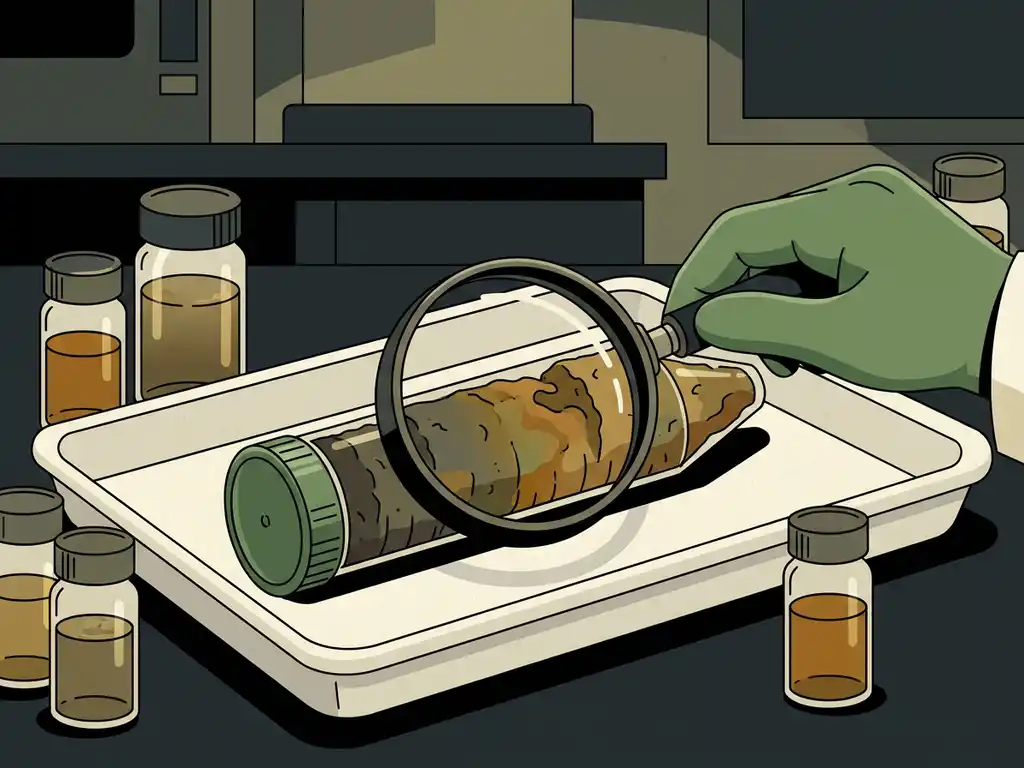
When soil contamination is discovered on your site, you are legally required to report it to the relevant environmental authority and initiate a formal site investigation. In Belgium, this means notifying OVAM and following the procedures set out under VLAREBO. The steps that follow — from soil investigation to remediation planning — depend on the type and extent of contamination, but the process is structured and non-negotiable.
For project managers, property developers, and environmental coordinators, discovering contamination often triggers immediate questions about liability, cost, and timeline. This article works through the most common questions that follow that discovery, from legal responsibility to remediation options and how to prove the work is actually succeeding.
Who is legally responsible for contaminated soil?
Legal responsibility for contaminated soil typically falls on the current owner of the land, the party who caused the contamination, or both — depending on national and regional legislation. In Flanders, VLAREBO establishes a clear framework: the owner, user, or polluter can each carry obligations, and responsibility does not automatically transfer when a property changes hands without proper due diligence.
In practice, this means that a property developer acquiring a brownfield site may inherit remediation obligations even if they did not cause the contamination. This is why soil investigations are a standard part of property transactions in Belgium. OVAM maintains a register of contaminated sites, and any parcel listed on that register requires a soil certificate before a transaction can proceed.
For public bodies such as municipalities or intermunicipal organizations, responsibility often arises from ownership of former industrial land or infrastructure. In these cases, the question is rarely whether remediation is required, but how quickly it must happen and at what cost.
Get in Touch
Let’s Talk Microbial Solutions
Book a conversation with Stijn, our CEO, or send us your request.
| Book an Appointment | Request Information |
What are the required next steps after soil contamination is found?
After soil contamination is discovered, the required next steps are: reporting to the competent authority, conducting a descriptive soil investigation, assessing the risk to human health and the environment, and — if the risk is unacceptable — drawing up a remediation plan. In Flanders, these steps are governed by OVAM under the VLAREBO decree.
The process typically unfolds in this sequence:
- Notification: The discovery must be reported to OVAM. Failure to report known contamination is a legal violation.
- Exploratory soil investigation (oriënterend bodemonderzoek): A licensed soil expert maps the nature and extent of contamination through sampling and analysis.
- Descriptive soil investigation (beschrijvend bodemonderzoek): If the exploratory investigation reveals a potential risk, a more detailed assessment follows, including groundwater analysis and risk modeling.
- Risk assessment: Based on the investigation results, a risk assessment determines whether active remediation is required or whether risk management measures are sufficient.
- Remediation project: If remediation is required, a licensed expert prepares a remediation plan, which must be approved by OVAM before work begins.
Each phase involves formal reporting and timelines. Delays in reporting or in commissioning investigations can result in enforcement action, which adds both cost and reputational risk for the responsible party.
What types of soil contamination are hardest to remediate?
The most difficult types of soil contamination to remediate are chlorinated solvents — also known as volatile organochlorine compounds (VOCl) — heavy metals, and dense non-aqueous phase liquids (DNAPLs). These contaminants are persistent, migrate into deep soil layers and groundwater, and resist conventional treatment approaches.
Chlorinated solvents such as tetrachloroethylene (PCE) and trichloroethylene (TCE) are particularly problematic. They were widely used as industrial degreasers and dry-cleaning agents, and their chemical stability means they can persist in soil and groundwater for decades. Because they are denser than water, they sink through the soil profile and accumulate in deep zones that are difficult to access physically.
Heavy metals present a different challenge: they do not degrade. Remediation options are limited to immobilization, containment, or physical removal. On sites where excavation is not feasible — due to existing buildings, infrastructure, or depth — this creates a serious technical and regulatory problem.
Hydrocarbons from fuel spills are generally more amenable to biological treatment, but when mixed with other contaminants or present at high concentrations, they can still resist standard approaches. The combination of contaminant type, soil matrix, and site-specific conditions determines how hard a given contamination is to address.
When is biological soil remediation a viable alternative to excavation?
Biological soil remediation is a viable alternative to excavation when the contamination is biodegradable, when the site conditions support microbial activity, and when excavation is technically or economically impractical. For chlorinated solvents in particular, in-situ bioremediation has a well-established track record when the right microbial communities are present or can be introduced.
Excavation remains the default reference for many project managers because it is familiar and produces a visible result. However, it is not always feasible. Buildings or infrastructure above the contamination zone may make excavation impossible. Contamination at depth, or spread across a large area, can make excavation disproportionately expensive. In these situations, biological approaches deserve serious consideration.
The key question is not whether biological remediation works in theory, but whether it will work for a specific site. That is where feasibility testing becomes essential. A microcosm test — a controlled laboratory experiment using actual soil and groundwater from the site — can determine within weeks whether the native microbial community is capable of breaking down the target contaminants, and whether bioaugmentation (introducing specialized microbial cultures) is needed.
Avecom, based in Ghent, specializes in exactly this type of assessment. Their work focuses on sites where conventional remediation has failed or is not feasible, and their approach starts with the science before committing to a full-scale intervention.
How long does biological soil remediation take?
Biological soil remediation typically takes between one and several years, depending on the type and concentration of contamination, the depth and extent of the affected zone, and the efficiency of the microbial processes involved. It is generally slower than excavation but can be more cost-effective over the full project lifecycle.
For chlorinated solvent contamination, complete biological degradation of PCE or TCE to harmless end products (ethylene and chloride) requires a sequential chain of microbial reactions. Each step depends on the right organisms being active under the right conditions. When those conditions are met — either naturally or through bioaugmentation and nutrient amendment — the process can proceed steadily. When they are not, progress stalls.
This variability is one reason why biological remediation sometimes gets a skeptical reception from project managers working under planning or regulatory pressure. The honest answer is that timelines are site-specific and cannot be guaranteed in advance without proper feasibility data. What can be managed is the monitoring — so that if the process is not progressing as expected, adjustments can be made early rather than after years of ineffective treatment.
How do you prove soil remediation is actually working?
Soil remediation progress is proven through a combination of chemical monitoring — measuring contaminant concentrations in soil and groundwater over time — and, for biological approaches, molecular monitoring that directly tracks the microbial populations responsible for degradation. Together, these methods provide evidence that remediation is active, not just assumed.
Chemical monitoring alone has limitations. A decrease in contaminant concentration could reflect dilution, migration, or volatilization rather than actual degradation. For biological remediation of chlorinated solvents, it is important to confirm that the full degradation pathway is active — that PCE is being converted all the way to harmless end products, not accumulating as vinyl chloride, which is itself a regulated contaminant.
Molecular tools such as quantitative PCR (qPCR) and amplicon sequencing make it possible to detect and quantify the specific microbial populations driving degradation. This gives project managers and environmental regulators concrete, data-driven evidence of biological activity — not just an absence of contaminants that might have moved rather than degraded.
For OVAM reporting, this kind of structured monitoring data is both practically useful and regulatorily relevant. Avecom’s molecular soil analysis services are designed specifically to support this type of evidence-based progress reporting, covering qPCR and sequencing alongside the full remediation guidance process.
If you are managing a contaminated site where classical remediation has reached its limits, or where excavation is not a realistic option, a structured biological assessment is a logical next step. Avecom’s team of environmental engineers and microbiologists works from initial feasibility screening through to field-scale implementation and OVAM-compliant reporting — starting with the data, not the solution.
Related Articles
- What should you do if you suspect soil contamination on your site?
- How do you seed a biological wastewater plant with the right bacteria?
- Can nutrient imbalance trigger sludge problems in wastewater treatment?
- How does low dissolved oxygen cause sludge bulking?
- What methods are used to assess soil contamination?