

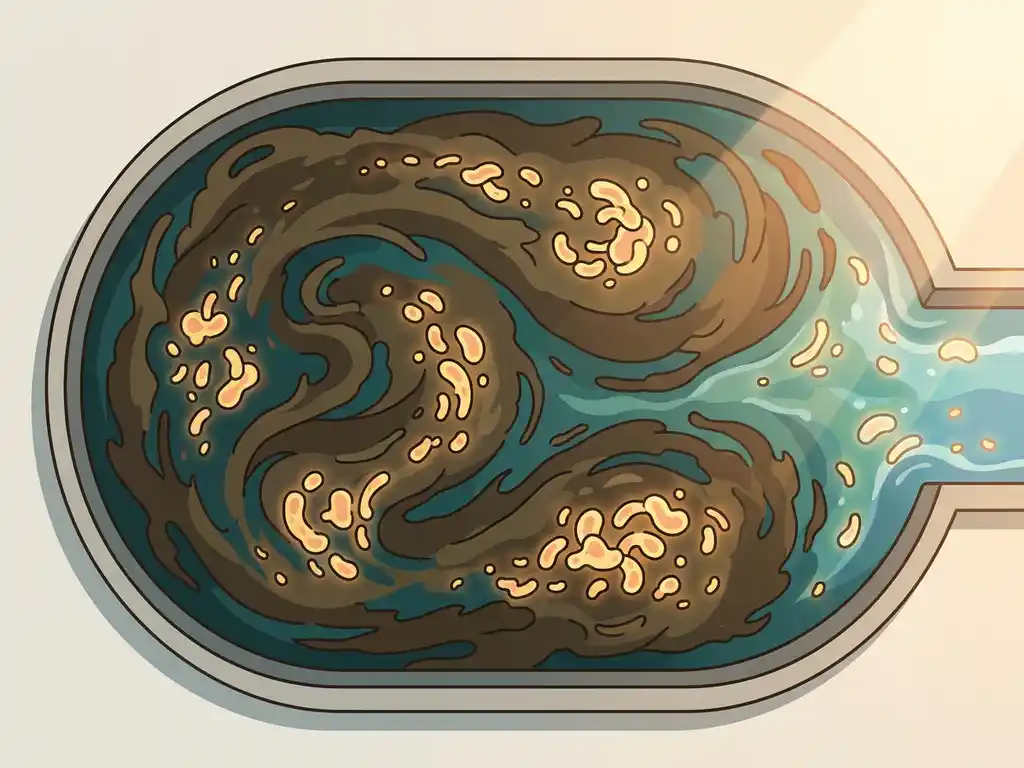
Yes, sludge problems in wastewater treatment can be addressed without relying on expensive chemical interventions. The key is shifting from chemical suppression to biological optimization — managing the microbial communities in your system so that excess sludge production is reduced at the source rather than treated after the fact. This article unpacks the most common questions industrial operators ask when facing sludge challenges, from root causes to practical transition strategies.
What actually causes excessive sludge in industrial wastewater systems?
Excessive sludge in industrial wastewater systems is primarily caused by an imbalance between organic loading and the microbial community’s capacity to process it efficiently. When the biological system is overloaded, poorly seeded, or operating under suboptimal conditions, bacteria reproduce faster than the system can manage, producing more biomass than necessary to treat the incoming waste.
Several factors compound this imbalance in industrial settings. Seasonal production peaks in food processing, for example, create sudden spikes in chemical oxygen demand (COD), nitrogen, and phosphorus that overwhelm a system calibrated for average loads. Nutrient imbalances — too much or too little nitrogen relative to carbon — push microbial populations toward inefficient metabolic pathways that generate excess cell mass.
Sludge bulking, a specific and common problem in biological treatment, occurs when filamentous bacteria outcompete floc-forming organisms. The result is a poorly settling sludge that clogs dewatering equipment and drives up disposal costs. Understanding which microbial populations are dominant in your system is the first step toward correcting the problem — and that requires more than a visual inspection.
Get in Touch
Let’s Talk Microbial Solutions
Book a conversation with Stijn, our CEO, or send us your request.
| Book an Appointment | Request Information |
Why is chemical sludge treatment so costly and hard to sustain?
Chemical sludge treatment is costly because it addresses symptoms rather than causes. Flocculants, coagulants, and oxidizing agents reduce sludge volume temporarily, but they do not correct the underlying biological imbalance that generates excess sludge in the first place. Each treatment cycle requires fresh chemical inputs, creating a recurring operational cost that compounds over time.
Beyond direct material costs, chemical treatment carries indirect burdens. Disposal of chemically conditioned sludge is more complex and expensive because the added substances can affect the sludge’s classification and the options available for its end use. In some cases, chemical additives prevent sludge from being applied to land or used in anaerobic digestion, narrowing the valorization options available to operators.
There is also a regulatory dimension. Tightening discharge standards under frameworks like the EU Water Framework Directive means that chemical dosing strategies that worked five years ago may no longer achieve compliance today. Operators find themselves increasing dosages and costs just to stay in place, while the environmental footprint of their treatment process grows rather than shrinks.
How does biological treatment reduce sludge without chemicals?
Biological treatment reduces sludge by engineering the microbial community to convert organic material more efficiently, producing less surplus biomass per unit of waste treated. Rather than adding chemicals to suppress or remove sludge after it forms, the goal is to optimize conditions so that the right microorganisms dominate and operate at maximum metabolic efficiency.
Several mechanisms contribute to lower sludge yields in well-managed biological systems. Aerobic processes operating at longer sludge retention times allow bacteria to undergo endogenous respiration, essentially consuming their own cell mass when external substrate is limited. Anaerobic pre-treatment stages can convert a significant portion of organic load into biogas before the aerobic stage ever sees it, reducing the biomass that needs to be grown and later disposed of.
Microbial consortia management plays a central role here. Mixed microbial communities, when correctly seeded and maintained, self-regulate more robustly than pure culture systems. They adapt to fluctuating loads, suppress problematic filamentous organisms through competitive dynamics, and recover faster from disturbances. This is the working principle behind approaches like those developed at Avecom’s water treatment services, where mixed culture optimization is used to stabilize biological systems without chemical intervention.
What types of industrial effluent are best suited to biological sludge reduction?
Industrial effluents with high biodegradable organic content and relatively consistent composition respond best to biological sludge reduction strategies. Food and beverage processing wastewater — including dairy, brewing, meat processing, and vegetable preparation streams — typically meets these criteria and offers strong candidates for biological optimization.
Effluents from the pharmaceutical and fine chemical industries can also be treated biologically, though they often require more careful microbial community selection to handle specific compounds. The key variable is not the industry itself but the biodegradability of the specific organic fraction and the presence of inhibitory substances that might suppress microbial activity.
Streams with high nitrogen loads, such as reject water from digestate dewatering or certain food processing side streams, present both a challenge and an opportunity. Biological nitrification and denitrification processes can handle these nutrient peaks without chemical precipitation, and in some configurations, the nitrogen can be recovered as a valuable product rather than discharged. This dual function — treating a difficult stream while recovering a resource — is increasingly relevant as input costs for nitrogen-based fertilizers and feed ingredients rise.
How do you switch from chemical to biological treatment without risking downtime?
Switching from chemical to biological treatment without operational disruption requires a phased approach that validates performance at small scale before committing to full-scale changes. The transition should never be a hard cutover — instead, the biological system is built up gradually alongside or within the existing process, with chemical backup maintained until the biological stage has proven stable.
The practical steps follow a logical sequence:
- Characterize your current effluent in detail. Flow rates, load variability, inhibitory compounds, and seasonal patterns all determine which biological strategy will work. This is best done through a dedicated laboratory analysis before any process changes are made.
- Run lab- and pilot-scale feasibility tests. Treating a representative sample of your effluent under controlled conditions reveals how quickly a microbial community can be established, what sludge yields to expect, and where process risks lie.
- Seed the biological system with targeted microbial inocula. Technologies that introduce pre-adapted microbial consortia can significantly shorten the startup period for biofilters and activated sludge systems, reducing the window of vulnerability during transition.
- Monitor microbial community composition during ramp-up. Molecular monitoring tools allow operators to track which organisms are present and whether the community is developing in the right direction — long before any performance problem becomes visible in discharge quality.
- Reduce chemical inputs progressively as biological performance stabilizes. This staged reduction protects compliance while the biological system builds resilience.
This approach is what Avecom applies in practice: combining microbiological audits, pilot-scale validation, and targeted inoculation to reduce transition risk for industrial operators who cannot afford discharge exceedances during the changeover period.
Can wastewater sludge become a resource instead of a waste stream?
Yes, in certain configurations, wastewater sludge and the nutrients it contains can be recovered and valorized rather than simply disposed of. The most developed pathways include anaerobic digestion for biogas production, nutrient recovery from reject water, and in some cases the conversion of sludge-derived biomass into protein-rich materials for use in animal nutrition.
The feasibility of valorization depends heavily on the composition of the incoming wastewater and the biological process used to treat it. Food processing streams with high nitrogen content are particularly interesting candidates because the nitrogen removed during biological treatment does not have to be lost — it can be captured and concentrated into a form that has market value as a feed ingredient or fertilizer substitute.
This is where the boundary between wastewater treatment and industrial biotechnology begins to blur. Avecom’s background in applied microbiology spans both domains, and the company’s ProMic platform is specifically designed to recover nitrogen and other nutrients from reject water streams as high-value inputs for animal feed production. For an industrial operator, this changes the economics of the entire treatment system: instead of paying to remove and dispose of nitrogen, there is a potential revenue or cost-offset attached to it.
Not every wastewater stream will support this kind of valorization, and the business case needs to be validated against actual stream composition and market conditions. But the direction of travel is clear: as disposal costs rise and raw material prices remain elevated, the incentive to treat sludge as a starting point rather than an endpoint will only grow stronger. Exploring that potential starts with understanding what is actually in your wastewater — and that begins with proper characterization, not a standard off-the-shelf solution.
If you are dealing with persistent sludge problems in your wastewater system and want to understand whether a biological approach is viable for your specific situation, a feasibility assessment is the logical first step before committing to any process change.
Related Articles
- What scientific reporting should you expect from a fermentation R&D partner?
- How long does it take to fix sludge bulking in biological treatment?
- How do you know if your soil is contaminated?
- What is molecular soil monitoring and why does it matter?
- How do environmental engineers assess contamination risk?