

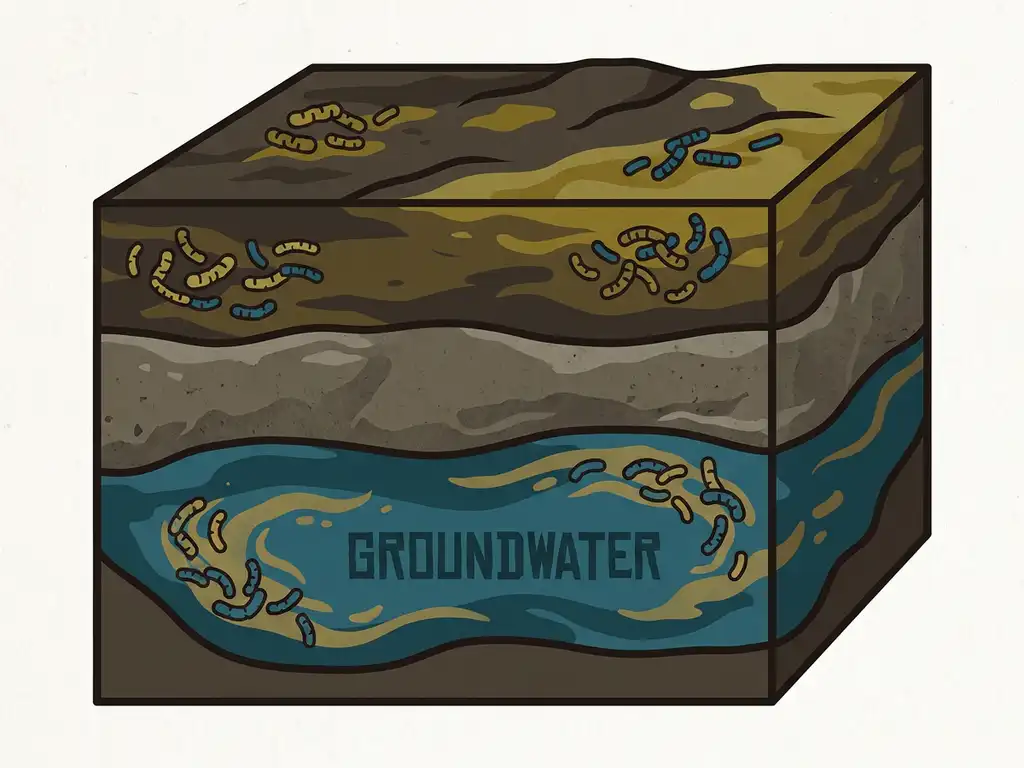
Soil contamination and groundwater contamination are distinct but closely connected problems. Soil contamination refers to the presence of harmful substances in the solid ground matrix, while groundwater contamination occurs when those pollutants dissolve and spread through subsurface water. The two rarely stay separate for long: what starts in the soil often migrates downward into the groundwater, turning a localized problem into a far more complex remediation challenge.
For anyone managing a contaminated industrial site, understanding this distinction matters in practice. It shapes which investigation methods apply, which regulatory obligations are triggered, and which remediation strategies are technically and financially feasible. The sections below address the most common questions that arise once contamination is discovered.
How does contamination move from soil into groundwater?
Contamination migrates from soil into groundwater primarily through a process called leaching. When rainwater or surface water infiltrates the ground, it carries dissolved pollutants downward through the soil profile until they reach the saturated zone where groundwater flows. The speed and extent of this migration depend on the type of pollutant, soil permeability, and depth to the water table.
Dense non-aqueous phase liquids (DNAPLs), such as chlorinated solvents like perchloroethylene (PCE) and trichloroethylene (TCE), are particularly problematic. Because they are denser than water, they sink through the unsaturated soil zone and penetrate deep into the aquifer, where they form persistent source zones that continue to dissolve into groundwater for decades. This behavior explains why chlorinated solvent contamination is among the most difficult to contain and remediate once it reaches subsurface water.
Lighter pollutants such as petroleum hydrocarbons behave differently. They tend to float near the water table rather than sinking, forming what is called a light non-aqueous phase liquid (LNAPL) layer. In both cases, the direction and speed of groundwater flow then carry dissolved contamination further from the original source, creating a plume that can extend well beyond the boundaries of the original site.
Get in Touch
Let’s Talk Microbial Solutions
Book a conversation with Stijn, our CEO, or send us your request.
| Book an Appointment | Request Information |
What types of pollutants are found in contaminated soil versus groundwater?
Contaminated soil and groundwater often contain the same underlying pollutants, but the form those pollutants take differs. In soil, contaminants are typically bound to soil particles or present as residual free-phase liquids. In groundwater, they appear in dissolved form or as separate-phase liquids floating on or sinking below the water table.
Common pollutants found in contaminated soil include heavy metals such as lead, cadmium, and arsenic, as well as mineral oil, polycyclic aromatic hydrocarbons (PAHs), and chlorinated solvents. Heavy metals tend to bind tightly to soil particles and do not migrate as readily into groundwater, though acidic conditions can increase their mobility. Chlorinated solvents, by contrast, are highly mobile and volatile, making them a primary driver of groundwater contamination at former industrial and dry-cleaning sites.
In groundwater, the contaminant profile shifts toward dissolved-phase substances. Volatile organic compounds (VOCs), including chlorinated solvents and BTEX compounds (benzene, toluene, ethylbenzene, and xylene), are frequently detected in affected aquifers. Nitrates from agricultural or industrial sources also commonly appear in groundwater. The dissolved phase is what makes groundwater contamination a public health concern, particularly where aquifers serve as drinking water sources.
Why is groundwater contamination harder to detect than soil contamination?
Groundwater contamination is harder to detect because it is invisible, subsurface, and dynamic. Unlike soil contamination, which can sometimes be identified through discoloration, odor, or surface sampling, groundwater contamination requires dedicated monitoring wells, laboratory analysis, and an understanding of subsurface hydrology to locate and characterize it accurately.
The plume itself is the central challenge. Dissolved contaminants spread in three dimensions, following groundwater flow paths that are influenced by geology, seasonal fluctuations, and nearby pumping activities. A monitoring well placed in the wrong location or at the wrong depth can entirely miss a contamination plume, giving a false impression that groundwater is unaffected.
Volatile compounds add another layer of complexity. Low concentrations of chlorinated solvents in groundwater can still pose significant risk, yet they may not be apparent without targeted chemical analysis using sensitive detection methods. This is why molecular monitoring tools have become increasingly valuable in site investigations. Techniques such as quantitative PCR (qPCR) allow specialists to detect and quantify the microorganisms responsible for natural or stimulated degradation of contaminants, providing a more complete picture of what is happening below the surface.
What’s the difference between remediating contaminated soil and contaminated groundwater?
Remediating contaminated soil and contaminated groundwater requires fundamentally different approaches because the contaminant is in a different physical state and medium. Soil remediation focuses on treating or removing pollutants bound to the solid matrix, while groundwater remediation must address dissolved-phase contamination moving through a dynamic, three-dimensional flow system.
Soil remediation approaches
For soil, the most common approach has historically been excavation: physically removing the contaminated material and disposing of or treating it off-site. This is effective when contamination is shallow and the site is accessible, but it becomes prohibitively expensive or technically impossible when contamination is deep, located under existing structures, or spread across a large area. In-situ techniques, including soil vapor extraction, chemical oxidation, and biological treatment, address contamination in place without the disruption and cost of excavation.
Groundwater remediation approaches
Groundwater remediation typically involves pump-and-treat systems, which extract contaminated water, treat it above ground, and re-inject or discharge it. While widely used, pump-and-treat is often a long-term containment measure rather than a permanent solution, particularly where DNAPLs are present as a continuing source. In-situ approaches such as permeable reactive barriers, monitored natural attenuation, and biological treatment methods offer alternatives that can address contamination within the aquifer itself.
The most effective remediation strategies treat both soil and groundwater as a connected system, targeting the source zone in the soil while also managing the dissolved plume in the groundwater. Addressing only one without the other typically results in incomplete remediation.
When does soil or groundwater contamination require regulatory reporting in Belgium?
In Belgium, soil and groundwater contamination triggers regulatory reporting obligations primarily under VLAREBO, the Flemish Soil Remediation Decree, administered by OVAM (the Public Waste Agency of Flanders). Reporting is required when contamination is discovered during a site transaction, a change of land use, or as part of a mandatory soil investigation for regulated activities.
The regulatory framework distinguishes between exploratory soil investigations, which establish whether contamination is present, and descriptive soil investigations, which characterize the nature and extent of the problem in detail. OVAM uses the results to determine whether a remediation obligation exists and, if so, what standard must be achieved. Contamination that poses a current or future risk to human health, groundwater quality, or ecosystems typically triggers a remediation obligation.
For project managers and brownfield developers, the practical implication is that contamination discovered during due diligence or site preparation cannot simply be set aside. It creates a documented liability that must be addressed before land use changes, building permits, or property transfers can proceed. Understanding what has been found, in which medium, and at what concentrations is the first step toward determining the regulatory pathway and the remediation strategy that follows.
How can biological methods treat both soil and groundwater contamination at once?
Biological remediation methods can treat soil and groundwater contamination simultaneously because they work in-situ, introducing or stimulating microorganisms that degrade contaminants directly within the subsurface. Rather than separating the soil and groundwater problems, biological approaches treat the connected system as a whole, targeting the source zone and the dissolved plume at the same time.
This is particularly relevant for chlorinated solvent contamination, where specialized bacteria capable of reductive dechlorination can break down compounds like PCE and TCE into harmless end products. The process, called enhanced in-situ bioremediation or bioaugmentation, involves injecting a consortium of microorganisms along with electron donors that support their activity. As the bacteria establish themselves in the subsurface, they degrade contaminants both in the soil matrix and in the groundwater flowing through it.
Avecom specializes in exactly this type of biological remediation for volatile organochlorine compounds (VOCl). Before committing to a full-scale intervention, the team conducts microcosm tests that use actual soil and groundwater samples from the site to determine whether biological degradation is feasible under site-specific conditions. This step avoids the risk of deploying a biological approach on a site where conditions do not support it.
Alongside the treatment itself, molecular monitoring tools such as qPCR and amplicon sequencing allow continuous tracking of microbial activity and contaminant breakdown throughout the remediation process. This provides the concrete data that regulators and site owners need to demonstrate progress, meet OVAM reporting requirements, and make informed decisions about when remediation objectives have been achieved.
For sites where excavation is too costly, too disruptive, or technically not feasible, a well-designed biological approach can offer a credible, science-based alternative. The soil remediation specialists at Avecom work from initial feasibility screening through to full field implementation, providing the technical foundation and regulatory documentation that complex contaminated sites require. If you are managing a site where conventional methods have fallen short, a screening with the Avecom team is a practical starting point for understanding what biological remediation can realistically achieve.
Related Articles
- Can a small biotech company access pilot-scale fermentation without building it?
- What contaminants are most commonly found on industrial sites?
- How do you audit a biological wastewater plant for sludge issues?
- How do you measure sludge settleability in a wastewater plant?
- How do you diagnose sludge problems in biological treatment?