

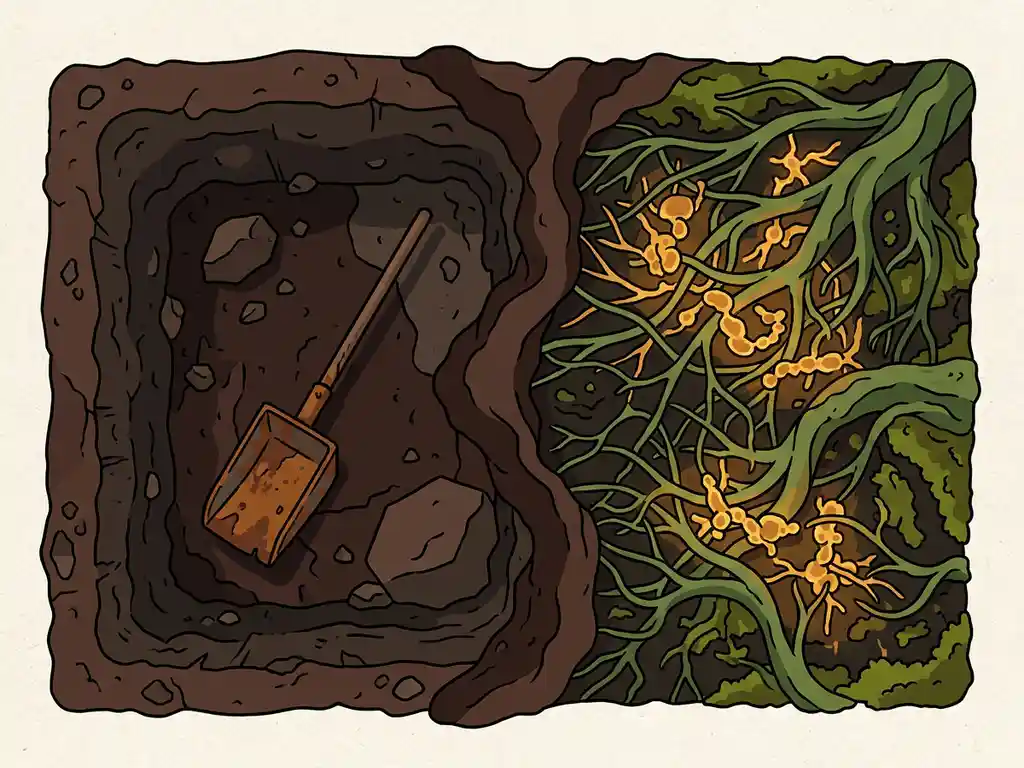
Excavation physically removes contaminated soil and is fast and certain, but biological soil remediation uses microorganisms to break down contaminants in place, often at a fraction of the cost. The right choice depends on the type of contamination, site conditions, and whether excavation is even technically feasible. The questions below unpack each factor so you can make an informed decision for your specific site.
When is excavation no longer a viable option for contaminated soil?
Excavation stops being viable when the contamination is too deep, too widespread, or located beneath structures that cannot be demolished or moved. In those situations, the cost of physical removal becomes prohibitive, and the logistical disruption makes it practically impossible. Many project managers discover this only after commissioning a site assessment.
Several conditions make excavation technically or financially unfeasible. Contamination that has migrated deep into the saturated zone, for example, cannot simply be dug out without major groundwater management works. Sites with existing buildings, infrastructure, or utility networks above the plume present similar barriers. When the legal risk of soil contamination is pushing a project forward under regulatory pressure, the temptation is to default to excavation because it feels conclusive. But if the contaminated volume is large, the cost per tonne removed quickly makes the approach unworkable.
There is also the question of residual risk. Excavation removes the bulk of contaminated material, but it rarely eliminates contamination entirely, particularly with volatile organochlorine compounds (VOCl) that partition into groundwater. In those cases, a purely physical approach leaves the site non-compliant and the project owner still liable. That is precisely the gap that biological soil remediation is designed to fill.
Get in Touch
Let’s Talk Microbial Solutions
Book a conversation with Stijn, our CEO, or send us your request.
| Book an Appointment | Request Information |
How does biological soil remediation actually work?
Biological soil remediation works by stimulating or introducing microorganisms that break down contaminants into harmless byproducts through natural metabolic processes. Rather than removing the soil, the treatment happens in place, using the contaminated zone itself as the bioreactor. The process can be managed and accelerated through targeted microbial intervention.
There are two main approaches. Biostimulation adds nutrients or electron donors to the subsurface to boost the activity of naturally occurring microorganisms that already have some capacity to degrade the target contaminant. Bioaugmentation goes further: it introduces a specialized microbial consortium specifically selected or cultivated for its ability to break down the contaminant in question. For persistent compounds like chlorinated solvents, bioaugmentation is typically required because the native microbial community lacks sufficient degradation capacity on its own.
The process is not passive. Effective in-situ biological remediation requires careful control of subsurface conditions, including pH, redox potential, electron donor availability, and temperature. Specialists design the intervention based on site-specific data, then monitor the microbial community over time to confirm that degradation is actually occurring. Avecom’s team, founded as a spin-out of Ghent University, has spent over 27 years developing exactly this kind of precision management for mixed microbial cultures in real-world soil conditions.
Which contaminants can biological remediation treat effectively?
Biological remediation is most effective against organic contaminants that microorganisms can metabolize, including petroleum hydrocarbons, chlorinated solvents such as trichloroethylene and perchloroethylene, polycyclic aromatic hydrocarbons, and certain pesticides. It is not suitable for heavy metals or inorganic contaminants, which cannot be broken down biologically.
Among the most challenging contaminants for any remediation method are VOCl compounds, the chlorinated solvents that persist in soil and groundwater from historical dry-cleaning, degreasing, and industrial solvent use. These compounds are resistant to aerobic degradation but can be broken down under anaerobic conditions by specific groups of bacteria through a process called reductive dechlorination. When the right organisms are present and conditions are correct, chlorinated solvents are progressively stripped of their chlorine atoms until they reach ethene, a harmless end product.
The key word is “when.” Not every contaminated site has the microbial population or the geochemical conditions needed for this process to work. That is why a feasibility assessment is essential before committing to a biological approach, particularly for sites where contaminated soil represents a legal risk and regulators expect documented progress.
How long does biological soil remediation take compared to excavation?
Excavation is fast: soil is removed in weeks or months. Biological soil remediation typically takes one to several years, depending on the contaminant, its concentration, the depth of the plume, and site-specific conditions. The tradeoff is cost and disruption, not speed, which is why biological remediation is chosen for sites where excavation is impractical rather than as a shortcut.
This timeline difference is one of the most common concerns for project managers facing regulatory deadlines or investor pressure. It is a legitimate concern, and the answer requires honesty: biological remediation is not a faster solution. What it offers is a workable solution when excavation is not, and a significantly lower cost per tonne of contamination treated.
The timeline can also be managed more actively than it might appear. Bioaugmentation with high-density, well-characterized microbial consortia can accelerate degradation compared to relying on natural attenuation alone. Regular monitoring allows the remediation team to adjust conditions, add substrate, or modify the approach if progress stalls. Sites where conditions are optimized from the outset tend to reach compliance targets faster than sites where the biological process is simply initiated and left to run.
How do you know if biological remediation is working on your site?
You confirm biological remediation is working through a combination of chemical analysis, showing declining contaminant concentrations, and molecular monitoring, showing that the responsible microorganisms are present and active. Contaminant data alone is not sufficient, because concentration changes can also result from dilution or migration rather than degradation.
Molecular monitoring tools, particularly quantitative PCR (qPCR), allow specialists to detect and quantify specific functional genes associated with contaminant degradation directly from soil or groundwater samples. If the genes encoding the enzymes responsible for reductive dechlorination are present and increasing in abundance, that is direct evidence that the biological process is functioning. This level of diagnostic precision is not available with conventional monitoring methods.
For project managers who need to demonstrate progress to regulators or investors, this distinction matters. A monitoring programme that only reports chemical concentrations leaves open the question of whether the biology is working or whether concentrations are simply fluctuating. Molecular data closes that gap and provides the kind of concrete evidence that supports OVAM reporting and satisfies regulatory requirements. Avecom offers qPCR-based soil analysis and amplicon sequencing as part of its monitoring services, giving site owners continuous, data-backed insight into remediation progress.
Should you choose excavation or biological remediation for a VOCl-contaminated site?
For VOCl-contaminated sites, biological remediation is often the more appropriate choice when contamination has reached the groundwater, when the plume is large or deep, or when excavation is blocked by existing structures. Excavation remains preferable for shallow, localized contamination where full removal is technically and financially feasible.
The decision should never be made on assumption. The first step for any site with suspected VOCl contamination is to determine whether the biological conditions for degradation exist. A microcosm test, conducted in the laboratory using soil and groundwater from the actual site, provides a rapid and cost-effective answer to that question. It tests whether the native microbial community can degrade the target compounds, and whether bioaugmentation is needed to achieve acceptable rates.
If the microcosm test confirms biological feasibility, a tailored remediation plan can be designed, including the choice of microbial consortium, the delivery method, and the monitoring protocol. If the test shows that biological conditions are unfavorable, that finding also has value: it prevents investment in an approach that would not work, and it redirects the project toward alternative methods before time and budget are wasted.
For project owners dealing with contaminated soil and uncertain options, the practical starting point is a feasibility screening rather than a commitment to either method. Avecom’s biological soil remediation service includes microcosm testing, in-situ bioaugmentation, molecular monitoring, and reporting aligned with regulatory requirements, covering the full process from initial screening to field-scale remediation.