

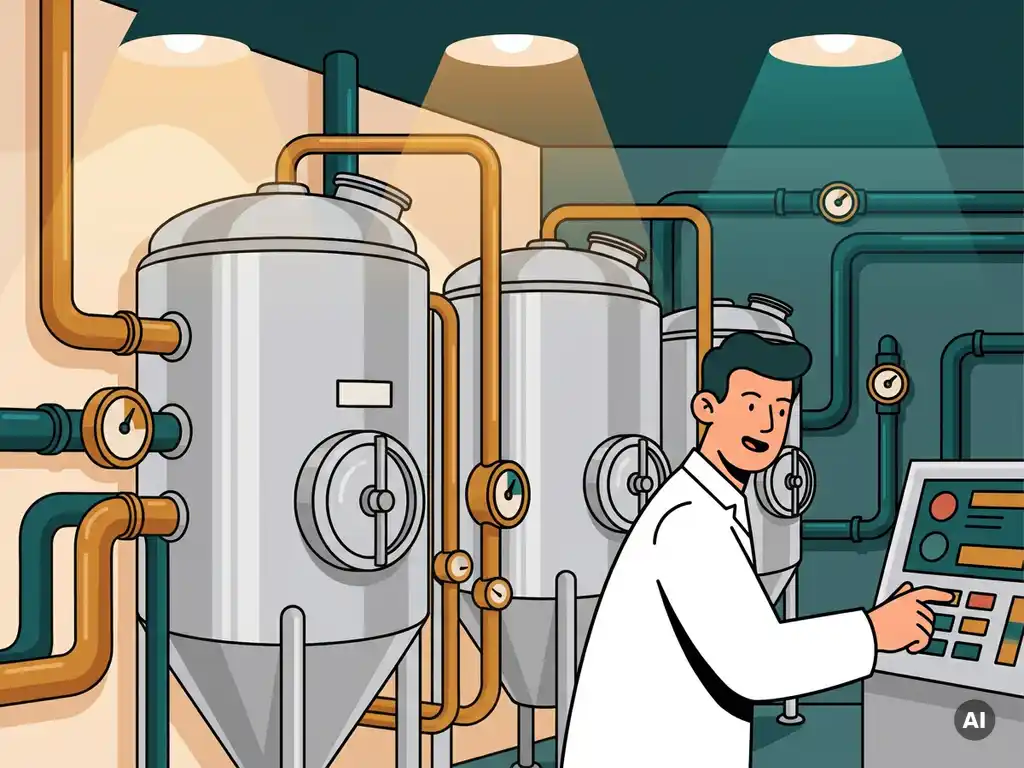
Contract manufacturing in fermentation is when a company outsources the production of a microbial product or process to a specialized third-party facility, rather than building or operating its own fermentation infrastructure. The contract manufacturer provides the bioreactors, technical expertise, and process control needed to produce the product to specification. This arrangement is common across biotech, food ingredients, agriculture, and specialty chemicals, and it spans everything from early feasibility work to small-scale commercial supply.
For many scale-ups and industrial companies, contract fermentation is not a fallback option but a deliberate strategic choice. It compresses the time between a validated concept and a market-ready product while avoiding the capital commitment of in-house infrastructure. The sections below address the most common practical questions about how contract manufacturing in fermentation actually works.
How does contract manufacturing work in fermentation?
In contract manufacturing fermentation, a client company transfers a process concept, strain, or formulation to a contract manufacturer, who then produces the product using their own equipment, staff, and quality systems. The client defines the target product and specifications; the contract manufacturer is responsible for hitting those specifications reliably at the agreed scale. Intellectual property typically remains with the client, governed by a contract signed before any technical work begins.
In practice, the engagement usually starts with a technical intake where both parties align on the process requirements: the organism or microbial community involved, the substrate, the target output, and the scale. From there, the contract manufacturer may run feasibility tests at lab scale before moving to pilot-scale runs. Once the process is stable and reproducible, production batches can begin.
Good contract fermentation is not a passive service. The manufacturer actively monitors and adjusts process parameters, including temperature, pH, aeration, and nutrient dosing, to ensure consistent output. In microbial fermentation specifically, this also means tracking the composition and activity of the microbial community over time, particularly when working with mixed cultures rather than single strains. Molecular tools such as amplicon sequencing and qPCR are increasingly used to make this monitoring quantitative and reproducible.
What types of fermentation processes can be outsourced?
Most fermentation process types can be outsourced, provided the contract manufacturer has the appropriate equipment and microbial expertise. This includes aerobic and anaerobic fermentation, batch and continuous processes, and mesophilic and thermophilic systems. Both pure-culture fermentation (using a single defined strain) and mixed-culture fermentation (using complex microbial communities) can be handled by specialized contract partners.
In terms of application areas, contract fermentation services cover a wide range:
- Production of microbial biomass for use as animal feed or single-cell protein
- Biosynthesis of enzymes, organic acids, vitamins, or other fermentation-derived ingredients
- Valorization of food processing side streams or industrial wastewater through microbial conversion
- Soil inoculants and microbial consortia for agricultural applications
- Fermentation-based biodegradation processes for environmental applications
The limiting factor is usually not the process type but the specific expertise of the contract manufacturer. Mixed microbial cultures, for instance, require a different set of analytical and operational skills than working with a genetically defined pure strain. Companies exploring microbial biomass fermentation or side-stream valorization should look for a partner with demonstrated experience in those specific system types, not just general fermentation capacity.
Get in Touch
Let’s Talk Microbial Solutions
Book a conversation with Stijn, our CEO, or send us your request.
| Book an Appointment | Request Information |
What’s the difference between contract R&D and contract manufacturing in fermentation?
Contract R&D in fermentation focuses on developing and validating a process, while contract manufacturing focuses on producing a defined product reliably and repeatedly. In contract R&D, the outcome is knowledge: a proven process, optimized parameters, and documented evidence that the concept works at a given scale. In contract manufacturing, the outcome is product: consistent batches that meet agreed specifications.
The two are often sequential rather than alternatives. A company with a new fermentation concept typically starts with contract R&D to establish feasibility and optimize the process, then transitions to contract manufacturing once the process is sufficiently understood and stable. Some contract partners offer both under one roof, which reduces the friction of transferring a process between organizations and preserves continuity in process knowledge.
The distinction also matters for IP and confidentiality agreements. In R&D engagements, the client and the contract partner may be co-generating new knowledge, so ownership of any resulting inventions needs to be clearly defined upfront. In manufacturing engagements, the process is already defined, and the contract is primarily about execution, quality, and supply reliability.
When should a biotech company outsource fermentation instead of building in-house?
A biotech company should seriously consider outsourcing fermentation when the cost and time required to build in-house capacity would delay market entry or consume capital better used for core product development. The clearest signal is when the company needs pilot-scale or production-scale fermentation capability within a 6- to 18-month window and does not yet have validated process parameters that justify a capital investment.
Several specific situations point strongly toward fermentation outsourcing:
- Process validation is still underway. Building a facility around an unvalidated process is a significant financial risk. Outsourcing allows the process to be proven before committing capital.
- The volume requirement is modest. For small-batch or specialty products, the economics of a dedicated in-house facility rarely make sense. Contract fermentation provides access to the right equipment without the overhead.
- The microbial system is complex. Mixed cultures, novel organisms, or processes that require specialized analytical monitoring are difficult to manage without deep in-house expertise. A contract partner with that expertise reduces technical risk.
- Investor timelines are short. When a proof of concept needs to be demonstrated within months, a contract partner with ready infrastructure is faster than any internal build.
In-house fermentation infrastructure makes more sense once a process is fully validated, volumes are large and predictable, and the company has the technical staff to operate and maintain the equipment reliably. Until those conditions are met, outsourcing is often the more rational path.
What certifications and quality standards should a fermentation CMO have?
The certifications required from a fermentation contract manufacturer depend on the end application of the product. For animal feed applications, Feed Chain Alliance (FCA) certification is an important baseline, as it demonstrates that the facility operates under a recognized quality management system for feed safety. For food-grade or pharmaceutical products, the requirements are more demanding and may include food safety certifications or GMP compliance.
Beyond formal certifications, there are practical quality indicators worth evaluating:
- Process documentation: The CMO should maintain detailed batch records and be able to demonstrate process reproducibility across runs.
- Analytical capability: In-house or contracted access to relevant analytical methods, including microbiological testing and, for microbial processes, molecular characterization tools.
- Downstream processing: Depending on the product, the facility should have appropriate equipment for separation, concentration, or preservation steps such as centrifugation or pasteurization.
- Traceability systems: The ability to trace inputs, process conditions, and outputs for every batch is a basic requirement for any regulated application.
It is worth asking a prospective CMO directly which certifications they hold, what quality management system they operate under, and whether they have experience producing products for the same regulatory context as your target market. A partner that has already navigated a relevant regulatory framework will save significant time during product approval.
How do you protect your IP when working with a fermentation contract manufacturer?
Protecting intellectual property in contract fermentation starts with a well-drafted confidentiality agreement and a clear contract that defines ownership of all process knowledge, data, and any improvements generated during the engagement. These agreements should be in place before any technical information is shared, and they should explicitly address who owns inventions that arise from the collaboration.
Several practical measures reinforce legal protections:
- Compartmentalize information. Share only what the CMO needs to execute the work. If the core innovation is a proprietary strain or formulation, consider whether the CMO needs to know the full composition or only the operating parameters.
- Define background IP clearly. The contract should distinguish between IP the client brings into the engagement (background IP) and anything new that is generated during the work (foreground IP). Ownership of foreground IP is a common source of disputes if not addressed upfront.
- Assess the CMO’s confidentiality culture. Reputation and track record matter. A contract manufacturer that routinely works with multiple clients in the same industry should be able to explain how they manage information separation between projects.
- Consider filing before disclosing. If a process is patentable, filing a patent application before sharing detailed technical information with a CMO provides a formal priority date and strengthens the IP position.
Working with a science-based contract partner that has its own publication history and patent portfolio can actually be an advantage here. Such organizations understand IP norms from both sides and typically have more rigorous internal policies around confidentiality. Avecom’s background as a university spin-off with its own patents reflects this kind of research culture, which tends to translate into clearer IP practices in contract engagements.