

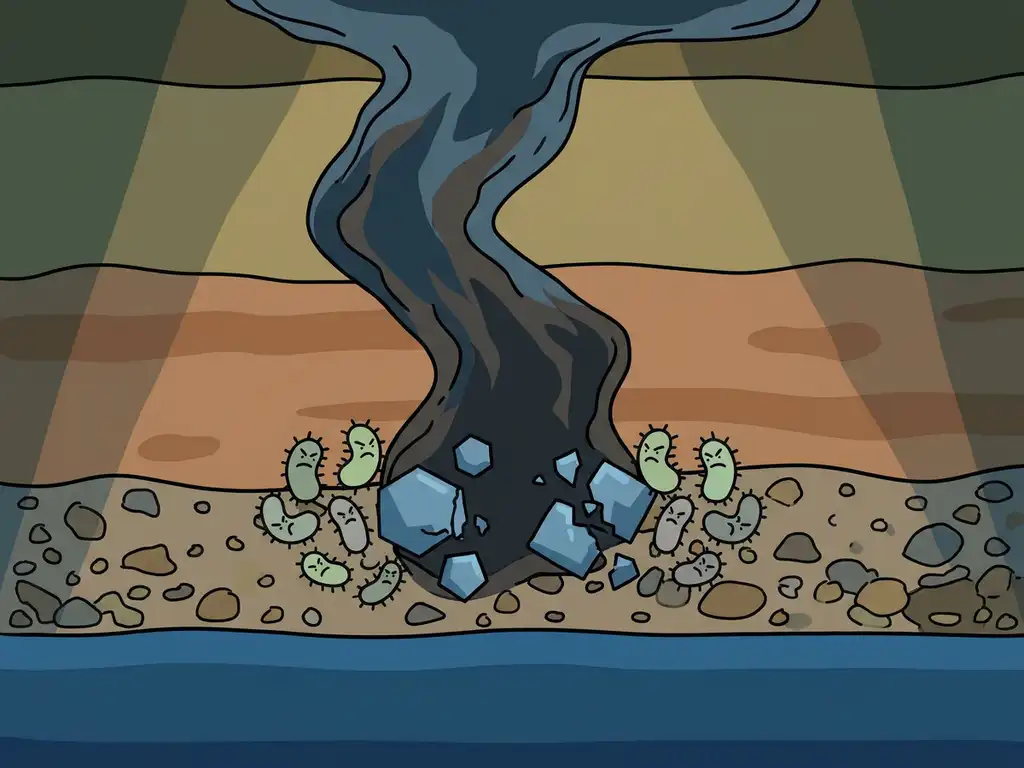
Chlorinated solvents are synthetic chemical compounds containing carbon and chlorine atoms, widely used as industrial degreasers, dry-cleaning agents, and chemical intermediates. They are hard to remove because they are chemically stable, poorly soluble in water, denser than water, and resistant to natural breakdown, allowing them to persist in soil and groundwater for decades without intervention.
Their persistence is not simply a chemical curiosity. For anyone managing a contaminated industrial site or brownfield, chlorinated solvents represent one of the most technically demanding remediation challenges in environmental practice. The sections below unpack why these compounds behave the way they do, what risks they carry, and why conventional cleanup approaches so often fall short.
How do chlorinated solvents end up in soil and groundwater?
Chlorinated solvents enter soil and groundwater primarily through industrial spills, leaking underground storage tanks, improper disposal of waste liquids, and historical land use practices that predate modern environmental regulation. Because these compounds were once treated as low-hazard waste, large volumes were routinely discharged directly onto land or into drainage systems.
Common sources include dry-cleaning facilities, metal degreasing operations, electronics manufacturing, and chemical production plants. In many cases, contamination occurred gradually over years or decades, with small but repeated releases accumulating in the subsurface. At sites where drums were buried or liquid waste was discharged into unlined pits, concentrations in the soil can be extremely high even if the surface shows no visible signs of a problem.
Because chlorinated solvents evaporate slowly at ambient temperatures, they can also migrate as vapour through soil pores, spreading the contamination footprint beyond the original release point. This vapour intrusion pathway is particularly relevant for buildings constructed on or near former industrial land, where indoor air quality can be affected even when the soil surface appears clean.
Get in Touch
Let’s Talk Microbial Solutions
Book a conversation with Stijn, our CEO, or send us your request.
| Book an Appointment | Request Information |
Why do chlorinated solvents sink deeper than other pollutants?
Chlorinated solvents sink deeper than most other organic pollutants because they are denser than water. Known as dense non-aqueous phase liquids, or DNAPLs, they do not float on the water table like petroleum products. Instead, they migrate downward through the saturated zone, pooling at the base of aquifers or in bedrock fractures far below the surface.
This downward migration is driven by gravity and is largely independent of groundwater flow direction. A spill at the surface can reach depths of tens of metres within a relatively short time, depending on soil permeability and the volume released. Once pooled at depth, the DNAPL acts as a long-term source of dissolved contamination, slowly releasing chlorinated compounds into the surrounding groundwater as it dissolves at the liquid-water interface.
The practical consequence for site managers is significant. Standard monitoring wells installed at shallow depths may detect contamination but fail to capture the true source zone. Remediation strategies that address only the dissolved plume without locating and treating the DNAPL source will see contaminant concentrations rebound after treatment ends, a pattern that has frustrated many cleanup programmes over the years.
What makes chlorinated solvents so persistent in the environment?
Chlorinated solvents are persistent because the carbon-chlorine bond is highly stable and resistant to the chemical and biological processes that break down most organic compounds in the environment. Most soil microorganisms lack the enzymatic pathways needed to attack these molecules under typical aerobic conditions, so natural attenuation is slow or absent without the right microbial community.
Several physical properties compound the problem. Low water solubility means that contamination dissolves into groundwater slowly, extending the period over which a source zone releases pollutants. High sorption to organic matter in soil means that a portion of the contamination binds tightly to soil particles and is difficult to flush or extract. Together, these properties mean that even after the original source is removed, residual contamination can continue to feed a dissolved plume for many years.
Temperature also plays a role. In the cool subsurface environments typical of Belgian and northern European sites, both chemical hydrolysis and microbial metabolism proceed more slowly than in warmer climates, further extending the effective lifetime of contamination. This is one reason why chlorinated volatile organic compounds, or VOCl, remain among the most frequently detected groundwater contaminants at former industrial sites across Flanders and the broader EU.
What are the health and regulatory risks of VOCl contamination?
VOCl contamination poses serious health risks because several chlorinated solvents and their breakdown products are classified as probable or confirmed human carcinogens. Trichloroethylene and tetrachloroethylene are among the most studied, with evidence linking long-term exposure to kidney cancer, liver damage, and neurological effects. Vinyl chloride, a degradation product that forms when reductive dechlorination stalls partway, is a confirmed human carcinogen.
Exposure routes include drinking contaminated groundwater, skin contact during remediation work, and vapour intrusion into buildings above or near contaminated sites. The last pathway is increasingly recognized as a significant public health concern, particularly for residential or mixed-use developments on former industrial land.
From a regulatory standpoint, VOCl contamination in Flanders is governed by VLAREBO and subject to oversight by OVAM. Sites that exceed intervention values are legally required to undergo remediation, and the site owner or responsible party carries the burden of demonstrating that cleanup targets have been met through monitored data. Failure to address contamination can block building permits, delay property transfers, and expose owners to ongoing liability. For project managers handling brownfield redevelopment, this regulatory framework is not a background consideration but an active constraint on every planning and financing decision.
Why do conventional remediation methods often fail for chlorinated solvents?
Conventional remediation methods such as excavation and pump-and-treat frequently fail for chlorinated solvents because they cannot effectively reach or remove contamination at depth, within DNAPL source zones, or in low-permeability soil layers. Excavation is only practical for shallow, accessible contamination, and pump-and-treat systems can manage dissolved plumes but rarely eliminate the source.
The rebound effect is a well-documented limitation of pump-and-treat for chlorinated solvents. When pumping stops, concentrations in monitoring wells often recover toward pre-treatment levels because the DNAPL source continues to dissolve slowly into groundwater. This means that pump-and-treat can become an indefinite operational commitment rather than a path to site closure.
Soil vapour extraction, another common technique, works well for volatile contaminants near the surface but loses effectiveness at depth and in saturated zones where the compounds are dissolved in groundwater rather than present as free-phase liquid or vapour. Chemical oxidation can destroy chlorinated solvents but requires thorough contact between the reagent and the contaminant, which is difficult to achieve in heterogeneous subsurface geology. At sites with complex stratigraphy, preferential flow paths mean that injected reagents bypass large portions of the contamination entirely.
The result is that many sites reach a condition sometimes called technical impracticability, where further application of conventional methods produces diminishing returns at disproportionate cost. This is the point at which biological approaches become not just an alternative but often the most scientifically and economically defensible path forward. Avecom’s biological soil remediation services are specifically designed for these difficult cases where standard methods have reached their limits.
How does biological degradation break down chlorinated solvents?
Biological degradation breaks down chlorinated solvents through a process called reductive dechlorination, in which specialized anaerobic bacteria use the chlorinated compounds as electron acceptors, progressively removing chlorine atoms from the molecule. The end products of complete dechlorination are ethene and chloride ions, both of which are non-toxic and environmentally benign.
The key organisms responsible for complete dechlorination belong to the genus Dehalococcoides, a group of strictly anaerobic bacteria that are the only known microorganisms capable of converting vinyl chloride, the most toxic intermediate, all the way to ethene. Their presence and activity in the subsurface can be quantified using molecular tools such as quantitative PCR, which detects the specific genes responsible for each dechlorination step. This level of diagnostic precision is what separates modern biological remediation from earlier, less controlled approaches.
Not every contaminated site has a native microbial community capable of complete dechlorination. Where the necessary organisms are absent or present in insufficient numbers, the process can stall at vinyl chloride, actually worsening the risk profile of the site. In these cases, bioaugmentation, the deliberate introduction of a targeted microbial consortium, can establish the required population and restart or accelerate the degradation pathway.
Before committing to a full-scale biological remediation programme, a microcosm feasibility test using actual site soil and groundwater is the most reliable way to determine whether the conditions for biological degradation can be achieved. This laboratory-scale test replicates subsurface conditions and provides direct evidence of dechlorination activity, giving project managers concrete data before a significant budget is committed to field implementation.
Avecom, based in Ghent, has built its environmental practice around exactly this type of evidence-based approach to biological soil decontamination. With over 30 years of experience in microbial process management and a specialisation in VOCl remediation, the team combines microcosm testing, in-situ bioaugmentation, and molecular monitoring to deliver remediation programmes that are both scientifically grounded and compliant with OVAM reporting requirements. For site owners and project managers dealing with chlorinated solvent contamination that has resisted conventional treatment, biological decontamination offers a technically credible and often more cost-effective alternative worth evaluating.
Related Articles
- How do you compare fermentation partners before signing a contract?
- How does organic loading rate affect sludge quality?
- How do you reduce the cost of a long-term remediation project?
- What are the most common causes of industrial soil contamination?
- How do you fix a biological wastewater system that underperforms?