

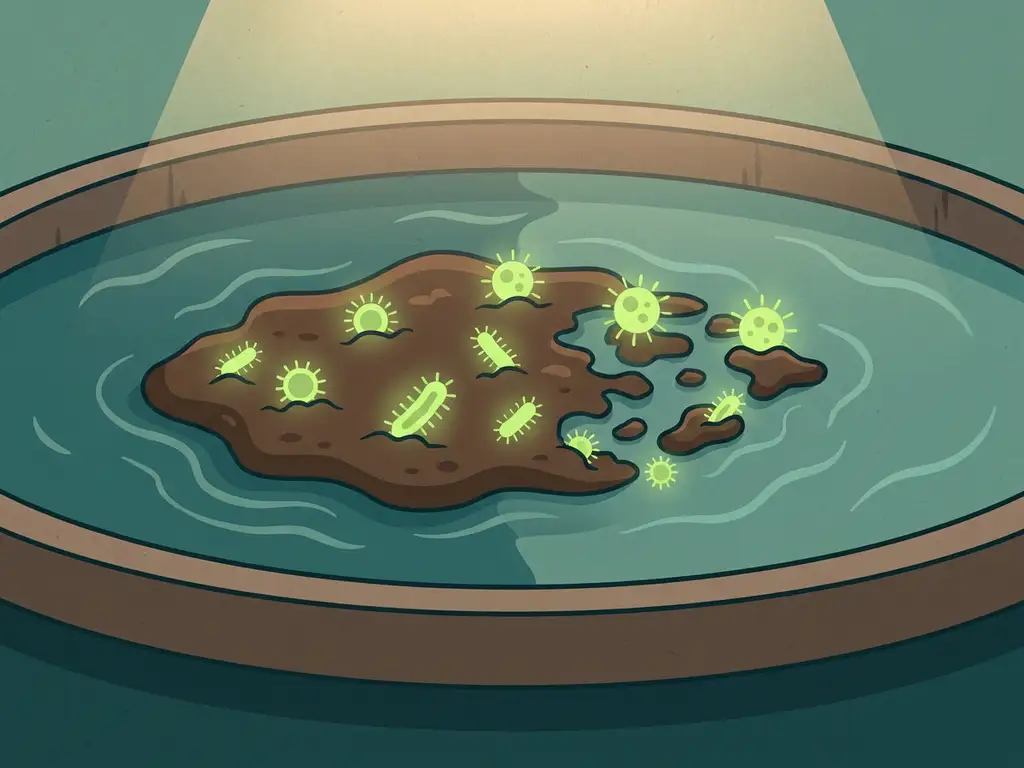
The most effective way to reduce excess sludge in a wastewater plant is to optimize the biological treatment process so that microorganisms consume more organic matter with less net biomass growth. Complementary strategies include improving sludge thickening and dewatering, adjusting operational parameters such as sludge retention time, and in some cases redirecting nutrient-rich streams toward resource recovery. The sections below address the most common questions plant operators and environmental managers face when sludge volumes start creating operational or compliance pressure.
What causes excess sludge to form in a wastewater treatment plant?
Excess sludge forms when microorganisms in the treatment system grow faster than they are removed. In a biological wastewater treatment plant, bacteria break down organic pollutants and, in doing so, multiply continuously. The resulting biomass, which is the sludge, accumulates in the system and must be periodically withdrawn to maintain stable operating conditions. When the balance between growth and removal is disrupted, sludge volumes increase rapidly.
Several operational and process factors accelerate this imbalance. High organic loading rates, particularly from food processing or seasonal production peaks, feed rapid bacterial growth. Nutrient imbalances, especially elevated nitrogen and phosphorus concentrations, can shift the microbial community toward species with high growth yields. Poor sludge settleability, sometimes called sludge bulking, prevents effective separation in the clarifier and leads to carryover and further accumulation. Temperature fluctuations, hydraulic shocks, and inconsistent feeding patterns can destabilize the microbial community and contribute to unpredictable sludge production.
Understanding which of these drivers is dominant in your specific situation is the first step toward meaningful sludge reduction. A process audit, including microbiological analysis of the active biomass, can pinpoint whether the root cause is biological, hydraulic, or linked to the incoming wastewater composition.
How much does excess sludge disposal actually cost?
Sludge disposal is consistently one of the largest cost items in industrial wastewater management, often representing between 30 and 60 percent of total treatment operating costs. The exact figure depends on sludge volume, dry matter content, and the disposal route chosen, but for most industrial plants the combination of dewatering, transport, and landfill or incineration fees adds up to a substantial recurring expense.
Beyond the direct disposal fee, there are indirect costs that are frequently underestimated. Dewatering equipment requires energy and maintenance. Polymer consumption for conditioning adds chemical costs. Labor for sludge handling, sampling, and documentation creates operational overhead. When sludge volumes increase due to process instability or stricter discharge standards, these costs scale proportionally and can trigger the need for capital investment in additional dewatering or storage capacity.
For industrial producers in the food, chemical, and pharmaceutical sectors, tightening regulations under frameworks such as the EU Water Framework Directive are placing additional pressure on how sludge is classified and disposed of. Sludge that contains certain contaminants may no longer qualify for agricultural land application, pushing it toward more expensive incineration routes. Reducing sludge production at the source is therefore not only an operational efficiency measure but an increasingly important risk management strategy.
Get in Touch
Let’s Talk Microbial Solutions
Book a conversation with Stijn, our CEO, or send us your request.
| Book an Appointment | Request Information |
What are the most effective methods to reduce sludge production?
The most effective methods for reducing excess sludge in a wastewater plant combine process optimization with targeted biological or physical interventions. No single technique works universally; the right approach depends on the wastewater composition, existing infrastructure, and the degree of sludge reduction required.
The following approaches are widely applied and have demonstrated results in industrial settings:
- Extending sludge retention time (SRT): A longer SRT allows microorganisms to undergo endogenous respiration, meaning they consume their own cellular material when external substrate is limited. This reduces net sludge yield without requiring additional equipment.
- Optimizing the microbial community: Selecting for slow-growing, high-efficiency microbial consortia reduces biomass production per unit of pollutant removed. This is particularly relevant in mixed-culture biological systems where community composition can be steered through operational parameters.
- Mechanical or thermal sludge disintegration: Pre-treating sludge with ultrasound, high-pressure homogenization, or thermal hydrolysis breaks open bacterial cells and makes the released organic material available for further biodegradation, reducing final sludge volumes.
- Anaerobic digestion of waste sludge: Routing excess sludge to an anaerobic digester converts a significant fraction of the organic content into biogas, reducing the mass requiring disposal while generating recoverable energy.
- Chemical uncouplers (used selectively): Certain compounds can disrupt the energy coupling in bacterial metabolism, reducing growth yield. This approach requires careful management and is not appropriate for all treatment systems.
In practice, the most durable reductions come from combining SRT optimization with a well-managed microbial community. Plants that invest in understanding their biology rather than simply managing the symptoms of sludge overproduction consistently achieve better long-term outcomes.
How does biological treatment reduce sludge compared to chemical treatment?
Biological treatment generally produces less net sludge than chemical treatment because microorganisms mineralize organic matter into carbon dioxide, water, and stable biomass, whereas chemical coagulation and precipitation convert dissolved pollutants into additional solid mass that must be disposed of. The sludge produced by chemical treatment is often denser and more difficult to stabilize, making it more expensive to process.
In a well-operated biological system, the active biomass itself performs the treatment work. When the microbial community is properly matched to the wastewater composition and the process is run at an appropriate SRT, a large proportion of the organic load is oxidized rather than simply transferred to a solid phase. Chemical treatment, by contrast, uses reagents such as iron salts, aluminum sulfate, or lime to precipitate pollutants out of solution. These reactions are fast and reliable for specific contaminants, particularly phosphorus, but they add chemical mass to the sludge stream rather than destroying it.
For plants currently relying heavily on chemical dosing to meet discharge standards, a shift toward or a strengthening of the biological stage can meaningfully reduce both chemical costs and sludge volumes. The transition requires careful process design and often a period of biological inoculation and stabilization, but the operational savings tend to justify the investment. biological wastewater treatment approaches that use mixed microbial cultures are particularly well-suited to complex industrial effluents where the pollutant composition varies over time.
Can excess sludge be turned into a valuable resource?
Yes, excess sludge from wastewater treatment can be converted into valuable outputs under the right conditions. The most established route is anaerobic digestion, which produces biogas for heat and power generation and a digestate that can, depending on its composition and regulatory classification, be used as a soil amendment. More advanced valorization pathways are emerging as the circular economy framework gains traction in industrial water management.
One increasingly relevant route involves recovering nutrients, particularly nitrogen and phosphorus, from nutrient-rich process streams such as reject water or sidestreams generated during sludge dewatering. Rather than treating these streams as a disposal problem, they can serve as a substrate for specialized microbial processes that concentrate and transform the nutrients into usable products.
Avecom has developed the ProMic platform specifically for this purpose, enabling nitrogen and other nutrients from reject water to be recovered as a high-quality ingredient for animal feed. This shifts the economic framing from a cost of disposal to a potential revenue stream, which strengthens the business case for investing in biological treatment upgrades. The approach is particularly relevant for food processors and other industrial producers whose wastewater contains significant organic nitrogen loads.
Sludge valorization is not universally applicable. The feasibility depends on the contaminant profile of the sludge, the scale of the operation, and the availability of downstream markets. A preliminary feasibility assessment is always the appropriate starting point before committing to a valorization pathway.
When should you call in an external expert for sludge reduction?
You should call in an external expert when internal adjustments to operational parameters have not resolved the sludge problem, when discharge standards are being exceeded despite ongoing efforts, or when the root cause of the problem is unclear. Sludge problems in wastewater treatment are frequently symptoms of deeper process imbalances that require microbiological or process engineering expertise to diagnose correctly.
Specific situations that warrant external support include:
- Persistent sludge bulking or foaming that does not respond to standard corrective actions
- Seasonal production changes causing nitrogen or phosphorus spikes that the existing system cannot handle
- A planned upgrade or expansion of the treatment plant where sludge minimization should be designed in from the start
- Increasing disposal costs that are making the current approach economically unsustainable
- Regulatory changes requiring improved treatment performance without a clear path to compliance
The value of an external expert lies not only in technical knowledge but in the ability to conduct a structured diagnosis before recommending any intervention. An audit that includes molecular monitoring of the microbial community, analysis of the incoming wastewater composition, and a review of operational data can identify the specific drivers of excess sludge in your plant, rather than applying a generic solution.
Avecom’s team of environmental and industrial engineers approaches these situations by starting with the problem, not the product. The process typically begins with lab- and pilot-scale testing to establish what is actually happening biologically in the system, followed by a concrete action plan that can include inoculation with specialized microbial consortia, process parameter adjustments, or a phased transition to a more efficient treatment configuration. For industrial operators who lack internal microbiological expertise, this kind of structured external partnership reduces both the technical risk and the operational disruption of making changes to a live treatment system.
If sludge volumes or compliance pressures are becoming unmanageable, the most practical first step is a direct conversation with a process specialist who can assess your specific situation. Avecom offers an initial intake to analyze the wastewater composition and treatment setup, and to formulate a targeted approach. You can reach the team via the water treatment services page to discuss your situation without obligation.
Related Articles
- What is the most cost-effective way to manage excess sludge in 2026?
- What is the difference between soil screening and full assessment?
- What are chlorinated solvents and why are they hard to remove?
- What causes sludge bulking in biological treatment?
- What data do regulators expect during soil remediation?