

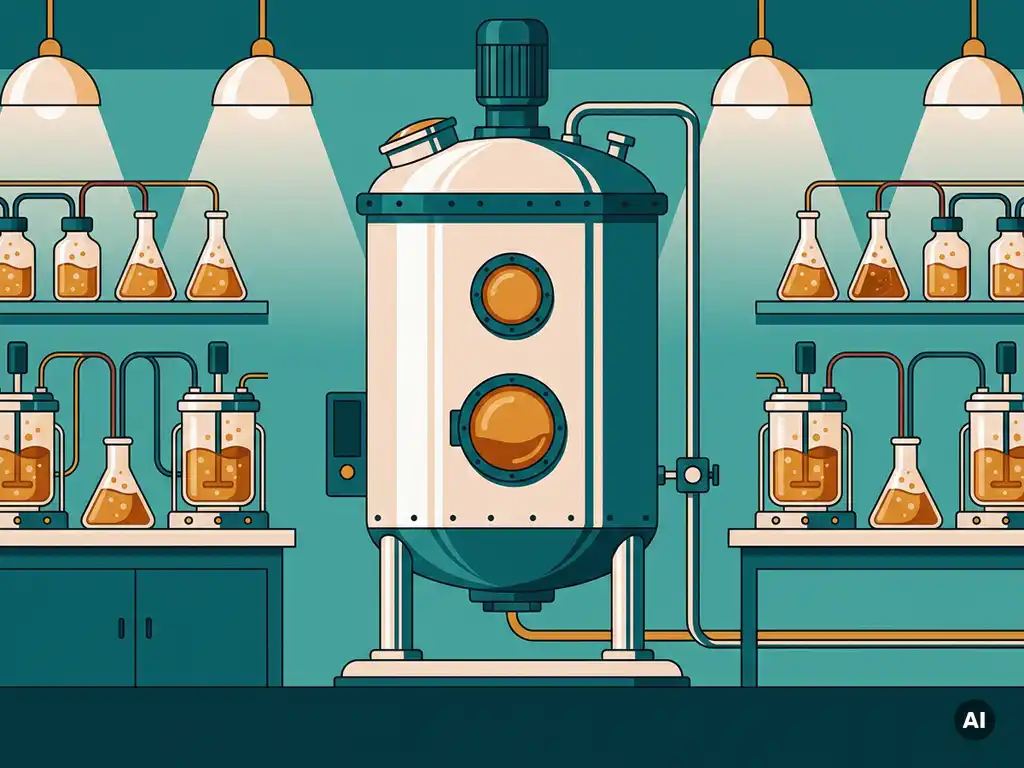
Failed scale-up in fermentation is almost always caused by process parameters that behave differently at larger volumes than they do at bench scale. The core fix is to identify and control those parameters systematically before committing to full production scale. The sections below walk through the most common failure points, the variables that matter most, and how to build a scale-up strategy that holds together under real operating conditions.
Why do fermentation processes fail when moving from lab to pilot scale?
Fermentation processes fail during scale-up primarily because physical and chemical conditions that appear stable at lab scale become uncontrollable at larger volumes. Mixing gradients, oxygen transfer rates, heat accumulation, and pH fluctuations all intensify as reactor volume increases, and microbial communities respond to those changes in ways that are difficult to predict from small-scale data alone.
At the lab scale, a 2-liter bioreactor is easy to keep homogeneous. Temperature is uniform, dissolved oxygen is consistent, and nutrients distribute evenly within seconds. Move to a 500-liter pilot vessel and none of those assumptions hold. Dead zones form. Oxygen transfer becomes the limiting factor. Local pH gradients develop near feed inlets. The microbial community that performed reliably in the lab is now operating in a fundamentally different environment, and its productivity, stability, or product yield shifts accordingly.
Another common failure mode is the assumption that the lab protocol can be transferred directly without re-optimization. Agitation speed, aeration rate, and feeding strategy all need to be recalculated for the new geometry and volume. When that recalculation does not happen, the process drifts, and teams often misinterpret the result as a biological problem when it is actually an engineering one.
What process parameters are most critical to control during scale-up?
The most critical parameters to control during fermentation scale-up are dissolved oxygen, mixing and mass transfer, temperature, pH, and nutrient feeding strategy. These variables interact with each other and with the microbial community in ways that become increasingly complex as reactor volume grows.
- Dissolved oxygen (DO): Oxygen transfer rate drops significantly as volume increases, because the surface-to-volume ratio decreases and mixing becomes less efficient. For aerobic fermentations, maintaining adequate DO is often the single most important scale-up challenge.
- Mixing and mass transfer: Larger vessels create longer mixing times, which means nutrients, oxygen, and metabolic products are not distributed uniformly. This directly affects microbial activity and product formation.
- Temperature: Heat generated by microbial metabolism accumulates in large reactors. Cooling capacity must be engineered for the pilot scale, not assumed to be proportional to the lab setup.
- pH: Metabolic activity produces acids and bases continuously. At scale, the lag between pH deviation and corrective dosing can be significant enough to stress the culture.
- Nutrient feeding: Batch feeding strategies that work at lab scale often create substrate gradients at pilot scale, leading to local over- or underfeeding that affects yield and culture stability.
Understanding how each of these parameters behaves at the target scale before committing to a full run is what separates successful scale-up from costly failure. This requires systematic pilot-scale experimentation, not extrapolation from lab data.
Get in Touch
Let’s Talk Microbial Solutions
Book a conversation with Stijn, our CEO, or send us your request.
| Book an Appointment | Request Information |
How do mixed microbial cultures behave differently than pure cultures during scale-up?
Mixed microbial cultures are generally more robust during fermentation scale-up than pure cultures because their diversity provides functional redundancy. If one population is stressed by a shift in conditions, other community members can compensate. Pure cultures, by contrast, have no such buffer and are more sensitive to the environmental gradients that emerge at larger scales.
This does not mean mixed cultures are easier to manage. Their complexity introduces a different set of challenges. Community composition can shift in response to changes in substrate availability, oxygen gradients, or temperature, and those shifts are not always visible without molecular monitoring tools such as amplicon sequencing or qPCR. A community that looks stable by conventional metrics may have undergone a significant functional change at the population level.
The practical implication is that scale-up with mixed cultures requires a monitoring strategy that goes beyond standard process analytics. Tracking community structure alongside process performance gives early warning of compositional drift before it becomes a productivity problem. This is an area where microbial fermentation expertise and high-throughput molecular tools make a measurable difference in scale-up outcomes.
Pure cultures, particularly genetically modified strains, offer more predictable behavior in controlled environments but are often more fragile under the real-world variability of pilot and production scale. For many industrial applications, a well-managed mixed culture is not a compromise but a deliberate engineering choice that delivers greater process stability.
What is the role of pilot-scale testing in de-risking fermentation development?
Pilot-scale testing de-risks fermentation development by revealing how a process actually behaves under near-production conditions before significant capital is committed. It is the stage where theoretical process models meet physical reality, and where most of the critical adjustments to aeration, feeding, and control strategy need to be made.
A well-designed pilot campaign does more than confirm that a process works. It generates the process understanding needed to define operating windows, identify failure modes, and establish control strategies that will hold at production scale. This data is also what investors, regulatory bodies, and industrial partners typically require before committing to further development or licensing.
Skipping or shortcutting pilot-scale validation is one of the most common and expensive mistakes in fermentation development. Teams that move directly from lab to production often discover at the worst possible moment that their process does not transfer. The cost of a failed production run, including lost material, downtime, and reputational damage, almost always exceeds the cost of thorough pilot-scale work.
For companies without their own pilot infrastructure, this is where access to an external facility with the right equipment and process expertise becomes a practical necessity rather than a convenience.
When should a company use a contract R&D partner for fermentation scale-up?
A company should use a contract R&D partner for fermentation scale-up when it lacks the infrastructure, specialized expertise, or time to conduct pilot-scale work internally. This applies to most biotech scale-ups and industrial companies that have strong product concepts but no dedicated fermentation facilities or microbiome monitoring capabilities.
The decision is often driven by one or more of the following situations:
- The internal lab can run small-scale experiments but has no pilot reactors capable of validating the process at meaningful volume.
- The team has fermentation knowledge but not the specific expertise needed for the microbial system in question, such as anaerobic consortia, thermophilic fermentation, or complex mixed cultures.
- There is a defined timeline, typically a proof-of-concept milestone for investors or a regulatory submission, that cannot be met by building internal capacity from scratch.
- The company wants to protect capital by avoiding infrastructure investment before the process is validated.
Contract R&D partnerships are also valuable when a company needs scientific documentation for subsidy applications, patent filings, or investor due diligence. A partner with a published research track record and an academic network can strengthen the credibility of those dossiers in ways that internal work alone cannot.
How do you choose the right fermentation partner for scale-up and contract manufacturing?
The right fermentation partner for scale-up and contract manufacturing is one that combines the physical infrastructure you need with genuine process expertise in your specific microbial system. Equipment alone is not sufficient. The partner’s team needs to understand the biology well enough to troubleshoot when the process behaves unexpectedly, which it will.
Evaluate a potential partner against these criteria:
- Relevant infrastructure: Do they have reactors at the scale you need, with the right configuration for your process (aerobic or anaerobic, batch or continuous, mesophilic or thermophilic)?
- Microbial expertise: Can they work with your specific organism or community type? Partners experienced only with standard pure-culture systems may struggle with complex mixed cultures or novel substrates.
- Analytical capability: Do they have the tools to monitor your process at the level of detail you need, including molecular techniques if microbial community dynamics are relevant?
- Track record: Have they successfully taken similar processes from lab to pilot or pilot to production? Ask for documented examples, not just references to general capability.
- IP and confidentiality practices: Understand how they handle proprietary process information, data ownership, and publication rights before signing anything.
- Scientific credibility: A partner with a published research history and institutional connections can add independent credibility to your process documentation, which matters for patents and funding applications.
Avecom, a spin-out of Ghent University with over 30 years of experience in microbial process development, operates aerobic and anaerobic fermenters up to 2,000 liters and holds Feed Chain Alliance certification for small-scale commercial production. For companies working with mixed microbial cultures in particular, that combination of scientific depth and practical scale-up infrastructure is difficult to find in a single partner. You can learn more about the team and approach on the Avecom about page.
Ultimately, the best partner is one that functions as an extension of your R&D team rather than a service provider executing a fixed scope. That distinction becomes critical when the process does not behave as expected and real-time scientific judgment is needed to keep development on track.
Related Articles
- What is the difference between pure culture and mixed culture fermentation?
- How do microorganisms break down soil contaminants?
- How does temperature affect sludge behavior in biological treatment?
- Can contaminated groundwater be treated at the same time as soil?
- Why is biological wastewater treatment so hard to manage?