

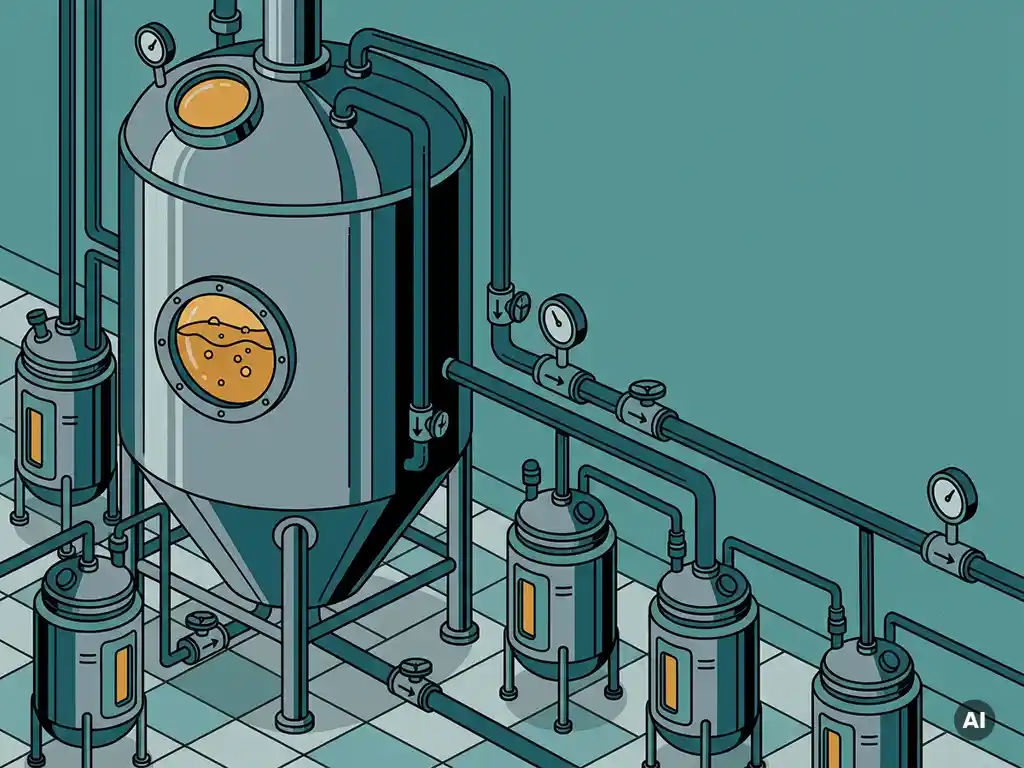
The most critical process parameters to control in fermentation scale-up are dissolved oxygen, pH, temperature, mixing and mass transfer, and nutrient feeding strategy. These parameters interact with each other and with the microbial community in ways that become increasingly difficult to manage as reactor volume increases. Understanding how each one behaves at larger scales, and why, is what separates a successful scale-up from a failed one. The sections below address the most common questions engineers face when moving a fermentation process from lab bench to pilot plant.
Why do fermentation processes fail when scaled up?
Fermentation processes most commonly fail during scale-up because physical conditions that were easy to maintain at small volumes become difficult or impossible to replicate at larger ones. A process that performs well in a 2-liter flask does not automatically translate to a 200-liter bioreactor. The underlying biology has not changed, but the engineering environment has, and microorganisms respond to that environment, not to the researcher’s intentions.
The core problem is that lab-scale systems are forgiving. Small volumes heat and cool quickly, oxygen dissolves easily, and pH adjustments distribute almost instantly. At pilot scale, these same corrections happen more slowly, creating gradients, zones within the reactor where conditions differ significantly from the bulk average. Microbial communities, particularly mixed cultures, are sensitive to these gradients. A region of low dissolved oxygen, a pocket of high acid concentration near a dosing port, or a stagnant zone with poor nutrient access can all shift the microbial population in ways that reduce yield, alter the product profile, or cause process instability.
A second common failure mode is that the process was never fully characterized at lab scale to begin with. When scale-up begins without a clear understanding of which parameters are truly controlling performance, engineers are essentially guessing what to replicate. That uncertainty compounds at every subsequent scale step.
What are the most critical process parameters to control in fermentation scale-up?
The most critical process parameters in fermentation scale-up are dissolved oxygen (DO), pH, temperature, agitation and mixing, and substrate or nutrient feeding. These five parameters govern the physiological state of the microorganisms and determine whether the desired metabolic pathway remains dominant as volume increases. Losing control of any one of them typically affects the others.
- Dissolved oxygen (DO): Controls aerobic metabolic activity and directly affects yield and product formation rates. Maintaining adequate DO becomes mechanically more demanding at larger volumes.
- pH: Affects enzyme activity, membrane integrity, and metabolic pathway selection. Buffering capacity changes with volume, and acid or base additions can create local concentration spikes.
- Temperature: Governs reaction kinetics and microbial growth rates. Heat generated by microbial metabolism increases with culture volume, requiring active cooling that lab-scale systems rarely need.
- Agitation and mixing: Determines how uniformly oxygen, nutrients, and pH-adjusting agents are distributed throughout the reactor. Poor mixing is the root cause of many other parameter failures.
- Substrate and nutrient feeding: Controls carbon and nitrogen availability, which shapes growth rate and product yield. Feeding strategies that work in batch mode at small scale often need to be redesigned as fed-batch or continuous processes at larger volumes.
For processes involving mixed microbial cultures, which tend to be more robust in industrial environments than pure strains, the interactions between these parameters are especially important to characterize. The composition of the microbial community can shift in response to subtle changes in any of these conditions, sometimes in ways that are not immediately visible in standard performance metrics.
Get in Touch
Let’s Talk Microbial Solutions
Book a conversation with Stijn, our CEO, or send us your request.
| Book an Appointment | Request Information |
How does dissolved oxygen control change at larger bioreactor volumes?
Dissolved oxygen control becomes significantly more challenging at larger bioreactor volumes because the ratio of gas-liquid interfacial area to liquid volume decreases as the reactor grows. In a small flask, oxygen from the headspace reaches the culture easily. In a large bioreactor, oxygen must be actively sparged and mechanically dispersed throughout a much greater liquid mass, and the time it takes for oxygen to transfer from a bubble to the microbial cell increases substantially.
The key engineering parameter here is the volumetric oxygen transfer coefficient, commonly written as kLa. This value quantifies how efficiently oxygen moves from the gas phase into the liquid. At lab scale, kLa values are relatively easy to achieve and maintain. At pilot scale, achieving the same kLa requires higher agitation speeds, increased aeration rates, or both, and these interventions introduce new problems. Higher agitation increases shear stress on microbial cells. Higher aeration can strip volatile metabolites or cause excessive foaming.
Practically, this means that the aeration and agitation strategy developed at lab scale almost never transfers directly. Engineers need to measure kLa at each scale and design an agitation and sparging configuration that achieves the target oxygen transfer rate without causing mechanical damage to the culture or destabilizing other parameters. For aerobic processes, this is often the single most consequential engineering challenge in scale-up.
What causes pH drift during scale-up and how is it managed?
pH drift during fermentation scale-up is caused by the accumulation of acidic or alkaline metabolic byproducts faster than the control system can neutralize them, combined with the reduced buffering capacity per unit volume that larger reactors often exhibit. At lab scale, the small volume and high surface-to-volume ratio make pH corrections fast and uniform. At larger scales, both the correction speed and the distribution of the corrective agent become limiting factors.
Microbial metabolism continuously produces acids and bases as byproducts, organic acids, carbon dioxide, and ammonia are common examples. In a well-mixed small reactor, a pH controller can add base or acid and achieve a uniform correction within seconds. In a large bioreactor, the same correction may create a localized zone of high or low pH near the dosing point before it disperses. If that zone is near a sensitive microbial population, it can cause stress or metabolic shifts even when the bulk pH reading appears stable.
Managing pH drift at scale involves several strategies. First, the placement of pH probes and dosing ports matters, probes should not be positioned directly adjacent to dosing inlets, or they will read local rather than bulk conditions. Second, the choice of buffer system and the concentration of the corrective agent affect how quickly and uniformly pH adjusts. Third, feeding strategies can be redesigned to reduce the metabolic acid load, for example, controlling the carbon source feed rate to limit overflow metabolism that generates unwanted acids.
When should mixing and mass transfer be characterized before scaling up?
Mixing and mass transfer should be characterized at lab scale before any scale-up attempt begins, not after problems emerge at the larger scale. Waiting until a pilot run fails to investigate mixing behavior wastes time and resources. Characterizing these properties early gives engineers the data they need to design a scale-up strategy rather than troubleshoot one.
At minimum, two measurements should be made at lab scale: the mixing time (how long it takes for a tracer to distribute uniformly throughout the reactor) and the kLa (the oxygen transfer coefficient described above). These two values together reveal how well the reactor distributes both dissolved gases and soluble nutrients. If mixing time is long relative to the microbial consumption rate of oxygen or substrate, gradients will form, and those gradients will be worse at larger scale, not better.
Characterizing mass transfer early also informs the choice of scale-up strategy. There are several approaches, maintaining constant power input per unit volume, constant tip speed, constant kLa, and none of them is universally correct. The right approach depends on which parameter is most limiting for the specific microbial process. Without mass transfer data from the lab scale, that choice becomes a guess. With it, engineers can make a reasoned decision and anticipate where the next scale step will create new constraints.
Avecom’s fermentation R&D services include this kind of early-stage process characterization, which is often the difference between a scale-up that proceeds predictably and one that requires repeated troubleshooting cycles at pilot scale.
Which parameters require re-optimization at each scale step?
In fermentation scale-up, agitation speed, aeration rate, pH dosing strategy, and feeding profiles all require re-optimization at each scale step. These parameters are geometry-dependent and equipment-dependent, meaning that the values that work in one reactor will not automatically transfer to a reactor of different size or design, even if the target conditions appear identical on paper.
Temperature control is often the parameter that surprises engineers most at scale. At lab scale, temperature is typically maintained passively or with minimal active control. At pilot scale, metabolic heat generation from a large biomass can be substantial, requiring active cooling that introduces its own engineering constraints, response time, spatial uniformity, and interaction with mixing patterns.
Feeding and substrate delivery strategies frequently need the most significant redesign. A batch process that works at 10 liters may need to become a fed-batch process at 200 liters to avoid substrate inhibition or oxygen depletion. The timing, concentration, and delivery rate of substrate additions all interact with DO, pH, and biomass growth rate in ways that must be re-evaluated at each new volume.
The practical implication is that scale-up is not a single step but a series of iterative optimization cycles. Each scale step, from lab to bench pilot, from bench pilot to full pilot, requires its own experimental phase to establish the correct operating window. Skipping a scale step to save time typically results in more time lost to troubleshooting at the final scale. Working with a partner that has established infrastructure across multiple scales, such as aerobic and anaerobic bioreactors from lab to 2,000 liters, allows these optimization cycles to happen systematically without the cost of building that infrastructure internally.