

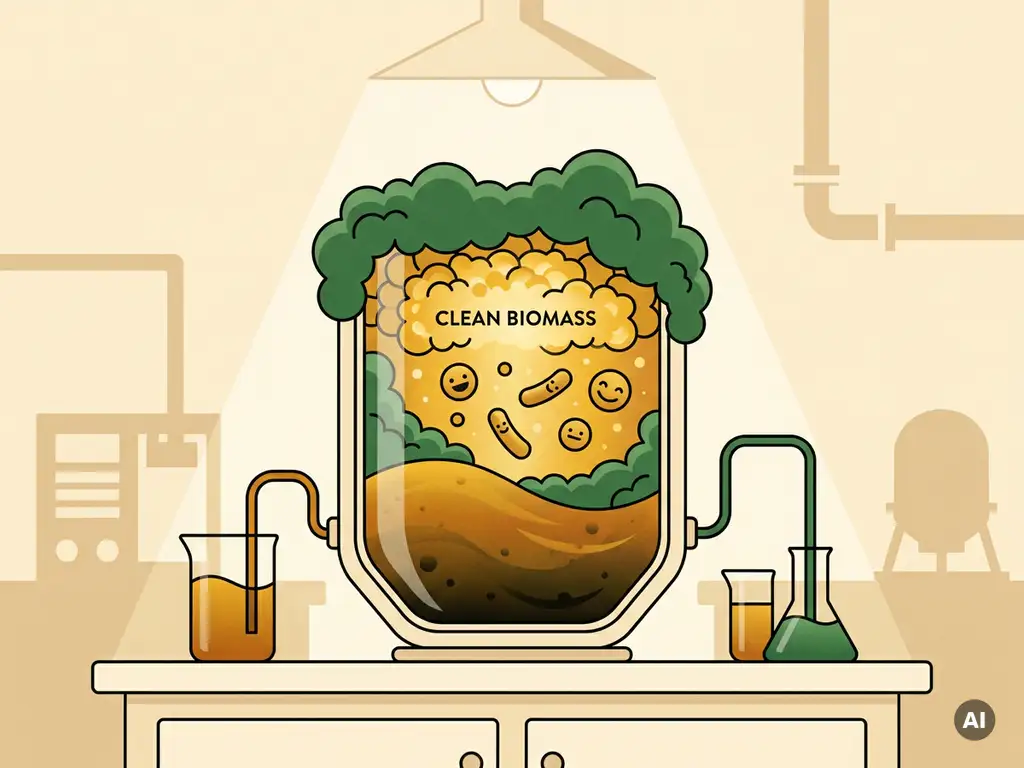
Food processing waste streams can be turned into valuable products primarily through microbial fermentation, which converts nutrient-rich effluents into biomass, proteins, and other biobased materials. The key is matching the right microbial process to the chemical composition of the waste stream. This article walks through the main questions companies face when evaluating side-stream valorisation as a viable strategy.
What types of food processing waste streams can be valorised?
Most liquid and semi-liquid food processing waste streams can be valorised if they contain sufficient carbon, nitrogen, or phosphorus to support microbial growth. Common candidates include dairy whey, starch processing water, brewery effluents, vegetable washing water, and slaughterhouse wastewater. The valorisation potential depends on the organic load, consistency of the stream, and absence of inhibitory compounds.
In practice, the most tractable streams share a few characteristics: they are generated in relatively stable volumes, they have a predictable nutrient profile, and they are available at a single collection point. Dairy side streams, for example, are rich in lactose and proteins that microorganisms can readily metabolize. Brewery spent yeast and grain processing water carry significant nitrogen loads that make them well suited for protein recovery applications.
Streams that are more challenging include those with high salt concentrations, fluctuating pH, or the presence of cleaning agents and disinfectants from CIP cycles. These do not disqualify a stream from valorisation, but they require more careful process design and often a pretreatment step before fermentation can begin.
How does microbial fermentation convert wastewater into protein?
Microbial fermentation converts food processing wastewater into protein by feeding dissolved organic compounds to microorganisms, which assimilate carbon and nitrogen into their own cellular biomass. The resulting microbial biomass is then harvested and dried to produce what is commonly called single-cell protein (SCP). The conversion is driven by controlled conditions: aeration, pH, temperature, and retention time.
The process works because microorganisms are highly efficient at incorporating dissolved organics into cellular structures. Under aerobic conditions, bacteria and yeasts consume sugars, organic acids, and nitrogen compounds, converting them into protein-rich biomass at conversion efficiencies that far exceed those of conventional animal protein production. The protein content of the harvested biomass typically ranges between 40 and 70 percent on a dry-weight basis, depending on the microbial species and growth conditions.
What makes this approach particularly relevant for food industry side streams is that the wastewater itself serves as the growth medium, eliminating the need for expensive synthetic feedstocks. The fermentation process simultaneously reduces the organic load of the effluent, which lowers downstream wastewater treatment costs. This dual function, producing value while reducing pollution load, is what makes the economics of microbial biomass fermentation increasingly attractive for food processors.
Mixed microbial cultures, rather than single genetically modified strains, are often more robust in this context. Natural consortia can adapt to fluctuations in feedstock composition, making them better suited to the variability inherent in industrial waste streams.
Get in Touch
Let’s Talk Microbial Solutions
Book a conversation with Stijn, our CEO, or send us your request.
| Book an Appointment | Request Information |
What products can be recovered from food processing side streams?
Beyond microbial protein, food processing side streams can yield a range of recoverable products depending on the fermentation strategy applied. The most commercially relevant include single-cell protein for animal feed, biopolymers, organic acids, enzymes, and biogas through anaerobic digestion. The choice of target product determines which microbial process is most appropriate.
Single-cell protein is currently the most mature application for nutrient-rich liquid streams. It is used in aquaculture feed, poultry nutrition, and increasingly in pet food formulations. Biogas production through anaerobic digestion is the most established route for high-volume, lower-value streams, converting organic matter into renewable energy while generating digestate that can be applied as a soil amendment.
More specialized fermentation processes can produce biosurfactants, short-chain fatty acids, or specific enzymes from targeted waste streams. These higher-value products require more controlled fermentation conditions and often a more homogeneous feedstock, but they can significantly improve the economics of valorisation for companies with consistent, well-characterized side streams.
What regulations apply to microbial protein from food waste streams?
Microbial protein produced from food processing waste streams is subject to feed and food safety regulations that vary by intended application and geography. In the European Union, products destined for animal feed must comply with Regulation (EC) No 767/2009 on feed materials and, where novel, require authorization under the novel food or novel feed framework. The regulatory pathway depends on the feedstock, the microbial species used, and whether the product is intended for food or feed.
For feed applications, the Feed Chain Alliance (FCA) certification is a relevant quality assurance framework that demonstrates adherence to feed safety standards throughout the production process. Producers must document the microbial species present in the final product, demonstrate the absence of pathogens, and show that the production process is consistently controlled.
The regulatory environment for microbial protein is evolving. European authorities have been progressively expanding the list of authorized substrates and microbial species for feed use, reflecting growing policy interest in circular bioeconomy solutions. Companies developing new valorisation processes should engage with regulators early, as the authorization process can take several years and requires robust safety data generated under controlled, documented conditions.
How do you validate a waste stream valorisation process before scaling up?
Validating a waste stream valorisation process before scaling up requires a structured progression from lab-scale feasibility testing to pilot-scale confirmation. The core objective is to demonstrate that the target microbial conversion is achievable with the actual waste stream, that process parameters can be controlled reproducibly, and that the product meets quality specifications before committing to larger infrastructure.
Lab-scale feasibility testing
The first phase uses small bioreactors, typically one to ten liters, to establish whether the waste stream can support the intended microbial growth. This phase characterizes the feedstock, identifies inhibitory compounds, and determines the basic process parameters: pH range, temperature, aeration rate, and hydraulic retention time. It also provides early data on biomass yield and product quality, which informs the business case before any significant capital is committed.
Pilot-scale validation and process optimization
Once lab results are promising, pilot-scale testing in reactors of fifty to several hundred liters confirms that the process behaves predictably at larger volumes. This is the stage where scale-up challenges typically emerge: mixing dynamics change, heat management becomes more complex, and the variability of real industrial waste streams becomes more apparent. Pilot testing also generates the process data needed for regulatory submissions and investor documentation. Microbiome monitoring tools such as amplicon sequencing are particularly useful here to track microbial community stability across different batches and feedstock conditions.
Companies that lack in-house fermentation infrastructure often conduct this validation work with a specialized contract research partner rather than building their own pilot facilities. This approach compresses the timeline significantly and avoids capital expenditure before the process is proven.
When does contract fermentation make sense for side-stream valorisation?
Contract fermentation makes sense for side-stream valorisation when a company has identified a promising waste stream but lacks the bioreactor infrastructure, microbial expertise, or analytical capacity to develop and validate the process internally. It is particularly well suited to companies facing time pressure to demonstrate proof of concept, or those that want to de-risk the development phase before committing to capital investment in their own facilities.
The decision typically comes down to three factors. First, internal capability: most food processors have strong knowledge of their own production processes but limited experience with microbial fermentation at pilot scale. Second, timeline: building and commissioning in-house fermentation infrastructure takes years, while a contract partner with existing reactors can begin feasibility work within weeks. Third, IP and confidentiality: a well-structured contract research agreement protects the client’s process data and any resulting intellectual property, making the arrangement viable even for proprietary applications.
Avecom works with industrial companies and biotech scale-ups as an external fermentation expertise center, running feasibility tests, pilot-scale validations, and small-scale contract production using aerobic and anaerobic bioreactors up to 2,000 liters. The team’s background in mixed microbial cultures is particularly relevant for waste stream applications, where feedstock variability makes robust, adaptable consortia more practical than pure-culture systems. For companies that need scientific documentation to support subsidy applications or investor conversations, the combination of pilot data and molecular microbiome analysis provides a credible technical foundation.
In short, contract fermentation is the faster, lower-risk path to a validated valorisation process for any organization that does not already have fermentation as a core competency.
Get in Touch
Let’s Talk Microbial Solutions
Book a conversation with Stijn, our CEO, or send us your request.
| Book an Appointment | Request Information |
Related Articles
- What should you do when your wastewater plant fails a compliance check?
- How deep can soil contamination reach?
- How do you use molecular monitoring to diagnose sludge problems?
- What happens if excess sludge is not removed from a wastewater plant?
- What are the main causes of sludge problems in wastewater treatment?