

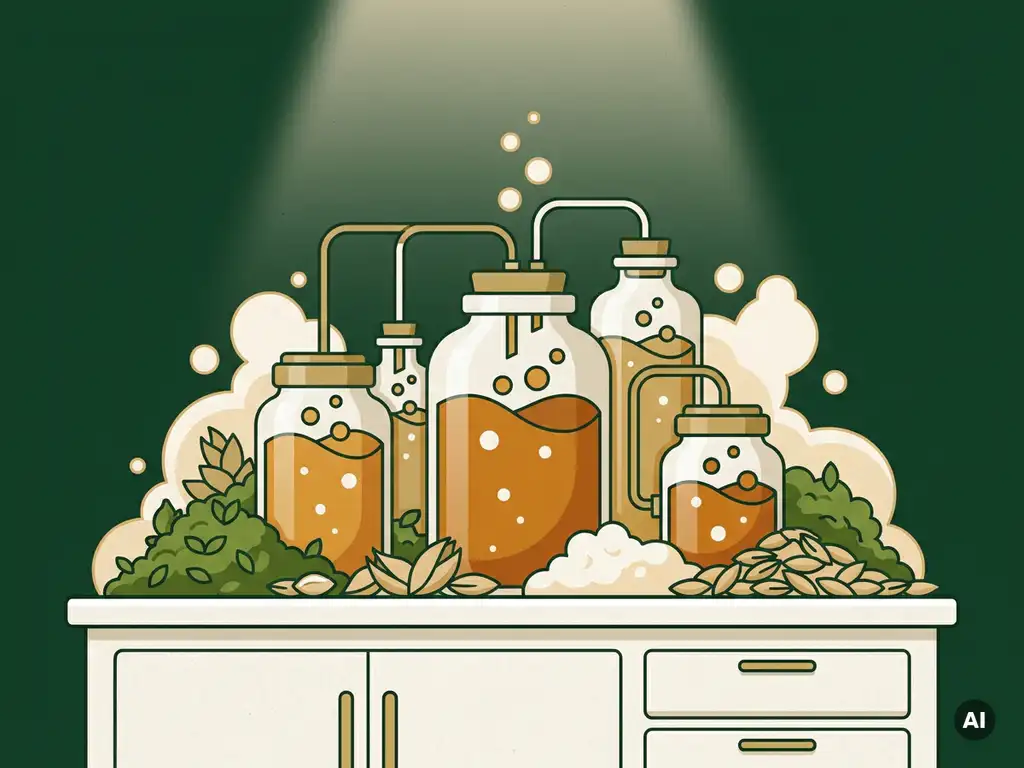
Fermentation supports sustainable ingredient manufacturing by replacing energy-intensive chemical synthesis with microbial processes that convert organic feedstocks into high-value compounds under mild conditions. The result is a lower carbon footprint, reduced reliance on petrochemical inputs, and the ability to valorize waste streams as raw materials. The sections below address the most common questions manufacturers ask when evaluating fermentation as a production route.
What types of ingredients can be produced through fermentation?
Fermentation can produce a wide range of bio-based ingredients, including amino acids, organic acids, enzymes, vitamins, antimicrobial peptides, single-cell proteins, biosurfactants, and specialty lipids. Microbial metabolism is remarkably versatile: depending on the organism and process conditions, the same fermentation platform can be tuned to favor different biosynthetic pathways and end products.
In food and feed applications, fermentation-derived ingredients include protein concentrates grown on organic side streams, fermented flavor compounds, and prebiotic oligosaccharides. In industrial biotechnology, the scope extends to bio-based monomers for polymers, pigments, and biocatalysts used in downstream chemical processes. The common thread is that a microbial culture acts as a living factory, assembling complex molecules from simple carbon and nitrogen sources with a selectivity that chemical synthesis often cannot match economically.
Mixed microbial cultures, as opposed to single genetically modified strains, are particularly relevant for applications where robustness and cost matter more than the absolute purity of a single compound. Microbial biomass fermentation is one area where this approach has proven commercially viable, producing protein-rich biomass from food processing water and agricultural residues.
How does fermentation reduce environmental impact compared to chemical synthesis?
Fermentation reduces environmental impact primarily by operating at ambient temperature and pressure, using renewable carbon feedstocks, and generating fewer toxic byproducts than conventional chemical synthesis routes. Where chemical synthesis often requires high-energy catalytic steps and petroleum-derived precursors, microbial processes run on sugars, organic acids, or even waste streams, with water as the primary solvent.
The environmental advantages compound across the value chain. Feedstock sourcing shifts from fossil-based raw materials to agricultural co-products or processing effluents, reducing upstream emissions. Downstream, the milder reaction conditions mean lower energy consumption per kilogram of product. Wastewater from fermentation processes is generally more biodegradable than chemical effluent, which simplifies treatment.
There are genuine trade-offs to acknowledge. Fermentation processes consume water, require aeration energy in aerobic systems, and generate biomass that must be managed. These factors need to be weighed against the baseline of the chemical route being replaced. Life cycle assessment comparing both options is increasingly standard practice before committing to a fermentation-based manufacturing strategy.
{div style=”box-sizing: border-box !important; margin: 32px 0 !important; padding: 28px 32px !important; background-color: #004070 !important; background-image: linear-gradient(135deg, #004070 0%, #003057 100%) !important; border: none !important; border-left: 4px solid #36a9e1 !important; font-family: ‘Exo’, sans-serif !important; text-align: center !important; line-height: normal !important;”}
{p style=”margin: 0 0 6px 0 !important; padding: 0 !important; font-family: ‘Exo’, sans-serif !important; font-size: 12px !important; font-weight: 500 !important; color: #36a9e1 !important; text-transform: uppercase !important; letter-spacing: 1.5px !important; line-height: 16px !important;”}Get in Touch{/p}
{p style=”margin: 0 0 8px 0 !important; padding: 0 !important; font-family: ‘Exo’, sans-serif !important; font-size: 20px !important; font-weight: 500 !important; color: #ffffff !important; line-height: 26px !important;”}Let’s Talk Microbial Solutions{/p}
{p style=”margin: 0 0 20px 0 !important; padding: 0 !important; font-family: ‘Exo’, sans-serif !important; font-size: 14px !important; font-weight: 300 !important; color: #ffffff !important; line-height: 20px !important;”}Book a conversation with Stijn, our CEO, or send us your request.{/p}
{table style=”border-collapse: collapse !important; border-spacing: 0 !important; margin: 0 auto !important; padding: 0 !important; width: auto !important;” cellpadding=”0″ cellspacing=”0″ role=”presentation”}
{tr style=”margin: 0 !important; padding: 0 !important;”}
{td style=”margin: 0 !important; padding: 0 6px 0 0 !important; white-space: nowrap !important;”}
{a href=”https://avecom.be/contact-2/” style=”display: inline-block !important; box-sizing: border-box !important; margin: 0 !important; padding: 11px 24px !important; background-color: #95c11f !important; color: #ffffff !important; font-family: ‘Exo’, sans-serif !important; font-size: 14px !important; font-weight: 500 !important; text-transform: uppercase !important; text-decoration: none !important; border: none !important; line-height: 18px !important; letter-spacing: 0.3px !important; white-space: nowrap !important;”}Book an Appointment{/a}
{/td}
{td style=”margin: 0 !important; padding: 0 !important; white-space: nowrap !important;”}
{a href=”https://avecom.callista.be/contactus” style=”display: inline-block !important; box-sizing: border-box !important; margin: 0 !important; padding: 9px 24px !important; background-color: transparent !important; color: #ffffff !important; font-family: ‘Exo’, sans-serif !important; font-size: 14px !important; font-weight: 500 !important; text-transform: uppercase !important; text-decoration: none !important; border: 2px solid #ffffff !important; line-height: 18px !important; letter-spacing: 0.3px !important; white-space: nowrap !important;”}Request Information{/a}
{/td}
{/tr}
{/table}
{/div}
What feedstocks can fermentation processes use?
Fermentation processes can use a broad range of feedstocks, including refined sugars, starch hydrolysates, molasses, lignocellulosic hydrolysates, food processing effluents, and nitrogen-rich side streams from agriculture or the food industry. The choice of feedstock is one of the most important levers for both process economics and environmental performance.
Refined sugars offer predictable composition and are well-suited for processes that require tight control over microbial metabolism. However, they carry a higher cost and compete with food supply chains. Industrial fermentation increasingly favors second-generation feedstocks: hydrolyzed agricultural residues, brewery spent grain, cheese whey, and slaughterhouse effluents are all actively researched as low-cost carbon and nitrogen sources.
The feasibility of any given feedstock depends on its composition, variability, and the tolerance of the microbial community being used. Mixed cultures are often more adaptable to variable or complex feedstocks than pure strains, which is one reason they are preferred in processes designed around waste stream valorization. Matching feedstock characteristics to microbial system capabilities is a core part of early-stage fermentation process development.
How does scaling fermentation from lab to pilot affect process outcomes?
Scaling fermentation from lab to pilot scale consistently introduces changes in process outcomes because physical parameters such as oxygen transfer rate, mixing homogeneity, heat dissipation, and CO2 accumulation behave differently at larger volumes. A process that performs well in a 2-liter bench-top reactor often requires significant parameter adjustment at 200 liters or beyond.
The most common challenge is maintaining adequate dissolved oxygen in aerobic fermentations. Oxygen transfer efficiency depends on impeller geometry, aeration rate, and vessel aspect ratio, all of which change nonlinearly with scale. Similarly, pH gradients and temperature uniformity become harder to control in larger vessels, which can shift microbial community composition or metabolic product ratios in ways that are difficult to predict from lab data alone.
Successful scale-up requires systematic characterization of the process at each scale rather than simple volume multiplication. This means measuring and modeling mass transfer coefficients, testing the robustness of the microbial system to realistic fluctuations, and validating that product quality and yield remain within acceptable bounds. Skipping this intermediate validation step is one of the most common reasons fermentation-based product development stalls before reaching commercial production.
When should a manufacturer use contract fermentation instead of building in-house capacity?
A manufacturer should consider fermentation contract manufacturing when the volume required does not justify the capital expenditure of a dedicated facility, when the process is still in development and specifications may change, or when time to market is a higher priority than long-term infrastructure ownership. Contract fermentation is also the practical choice when specialized equipment or microbial expertise is needed that the internal team does not have.
Building in-house fermentation capacity is a significant investment. Beyond the bioreactor hardware, it requires qualified personnel for operation and quality management, analytical infrastructure for process monitoring, and regulatory compliance systems for any ingredient intended for food, feed, or pharmaceutical use. For companies at proof-of-concept or early pilot stage, these costs are difficult to justify before the process is fully validated.
Contract partners with established fermentation infrastructure can compress development timelines considerably. Access to aerobic and anaerobic reactors across multiple scales, combined with in-house analytical tools such as amplicon sequencing for microbiome monitoring, allows faster iteration than most internal R&D environments can achieve. Avecom operates as this type of external fermentation expertise center, supporting clients from lab-scale feasibility through pilot validation and into small-scale production.
What quality and safety standards apply to fermentation-derived ingredients?
Fermentation-derived ingredients are subject to quality and safety standards that vary by application sector. For food and feed ingredients, producers must comply with relevant food safety regulations, demonstrate the microbiological safety of the final product, and in many jurisdictions obtain regulatory approval for novel ingredients or novel food status before market entry.
In the feed sector specifically, production facilities must meet traceability and hygiene requirements set by national and European authorities. Certification schemes such as Feed Chain Alliance (FCA) provide a recognized framework for demonstrating that fermentation-derived feed ingredients are produced under controlled, auditable conditions. Avecom holds FCA certification for small-scale commercial production of animal feed using microbial fermentation, which reflects the level of process control and documentation required in this space.
Beyond regulatory compliance, quality in fermentation-derived ingredients depends on process consistency. Batch-to-batch variation in microbial composition, substrate quality, or process parameters can affect product specifications. Robust quality management therefore starts at the process level, with real-time monitoring of fermentation parameters and regular microbiological characterization of the culture, rather than relying solely on end-product testing. This process-centered approach to quality is what distinguishes well-engineered fermentation from less controlled production methods.
Related Articles
- How is microbial protein produced from food processing side streams?
- What happens when soil contamination is discovered on your site?
- How do you report soil contamination to the authorities?
- What is bioaugmentation and how is it used in soil cleanup?
- Is it possible to fully remediate heavily contaminated soil?