

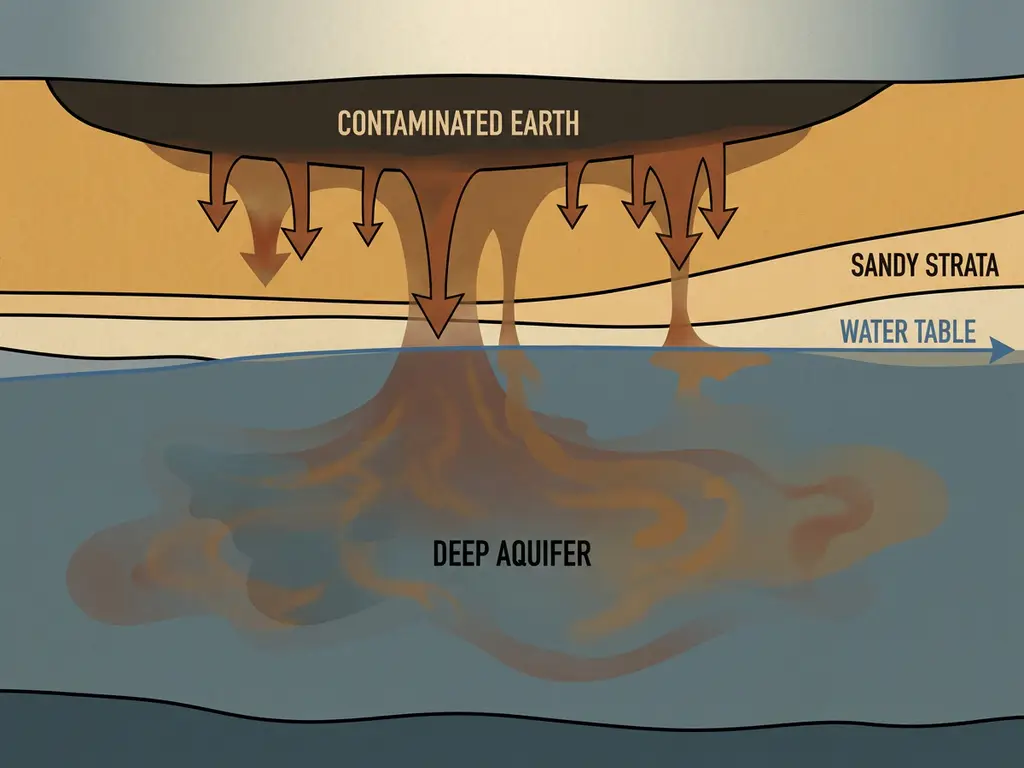
When contaminated soil is left untreated, pollutants migrate downward through the soil profile and enter the groundwater beneath. This process is not hypothetical — it is the predictable outcome of how water moves through porous earth. The rate and severity depend on the type of contaminant, soil permeability, and the depth of the water table, but the direction of travel is almost always the same: downward and outward.
For site owners, environmental project managers, and anyone dealing with a brownfield or industrial parcel, understanding this process is essential for making sound decisions about timing, liability, and remediation strategy. The questions below address the most critical aspects of that risk.
How does contamination move from soil into groundwater?
Contaminants migrate from soil into groundwater through a process called leaching. As rainfall and surface water percolate downward through the unsaturated soil zone, they dissolve soluble compounds and carry them deeper. Once these dissolved substances reach the saturated zone, they enter the groundwater and begin spreading laterally with the natural flow of the aquifer.
The speed and extent of this migration depend on several factors. Highly permeable soils such as sand and gravel allow rapid downward movement, while clay-rich soils slow the process considerably. However, slower movement does not mean safe containment — it simply delays the point at which groundwater becomes affected. Dense non-aqueous phase liquids (DNAPLs), which include many chlorinated solvents, present a particular challenge because they are denser than water and sink directly through the saturated zone, creating deep contamination sources that are extremely difficult to remove once established.
Avecom’s work in biological soil remediation is built around understanding these migration pathways, particularly for volatile organochlorine compounds (VOCl) that behave as DNAPLs and persist in both soil and groundwater for decades without intervention.
Get in Touch
Let’s Talk Microbial Solutions
Book a conversation with Stijn, our CEO, or send us your request.
| Book an Appointment | Request Information |
What types of soil contaminants pose the greatest risk to groundwater?
The contaminants that pose the greatest risk to groundwater are those that are both mobile and persistent. Chlorinated solvents such as trichloroethylene (TCE) and perchloroethylene (PCE) rank among the most hazardous because they dissolve readily in water, resist natural degradation, and sink deep into aquifers. Heavy metals, petroleum hydrocarbons, and nitrates also represent significant groundwater risks depending on soil chemistry and local hydrogeology.
Chlorinated solvents deserve particular attention in the context of industrial and brownfield sites. These compounds were widely used in dry cleaning, metal degreasing, and electronics manufacturing, and their legacy contamination is found across many European industrial zones. Once in the groundwater, they form persistent plumes that can extend hundreds of meters from the original source. Without active remediation, these plumes do not simply disappear — they continue spreading and can affect drinking water sources, surface water bodies, and neighboring properties over time.
What are the long-term consequences of groundwater contamination?
The long-term consequences of groundwater contamination include the spread of toxic plumes beyond the original site boundary, loss of groundwater as a usable resource, ecological damage to surface water systems fed by the aquifer, and significant legal and financial liability for site owners. In many cases, secondary contamination sources form when dissolved compounds re-volatilize into buildings above the water table.
From a regulatory standpoint, untreated groundwater contamination rarely stays a contained problem. As plumes migrate, they cross property lines and jurisdictional boundaries, triggering obligations under frameworks such as VLAREBO in Flanders. Site owners who delay action often face more extensive and costly remediation requirements later, compounded by the difficulty of treating a contaminant that has dispersed across a larger area. The longer a source zone remains in place, the larger the downstream plume becomes, and the harder it is to achieve cleanup targets within a reasonable timeframe.
How long does it take for contaminated soil to affect groundwater?
Contaminated soil can begin affecting groundwater within weeks to years, depending on the depth of the water table, soil permeability, and the physical properties of the contaminant. In sandy soils with a shallow water table, leaching can occur within months of a spill. In clay-heavy soils with a deep water table, the same contaminant might take years to reach groundwater — but the eventual impact is not avoided, only delayed.
This timeline uncertainty is one of the reasons why waiting for visible evidence of groundwater impact before acting is a poor risk management strategy. By the time monitoring wells confirm contamination in the saturated zone, a plume is already established and actively spreading. Early site assessment and feasibility testing allow project managers to intervene during the source zone phase, before the problem becomes a multi-zone remediation challenge.
Can biological soil remediation prevent further groundwater contamination?
Yes. Biological soil remediation can prevent further groundwater contamination by destroying contaminants within the source zone before they leach into the aquifer. When applied in-situ, microbial processes break down compounds such as chlorinated solvents directly in the soil matrix, reducing the mass of contaminant available for downward migration. This approach addresses the root cause rather than managing symptoms.
The effectiveness of biological remediation depends on whether the right microbial communities are present or can be introduced, and whether site conditions support their activity. This is where a structured feasibility assessment becomes critical. A microcosm test evaluates whether biological degradation is viable for a specific soil matrix and contaminant profile before any full-scale intervention is committed to. This avoids the risk of deploying a biological approach on a site where conditions do not support it.
For chlorinated solvents specifically, in-situ bioaugmentation with specialized microbial consortia has proven effective at achieving complete reductive dechlorination under the right conditions. Molecular monitoring tools, including quantitative PCR, allow project managers to track the presence and activity of degrading microorganisms throughout the process, providing concrete data for both internal reporting and regulatory compliance.
When should a contaminated site be treated rather than monitored?
A contaminated site should move from monitoring to active treatment when the contaminant plume is expanding, when the source zone remains intact, when groundwater quality targets are not being met through natural attenuation, or when regulatory deadlines or development plans require demonstrated progress. Monitoring is a tool for understanding a site, not a substitute for remediation when conditions are deteriorating.
The decision is also driven by practical site constraints. If excavation is not feasible due to existing structures, infrastructure, or the depth of contamination, biological in-situ treatment often becomes the most viable path forward. The key is to base that decision on site-specific data rather than assumptions. A preliminary feasibility screening, such as the microcosm testing offered by Avecom’s environmental team, provides the evidence base needed to make that call with confidence rather than uncertainty.
Sites where classical remediation techniques have already been attempted without achieving cleanup targets are often good candidates for a biological approach. In these cases, the contamination that remains is typically the fraction most resistant to physical removal but potentially accessible to microbial degradation under the right conditions. Combining molecular soil diagnostics with a targeted bioaugmentation strategy can unlock progress on sites that have been stalled for years.
If you are managing a contaminated parcel and classical approaches have reached their limits, Avecom offers a science-based preliminary screening to assess whether biological remediation is a viable next step for your specific situation.