

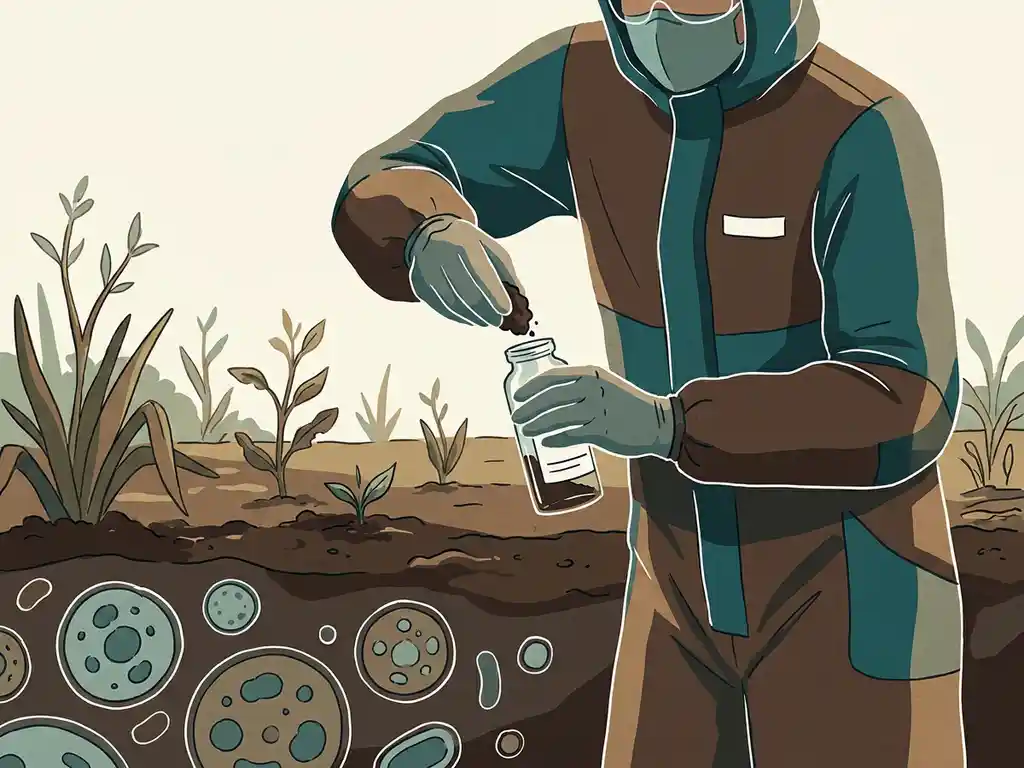
Biological remediation is feasible when the contaminated site contains microbial communities capable of breaking down the target pollutants and when soil conditions support microbial activity. The most reliable way to confirm feasibility before committing to a full remediation plan is a microcosm test, which simulates degradation under controlled laboratory conditions using actual soil and groundwater from the site.
Feasibility depends on the specific contaminant, the soil matrix, redox conditions, and whether the right microbial populations are present or can be introduced. This article works through the key questions project managers and environmental coordinators typically face when evaluating biological soil remediation as an alternative to excavation.
What conditions make a site suitable for biological remediation?
A site is suitable for biological remediation when the soil and groundwater conditions allow microbial communities to survive and metabolize the target contaminants. The most critical factors are the presence of degrading microorganisms, appropriate redox conditions, sufficient moisture, and a pH within a range that supports microbial activity. No single factor is decisive in isolation.
For sites contaminated with volatile organochlorine compounds (VOCl) such as chlorinated solvents, anaerobic conditions are typically required because the reductive dechlorination process depends on electron donors like hydrogen or organic carbon. If the site is highly aerobic, the microbial community may lack the capacity to drive complete dechlorination without intervention.
Key site parameters to evaluate include:
- Redox potential and dissolved oxygen levels in groundwater
- Presence and concentration of electron donors (organic carbon, hydrogen)
- Soil pH (typically 6 to 8 for most degrading consortia)
- Temperature, which affects microbial metabolic rates
- Contaminant concentration and distribution (plume depth, heterogeneity)
- Presence of co-contaminants that may inhibit microbial activity
Sites where excavation is technically impossible, such as those beneath existing structures or in areas with high groundwater tables, are often strong candidates for in-situ biological approaches, provided the above conditions are met or can be engineered. Avecom’s soil remediation expertise focuses precisely on these difficult cases where standard techniques fall short.
Get in Touch
Let’s Talk Microbial Solutions
Book a conversation with Stijn, our CEO, or send us your request.
| Book an Appointment | Request Information |
What is a microcosm test and what does it reveal?
A microcosm test is a controlled laboratory experiment that uses actual soil and groundwater samples from a contaminated site to evaluate whether biological degradation of the target contaminant is achievable under realistic conditions. It is the most cost-effective way to screen for biological feasibility before investing in a full-scale remediation strategy.
In a microcosm test, small sealed vessels are prepared with site material and subjected to defined conditions, including specific redox environments, electron donor additions, or bioaugmentation with specialized microbial consortia. Samples are monitored over weeks to months to track contaminant degradation and the accumulation of intermediate breakdown products.
For VOCl contamination, a well-designed microcosm test reveals:
- Whether indigenous microorganisms can initiate reductive dechlorination
- Whether dechlorination stalls at a toxic intermediate such as vinyl chloride
- Whether bioaugmentation with specialized consortia improves degradation rates
- The approximate degradation kinetics under site-specific conditions
- Which amendments (electron donors, nutrients) are needed to support the process
The value of a microcosm test is that it produces site-specific evidence rather than general assumptions. A negative result saves the project from committing to a biological approach that will not deliver. A positive result provides the technical basis for designing an in-situ strategy and supports regulatory documentation for OVAM reporting. Avecom conducts these tests as a first step in its biological soil decontamination service, ensuring that resources are only committed to approaches with a demonstrated chance of success.
How does biological remediation differ from excavation for VOCl-contaminated sites?
Biological remediation treats VOCl contamination in place by activating or introducing microbial communities that break down chlorinated compounds within the soil and groundwater. Excavation physically removes contaminated material from the site. The two approaches differ fundamentally in cost structure, technical feasibility, timescale, and the types of sites where they can be applied.
Excavation is effective when contamination is shallow, well-defined, and accessible. It delivers fast, verifiable results and is familiar to regulators and project teams. However, it becomes prohibitively expensive or technically impossible when contamination extends deep into the saturated zone, spreads across a large plume, or sits beneath existing infrastructure.
Biological remediation, specifically in-situ bioaugmentation with reductive dechlorinating consortia, addresses VOCl contamination where it sits. It does not require soil removal, generates no excavation waste, and can reach contaminants in the saturated zone that mechanical methods cannot access. The tradeoff is time: biological processes operate on a timescale of months to years, not weeks.
For project managers evaluating both options, the relevant comparison points are:
- Cost: Excavation costs scale with volume; biological remediation costs are driven by site investigation, feasibility testing, and monitoring
- Disruption: Excavation is highly disruptive to site operations; in-situ biological treatment is largely non-intrusive
- Regulatory acceptance: Both approaches are accepted under VLAREBO, provided monitoring data supports remediation progress
- Risk profile: Excavation delivers certainty faster; biological remediation requires ongoing verification through monitoring
How long does biological soil remediation typically take?
Biological soil remediation for VOCl-contaminated sites typically takes between one and five years, depending on contaminant concentration, plume size, soil heterogeneity, and the microbial approach used. Sites with lower concentrations, homogeneous soil, and active indigenous microbial communities tend to respond faster than deep, heterogeneous, or heavily contaminated plumes.
In-situ bioaugmentation with specialized reductive dechlorinating consortia can accelerate the process significantly compared to relying on natural attenuation alone. When electron donors and the right microbial populations are introduced under optimized conditions, measurable degradation can begin within weeks, though complete remediation to target concentrations takes considerably longer.
Several factors extend the timeline:
- Dense non-aqueous phase liquid (DNAPL) source zones that continuously release dissolved contaminants
- Low permeability soils that limit distribution of amendments and microbial inoculants
- Stalling of dechlorination at intermediate compounds requiring additional intervention
- Large or deep plumes requiring phased treatment
Project managers should treat timelines as ranges rather than fixed commitments. Molecular monitoring data, discussed in the next section, provides the most reliable basis for tracking progress and adjusting expectations during the remediation process.
What molecular tools are used to monitor bioremediation progress?
The primary molecular tools used to monitor bioremediation progress are quantitative PCR (qPCR) and amplicon sequencing. These methods quantify the presence and activity of specific degrading microorganisms directly in soil and groundwater samples, providing far more diagnostic resolution than chemical concentration data alone.
qPCR targets specific gene sequences associated with key degradation steps. For VOCl remediation, this includes genes encoding reductive dehalogenases, the enzymes responsible for stepwise dechlorination of compounds like trichloroethylene (TCE) to ethene. By tracking gene copy numbers over time, it is possible to confirm whether the degrading population is growing, stable, or declining, and whether the process is proceeding through the complete dechlorination pathway.
Amplicon sequencing provides a broader picture of the microbial community structure. This is useful for diagnosing why a remediation process is underperforming, identifying whether competing microbial groups are consuming electron donors, or confirming that introduced consortia have established themselves in the subsurface.
Together, these tools serve two practical purposes for project teams:
- Operational guidance: Data on microbial activity informs decisions about amendment dosing, injection intervals, and whether bioaugmentation is needed
- Regulatory reporting: Quantitative microbial data provides evidence of active biological degradation for OVAM documentation, complementing chemical monitoring results
Molecular monitoring reduces the overall cost of site oversight by making monitoring more targeted and informative. Rather than relying solely on periodic chemical sampling, which may not detect early shifts in the degradation process, molecular data provides a continuous functional picture of what is happening in the subsurface. Avecom’s scientific team integrates these molecular tools into remediation projects as standard practice, not as an add-on.
When should you rule out biological remediation as an option?
Biological remediation should be ruled out when site conditions are fundamentally incompatible with microbial activity and cannot be economically corrected, when the contaminant is not biologically degradable under achievable conditions, or when regulatory timelines require faster results than biological processes can deliver.
Specific indicators that biological remediation is unlikely to be the right primary approach include:
- Extremely high contaminant concentrations that are directly toxic to microbial communities
- Strongly acidic or alkaline soil conditions that cannot be buffered cost-effectively
- Presence of co-contaminants such as heavy metals that inhibit key degrading organisms
- Very low permeability soils that prevent distribution of amendments or microbial inoculants
- Hard regulatory deadlines that require complete remediation within months rather than years
It is worth noting that a negative microcosm test result does not automatically eliminate biological remediation as an option. It may indicate that bioaugmentation with a specialized consortium is needed, or that specific amendments are required to create permissive conditions. The distinction between “not feasible as-is” and “not feasible under any conditions” is an important one that requires expert interpretation.
In practice, many remediation projects use a combination of approaches. Excavation may address a concentrated source zone, while biological treatment manages the dissolved plume in groundwater. The decision to pursue biological remediation, rule it out, or combine it with other methods should always be grounded in site-specific data rather than assumptions based on contaminant type alone.
If you are managing a contaminated site and are uncertain whether biological remediation is viable, a microcosm feasibility test is the most efficient starting point. It answers the question with evidence from your specific site before any larger commitment is made. For sites with persistent VOCl contamination in particular, Avecom’s biological decontamination service provides the full pathway from initial screening through to field-scale implementation and regulatory reporting. You can learn more about the team and scientific approach at avecom.be.