

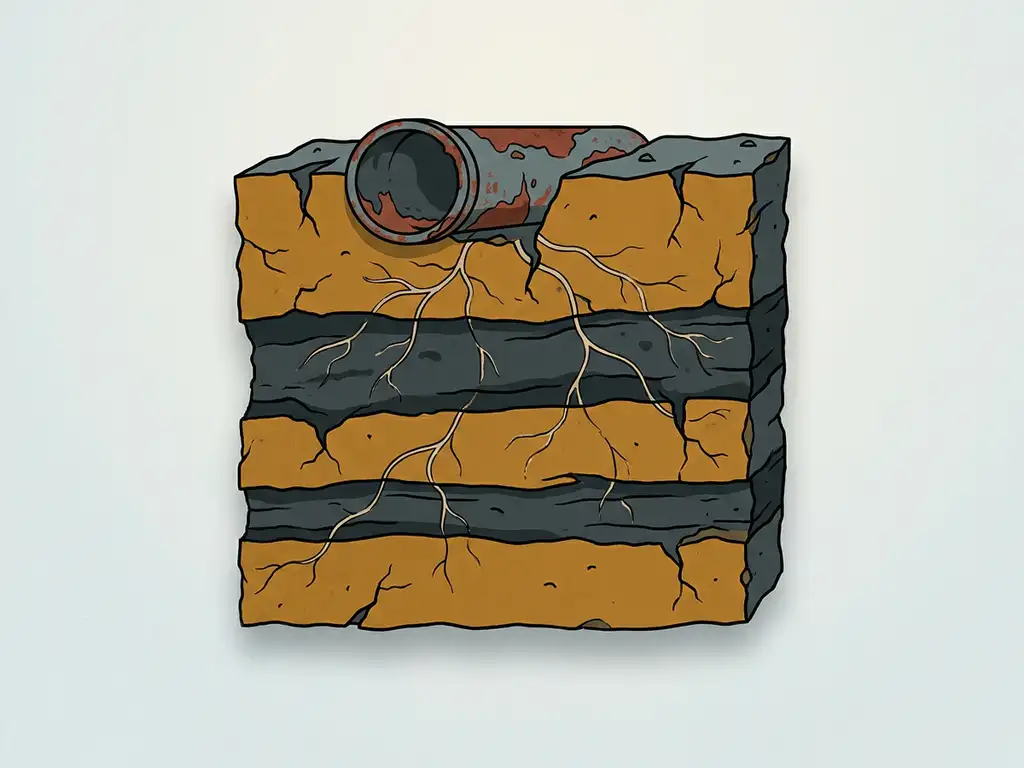
Industrial soil contamination is most commonly caused by leaking underground storage tanks, improper disposal of chemical waste, industrial spills, and the long-term use of solvents and fuels in manufacturing processes. Petroleum products, chlorinated solvents, heavy metals, and pesticides account for the majority of cases encountered on industrial and brownfield sites. The sections below unpack the specific industries involved, the pollutants they leave behind, and what to do when contamination is discovered on a site.
Which industries are responsible for the most soil contamination?
The industries most frequently linked to soil contamination are petroleum refining and fuel distribution, chemical manufacturing, metal processing and surface treatment, dry cleaning operations, and former gasworks or coal processing facilities. These sectors share a common factor: the routine use, storage, or disposal of substances that persist in soil and groundwater long after operations have ceased.
Fuel distribution and storage facilities are among the most widespread sources, largely because underground storage tanks degrade over time and can leak for years before being detected. Metal processing industries introduce heavy metals such as lead, cadmium, chromium, and zinc through surface treatments, electroplating baths, and wastewater discharge. Chemical manufacturing plants contribute a broad spectrum of organic compounds, including chlorinated solvents used in degreasing and cleaning processes.
Former industrial sites, often called brownfields, present a particular challenge because the original operations may have ended decades ago, the responsible party may no longer exist, and the contamination has had time to migrate well beyond the original footprint. Many of the most difficult remediation cases involve sites where multiple industrial activities occurred sequentially, leaving layered contamination profiles that are complex to characterize and treat.
Get in Touch
Let’s Talk Microbial Solutions
Book a conversation with Stijn, our CEO, or send us your request.
| Book an Appointment | Request Information |
What types of pollutants are most commonly found in industrial soil?
The most common pollutants found in industrial soil are petroleum hydrocarbons, volatile organic compounds (VOCs) including chlorinated solvents, heavy metals, polycyclic aromatic hydrocarbons (PAHs), and, in agricultural or mixed-use areas, pesticides and nitrates. Each pollutant class behaves differently in the subsurface and requires a different remediation approach.
Petroleum hydrocarbons, including diesel, gasoline, and fuel oil, are among the most frequently detected contaminants globally. They tend to remain in the unsaturated zone near the source but can dissolve into groundwater over time. PAHs, which are byproducts of combustion and coal processing, bind strongly to soil particles and are slow to degrade naturally.
Heavy metals do not break down biologically and must either be immobilized in place or physically removed. Chlorinated solvents, particularly volatile organochlorine compounds (VOCl) such as trichloroethylene (TCE) and perchloroethylene (PCE), are dense non-aqueous phase liquids that sink through the soil profile and can penetrate deep into aquifers. Their persistence and mobility make them one of the most technically challenging contaminant classes to address, a point returned to in more detail below.
How does industrial contamination spread beyond the original source?
Industrial contamination spreads beyond its original source through three primary mechanisms: leaching into groundwater, vapor migration through the unsaturated soil zone, and physical transport via excavation, flooding, or soil movement. Once a contaminant reaches the groundwater table, it can travel significant distances depending on the hydraulic gradient, soil permeability, and the chemical properties of the substance.
Dense non-aqueous phase liquids (DNAPLs), such as chlorinated solvents, are particularly prone to deep migration. Because they are denser than water, they sink through the saturated zone and can accumulate at the base of an aquifer or in low-permeability layers, creating secondary source zones far from the original spill location. This makes them extremely difficult to locate and treat.
Vapor intrusion is another significant pathway. Volatile compounds in contaminated soil can move upward through the soil gas and enter buildings through foundations, creating indoor air quality problems even when the surface soil appears unaffected. For site owners and project managers, this means the risk perimeter of a contaminated site is rarely limited to the visible footprint of the original industrial activity.
What’s the difference between primary and secondary soil contamination?
Primary soil contamination refers to pollution at or immediately adjacent to the original source, such as a leaking tank, a spill point, or a waste disposal area. Secondary contamination refers to pollution that has migrated away from that source through groundwater flow, vapor transport, or surface runoff, and has affected areas that were not directly exposed to the original release.
The distinction matters practically because primary and secondary contamination zones often require different remediation strategies. The source zone, where contaminant concentrations are highest and free product may still be present, typically needs more aggressive intervention. Secondary zones, where contaminants are more dilute but spread across a larger area, may be candidates for monitored natural attenuation or targeted biological treatment.
For regulatory purposes, particularly under frameworks such as VLAREBO in Flanders, understanding the extent of both primary and secondary contamination is a prerequisite for designing a compliant remediation plan. Characterizing both zones accurately is therefore one of the first steps after contamination is discovered on a site.
Why is VOCl contamination particularly difficult to remediate?
VOCl contamination is particularly difficult to remediate because chlorinated solvents are chemically stable, dense enough to migrate deep into aquifers, and tend to form persistent source zones that continuously release contaminants into groundwater over long timeframes. Conventional excavation is often impractical at the depths involved, and pump-and-treat systems can take decades to achieve cleanup targets.
The chemical structure of compounds like TCE and PCE makes them resistant to aerobic biodegradation. Under the right anaerobic conditions, specialized microorganisms can break them down through a process called reductive dechlorination, progressively removing chlorine atoms until harmless end products such as ethylene are formed. However, these microbial communities are not always naturally present in sufficient numbers, and the subsurface conditions may not support their activity.
This is where targeted biological intervention becomes relevant. biological soil remediation approaches, including bioaugmentation with specialized microbial consortia, are designed specifically for these difficult cases. Avecom’s work in this area focuses on assessing whether the conditions for biological degradation exist at a given site before committing to a full-scale approach, using microcosm tests to screen feasibility quickly and cost-effectively.
A further complication is that incomplete dechlorination can produce intermediates such as vinyl chloride, which is more toxic and more mobile than the parent compound. Managing this risk requires precise monitoring of the microbial community and the degradation pathway throughout the remediation process.
How can you determine whether a site has industrial soil contamination?
Determining whether a site has industrial soil contamination involves a phased assessment process: a desk study of historical land use, followed by a preliminary site investigation with soil and groundwater sampling, and, if necessary, a detailed characterization study. Soil contamination assessment methods include chemical analysis of soil cores, groundwater monitoring wells, and increasingly, molecular biological tools that detect specific contaminants or the microorganisms associated with their degradation.
Soil and groundwater sampling
The most direct method for confirming contamination is laboratory analysis of soil samples and groundwater taken from strategically placed monitoring wells. Samples are analyzed for the contaminant classes suspected based on the site history. For sites with a history of solvent use or dry cleaning, VOCl analysis is a standard component. For former fuel depots, total petroleum hydrocarbon and BTEX analysis are typically prioritized. Knowing what to test for is as important as the testing itself, which is why historical land use research precedes field sampling.
Molecular monitoring tools
Beyond chemical analysis, molecular biological tools such as quantitative PCR (qPCR) and amplicon sequencing allow investigators to detect and quantify the specific microorganisms responsible for contaminant degradation. These tools answer not just whether contamination is present, but whether the biological conditions for natural or enhanced attenuation exist. For project managers asking how to test if soil is contaminated and whether it can be treated biologically, this combination of chemical and molecular data provides a much more complete picture than chemistry alone.
If contamination is discovered on an industrial site, the immediate steps are to define the extent of the contamination, notify the relevant regulatory authority (in Flanders, OVAM), and commission a risk assessment that determines whether the contamination poses an unacceptable risk given the intended land use. From that point, the remediation approach depends on the contaminant type, depth, and the feasibility of available treatment methods.
For sites where classical excavation is too costly or technically impractical, in-situ biological remediation offers a science-based alternative that works within the existing soil matrix. Avecom, founded as a spin-out of Ghent University and active in this field for over 30 years, provides the diagnostic tools, feasibility screening, and remediation design needed to move from confirmed contamination to a compliant, workable plan. For contaminated soil and the question of what to do next, early-stage site characterization combined with targeted biological assessment is consistently the most efficient starting point.
If you are managing a site where contamination has been found and conventional approaches have not delivered results, contact Avecom for a preliminary screening to determine whether biological remediation is a viable path forward.
Related Articles
- How do you know if groundwater is affected by soil contamination?
- How do stricter discharge limits affect sludge management decisions?
- How do filamentous bacteria cause sludge bulking?
- What happens if excess sludge is not removed from a wastewater plant?
- How do you fix sludge bulking in a wastewater plant?