

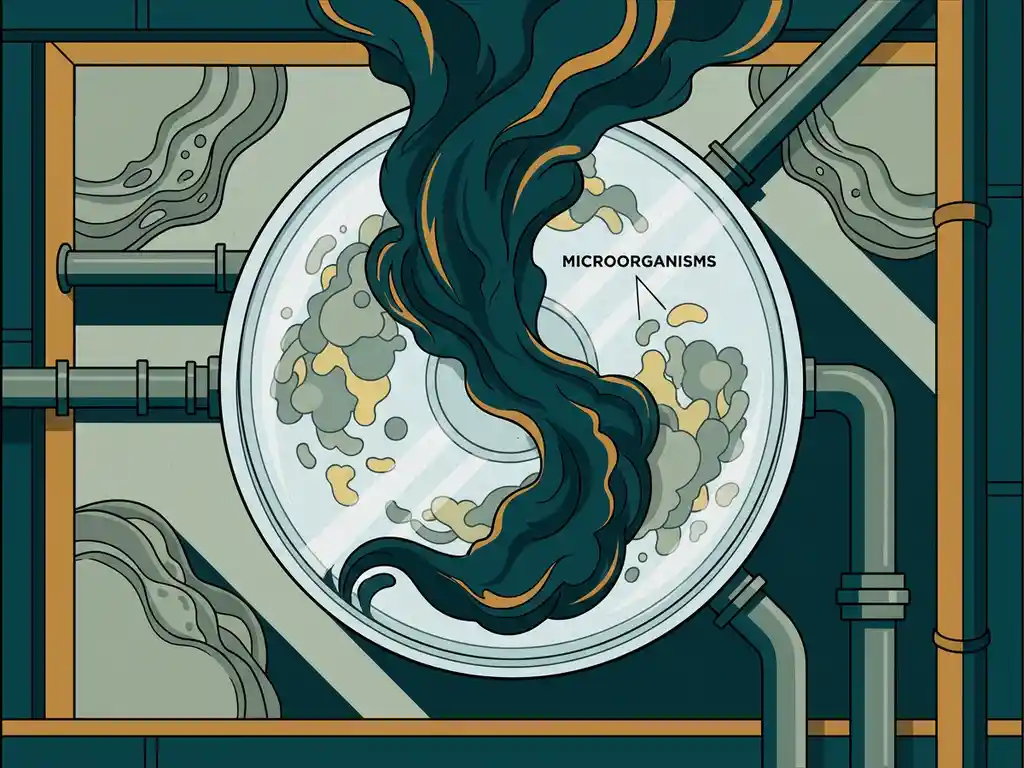
For many food and beverage producers, wastewater treatment works reliably enough — until it suddenly does not. Discharge limits are missed, regulators are notified, and the operations team scrambles to explain what went wrong. In a significant number of these cases, the root cause is not a broken pump or a failed sensor. It is a nitrogen spike that overwhelms a biological treatment system that was never designed to handle it. Understanding how these spikes develop, and why they cause industrial wastewater compliance failures, is the first step toward preventing them.
Nitrogen management sits at the intersection of process chemistry, microbial biology, and regulatory pressure. As discharge standards under frameworks like the Water Framework Directive continue to tighten in 2026, the margin for error is shrinking. Facilities that once operated comfortably within limits are now finding their existing installations inadequate, not because the process changed dramatically, but because the permitted thresholds did. The result is a growing number of plants where wastewater treatment is not working the way it once did, even though nothing obvious has broken down.
Why seasonal production creates dangerous nitrogen loads
Seasonal production patterns are one of the most underappreciated drivers of nitrogen-related compliance failures. When a food processing facility ramps up output for a harvest season, a holiday period, or a contract peak, the volume and concentration of nitrogen-rich wastewater it generates can increase dramatically within days. Nitrogen enters the wastewater stream primarily through protein-rich raw materials, cleaning agents, and process residues, and its concentration is directly tied to production intensity.
The problem is not just volume. It is the speed of change. A biological treatment system operates on microbial timescales. The bacteria responsible for nitrification and denitrification grow, adapt, and establish population balances over days and weeks. When nitrogen loading doubles or triples in a short window, the microbial community cannot respond quickly enough. The result is a system that was calibrated for average conditions suddenly facing peak loads it cannot metabolize. This mismatch between production cycles and biological capacity is where many compliance failures originate.
Get in Touch
Let’s Talk Microbial Solutions
Book a conversation with Stijn, our CEO, or send us your request.
| Book an Appointment | Request Information |
How nitrogen spikes overwhelm biological treatment systems
Biological nitrogen removal depends on a finely balanced sequence of microbial processes. Ammonia is first oxidized to nitrite and then to nitrate by nitrifying bacteria, and subsequently reduced to nitrogen gas by denitrifying bacteria. Each step requires specific microbial populations, adequate oxygen levels, appropriate carbon-to-nitrogen ratios, and stable temperature and pH conditions. When any of these parameters shifts abruptly, the entire chain is disrupted.
A nitrogen spike introduces excess substrate faster than the nitrifying community can process it. Ammonia accumulates, intermediate compounds build up, and the denitrification stage receives an unbalanced feed. The system does not fail catastrophically in most cases. Instead, it underperforms in ways that are difficult to detect until effluent sampling reveals a breach. This is one reason why sludge problems in wastewater treatment often accompany nitrogen events: the microbial population in the sludge becomes stressed, activity drops, and settling behavior deteriorates. What looks like a sludge issue on the surface is frequently a symptom of nitrogen overload upstream.
Facilities without real-time nitrogen monitoring are particularly vulnerable. By the time a lab result confirms elevated ammonium in the effluent, the discharge has already occurred.
The compliance consequences of a single discharge exceedance
A single nitrogen exceedance carries consequences that extend well beyond the immediate fine. Regulatory frameworks such as VLAREM in Flanders operate on cumulative compliance records, meaning that one reported breach increases scrutiny, triggers more frequent inspections, and can affect permit renewal conditions. For facilities that discharge to municipal sewer networks, exceedances may also trigger surcharges from the water utility based on nitrogen load, compounding the direct financial impact.
Beyond the regulatory dimension, there is an operational cost. Investigating a compliance failure, preparing documentation, engaging with inspectors, and implementing corrective measures all consume management time and internal resources. If the root cause is not correctly identified, the same spike will recur in the next production peak. Many facilities find themselves in a reactive cycle, addressing symptoms rather than the underlying mismatch between their production profile and their treatment capacity. Identifying that mismatch requires a level of microbiological understanding that most environmental managers do not have in-house, which is precisely why external expertise in biological wastewater treatment adds measurable value.
Early warning signs that nitrogen peaks are building
Catching a nitrogen spike before it reaches the discharge point requires monitoring at the right locations and with the right frequency. Several early indicators tend to appear in the treatment system before effluent quality degrades.
Process-level signals
Rising ammonia concentrations in the aeration tank, declining dissolved oxygen despite stable aeration rates, and increasing sludge volume index are among the first measurable signs that the nitrification process is under stress. A drop in nitrate concentration in the denitrification zone, or an unexpected rise in nitrite, can indicate that the microbial balance is shifting in response to an elevated nitrogen load.
Operational and production signals
On the production side, planned increases in throughput, changes in raw material composition, or extended cleaning cycles are predictable precursors to elevated nitrogen loading. Connecting production scheduling data to wastewater monitoring protocols allows operators to anticipate spikes rather than react to them. Facilities that treat these two domains as separate often discover the connection only after a compliance failure has occurred.
Molecular monitoring of microbial communities, an approach that Avecom’s specialist team applies as part of its microbiological audits, can reveal population shifts in nitrifying bacteria weeks before effluent quality is affected. This kind of early intelligence transforms the response from reactive to preventive.
How adaptive microbial management buffers nitrogen variability
The most effective long-term response to nitrogen variability is not to build more treatment capacity. It is to make the existing biological system more resilient. Adaptive microbial management focuses on maintaining a diverse and robust microbial community that can absorb fluctuations in loading without losing functional performance.
This involves several interconnected strategies. First, the microbial seed material introduced into the system during startup or after a disruption must be matched to the specific nitrogen chemistry and organic load of the facility. Generic inoculants designed for municipal wastewater often underperform in industrial settings where concentrations and compositions differ significantly. Second, operational parameters such as sludge retention time, aeration cycles, and carbon dosing must be actively adjusted in anticipation of production peaks, not held static once the system is running.
Avecom has developed its ABIL technology specifically to allow existing biofilters and biological treatment systems to be steered and restabilized without requiring a full restart. Combined with the ProMic platform, which recovers nitrogen and other nutrients from reject water as a feedstock for animal nutrition, the approach reframes the problem entirely: rather than treating nitrogen as a compliance liability, it becomes a recoverable resource. This shift in perspective, from cost center to potential value stream, is increasingly relevant as both disposal costs and raw material prices rise.
For facilities currently experiencing wastewater treatment failures or anticipating tighter discharge limits, the practical starting point is a structured microbiological audit of the existing installation. Understanding which microbial populations are present, how they are performing, and where the system is vulnerable to peak loads provides the evidence base for targeted intervention. Avecom offers exactly this kind of diagnostic and optimization service, moving from lab-scale feasibility testing through to operational implementation without requiring facilities to manage the microbiological complexity themselves.
Nitrogen spikes will continue to challenge industrial wastewater systems as long as production volumes fluctuate and discharge standards tighten. The facilities that manage this challenge most effectively are those that treat biological treatment not as a fixed installation to be monitored, but as a living process to be actively managed. That shift in approach, supported by the right expertise, is what separates recurring compliance failures from sustained operational control. To explore what that looks like for a specific facility, contact Avecom for an initial assessment.