

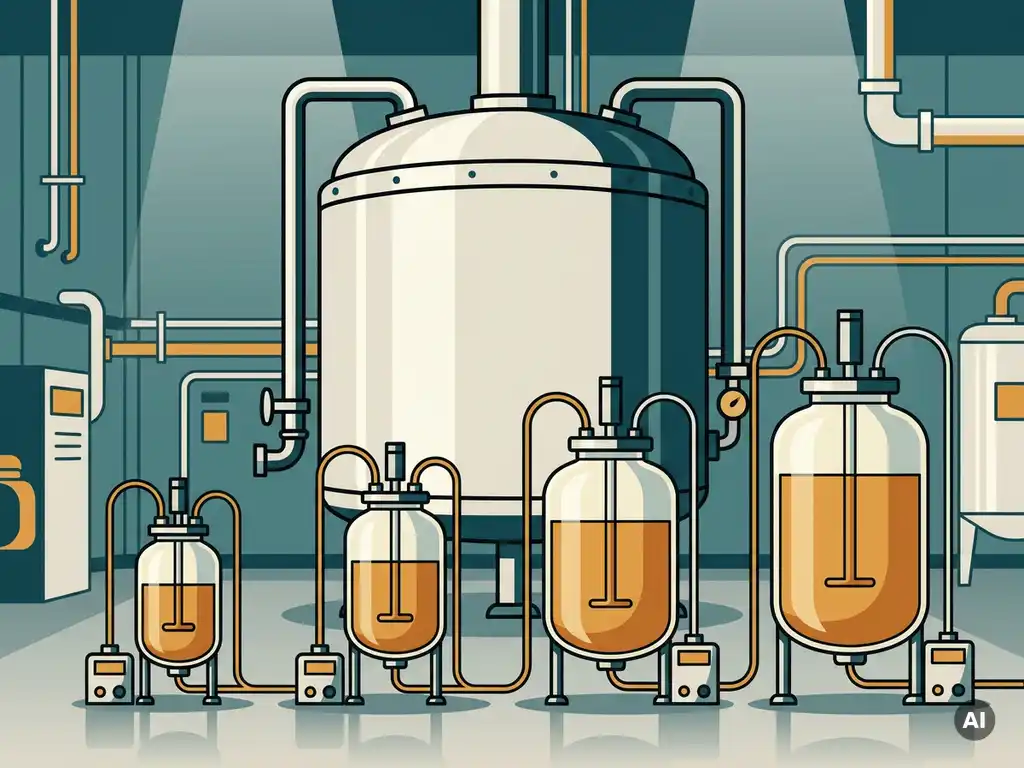
To demonstrate fermentation scalability to an investor, you need documented evidence that your process behaves predictably as reactor volume increases, not just that it works at lab scale. The most convincing proof combines controlled pilot-scale data with a clear mechanistic understanding of why the process performs the way it does. The sections below break down exactly what investors expect and how to build that case systematically.
What data do investors actually expect from a fermentation scale-up?
Investors evaluating a fermentation scale-up expect reproducible performance data across at least two scales, with quantified process parameters and a credible explanation of how those parameters will hold at commercial volume. A single successful lab run is not sufficient. What signals confidence is consistency, not a single peak result.
In practice, the data package that satisfies a technical reviewer typically includes yield and productivity metrics at each scale tested, along with the variance across replicate runs. Investors with biotech experience understand that fermentation processes are inherently variable, what they want to see is that you understand and control the sources of that variability.
Beyond yield, the investor proof of concept for fermentation should address:
- Substrate conversion efficiency — how consistently does the microbial system convert feedstock to product?
- Process stability over time — does performance hold across the full batch duration or continuous run?
- Contamination control — what is your containment strategy and what is your track record?
- Cost of goods at scale — even a rough model showing input costs, energy, and downstream processing assumptions demonstrates commercial awareness
Investors are not expecting full-scale production data at an early stage. They are expecting evidence that you understand your process well enough to predict what will happen when the volume increases.
What is the difference between lab-scale and pilot-scale fermentation results?
Lab-scale fermentation results show whether a biological concept is viable under controlled, idealized conditions. Pilot-scale fermentation results show whether that concept survives the physical and engineering realities of larger reactors: mixing gradients, heat transfer limitations, oxygen distribution, and the mechanical stress that microorganisms experience in bigger vessels.
The gap between the two is where most fermentation scale-up projects encounter problems. A process that delivers excellent titers in a 2-liter benchtop fermenter may underperform at 200 liters if the mixing regime is not equivalent, or if dissolved oxygen drops in zones of the larger reactor. These are not failures of the biology, they are failures of process translation.
What changes physically when you scale up a fermenter?
As reactor volume increases, the ratio of surface area to volume decreases, which affects heat exchange and gas transfer. Impeller tip speed, shear forces, and mixing time all change in ways that can stress microbial cells or alter metabolic activity. Understanding these engineering parameters, and demonstrating that you have characterized them at pilot scale, is what separates a credible scale-up story from an optimistic one.
Why pilot-scale data carries more weight with investors
Pilot-scale fermentation results are more compelling to investors because they represent a deliberate step toward commercial conditions. They show that the team has encountered and resolved real engineering challenges, not just biological ones. A pilot run at 500 to 2,000 liters, with documented process control and performance data, substantially de-risks the investment thesis.
Get in Touch
Let’s Talk Microbial Solutions
Book a conversation with Stijn, our CEO, or send us your request.
| Book an Appointment | Request Information |
How do you build a scalability argument without full-scale production data?
You build a fermentation scalability argument without full-scale data by combining mechanistic process understanding with dimensional analysis and pilot-scale validation. The argument is not “we have proven this works at 10,000 liters,” it is “we understand the governing parameters well enough to predict performance at 10,000 liters, and here is the evidence.”
The strongest scalability arguments rest on three pillars. First, identify the critical process parameters, the variables that most directly determine yield, productivity, or product quality. Second, demonstrate that you have characterized how those parameters behave across the scales you have tested. Third, show a credible engineering model or scale-up rule (such as constant power-per-volume or constant kLa for aerated systems) that connects your pilot data to the next scale.
This approach is particularly relevant when working with mixed microbial cultures, where the community composition itself is a process variable. Demonstrating that the microbial consortium remains stable and functionally consistent across scales, using tools like amplicon sequencing or qPCR monitoring, adds a layer of biological credibility that pure-culture processes cannot easily match.
Supporting this argument with scientific reporting, published methodology, or a partner with a recognized research track record further strengthens the investor narrative. Avecom, as a Ghent University spin-off with over 30 years of fermentation expertise, provides exactly this kind of scientific backing for clients building investor dossiers.
Which fermentation process parameters signal scalability to a technical reviewer?
The fermentation process parameters that most signal scalability to a technical reviewer are those that directly govern mass transfer, mixing, and microbial physiology, specifically dissolved oxygen (DO), pH control response time, volumetric mass transfer coefficient (kLa), mixing time, and temperature uniformity. A process that has been characterized across these dimensions is one that can be rationally translated to a larger vessel.
Technical reviewers, whether they are investor advisors, grant evaluators, or due diligence consultants, look for evidence that the team is not just measuring outcomes but understands the mechanisms behind them. Reporting only final yield without the process trajectory raises questions. Showing how DO was maintained, how pH excursions were managed, and how the microbial community responded to those conditions tells a far more credible story.
For processes involving complex microbial consortia, additional parameters matter: community stability metrics, substrate utilization profiles, and the ratio of productive to non-productive biomass. These are not standard metrics in every fermentation context, but for mixed-culture fermentation, which tends to be more robust and cost-efficient than genetically modified pure cultures, they are the parameters that demonstrate process control at a level investors can trust.
When should you involve a contract fermentation partner in your scale-up story?
You should involve a contract fermentation partner as early as the pilot-scale validation phase, ideally before you need to present investor proof of concept. Waiting until you have exhausted internal lab capacity means arriving at investor conversations with incomplete data. A specialist partner can compress the timeline significantly and add credibility that an internal team without dedicated infrastructure cannot provide on its own.
For scale-up teams without their own bioreactor infrastructure, a contract fermentation partner serves two functions simultaneously: it provides the physical capacity to generate pilot-scale data, and it adds a layer of scientific validation that strengthens the investment narrative. Investors understand that building and operating pilot-scale fermentation equipment is capital-intensive and technically demanding. Demonstrating that you have partnered with an experienced facility, rather than attempting to improvise, signals sound judgment about resource allocation.
The timing consideration also involves IP protection. Engaging a contract partner early, under a clear confidentiality framework, ensures that your process data and microbial know-how remain protected throughout the scale-up process. This is a practical concern that investors in biotech and food ingredient sectors take seriously.
Avecom’s fermentation R&D and contract manufacturing service is structured precisely for this stage, offering lab-scale feasibility work, pilot-scale validation up to 2,000 liters, and the scientific reporting needed to support subsidy applications and investor dossiers. For companies without internal fermentation infrastructure, this kind of partnership can be the difference between a credible scale-up story and a promising idea that stalls before proof of concept.
Related Articles
- What is the most cost-effective way to manage excess sludge in 2026?
- How does biological remediation differ from excavation?
- What is the fastest way to recover from a sludge bulking event?
- Can nutrient imbalance trigger sludge problems in wastewater treatment?
- How much does soil remediation typically cost?