

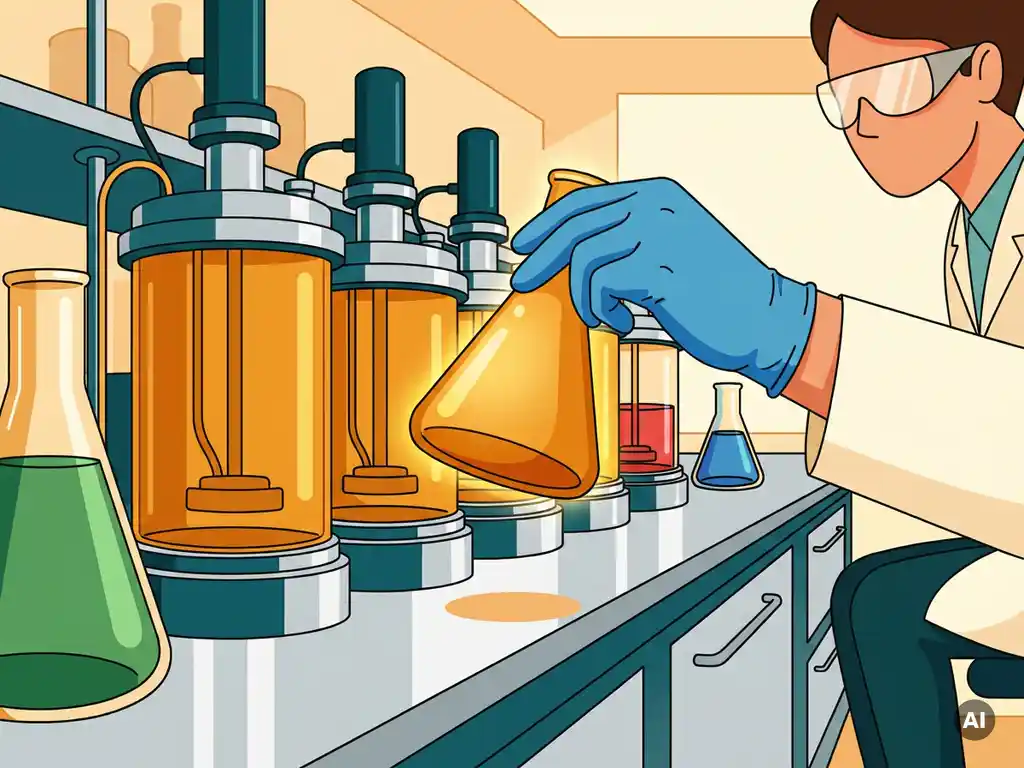
Select a fermentation partner by matching their technical infrastructure, microbial expertise, and process development experience to your specific application. The right partner acts as an extension of your R&D team, not just a service provider with available reactor capacity. The questions below walk through the criteria that matter most, from core capabilities to IP protection and the build-versus-outsourcing decision.
What capabilities should a fermentation partner have?
A qualified fermentation partner should offer a continuous range of infrastructure spanning lab-scale feasibility testing, pilot-scale validation, and small-scale contract production, supported by analytical tools capable of monitoring and steering the microbial process in real time. Infrastructure alone is not enough: the team must understand process engineering well enough to translate results from one scale to the next.
At the lab scale, look for controlled bioreactors with precise management of temperature, pH, dissolved oxygen, and feeding strategy, covering both aerobic and anaerobic conditions. At pilot scale, the partner should be able to replicate those parameters in larger vessels without losing process performance. Downstream processing capabilities, including centrifugation, pasteurization, and basic product characterization, are equally important if you need a material output rather than just process data.
Analytical depth is a differentiator that is easy to overlook. Partners who can apply molecular tools such as amplicon sequencing and quantitative PCR to monitor microbial community composition give you far more process insight than partners who rely on classical cultivation methods alone. This matters especially when your process involves complex or mixed microbial systems, where population dynamics directly affect yield and product quality.
Finally, consider whether the partner holds relevant quality certifications. For food and feed applications, accreditations such as Feed Chain Alliance (FCA) certification signal that production practices meet recognized industry standards, which simplifies your own regulatory pathway downstream.
How do you evaluate a partner’s experience with mixed microbial cultures?
Evaluate experience with mixed microbial cultures by asking for evidence of process outcomes achieved with defined or undefined consortia, not just with pure strains. A partner with genuine expertise in this area will be able to discuss how they steer community composition, manage population stability over time, and use molecular monitoring to detect and correct microbial drift.
Most academic and commercial fermentation providers focus on genetically modified pure cultures, where the biology is well characterized and relatively predictable. Mixed cultures are inherently more complex: multiple populations compete and cooperate simultaneously, and small changes in substrate, temperature, or feeding regime can shift the community in ways that affect product formation. A partner experienced in this space understands those dynamics and has tools to manage them.
Ask specifically about their molecular monitoring practice. Do they use amplicon sequencing to profile community composition at regular intervals? Can they correlate shifts in microbial population structure with changes in process performance? Partners who can answer these questions with concrete examples demonstrate applied expertise, not just theoretical familiarity. Avecom, for instance, was founded on the principle that mixed microbial communities offer robustness and cost advantages that pure-culture approaches cannot always match, and that perspective shapes how their process development work is structured.
Get in Touch
Let’s Talk Microbial Solutions
Book a conversation with Stijn, our CEO, or send us your request.
| Book an Appointment | Request Information |
What questions should you ask about IP protection and confidentiality?
Before sharing any proprietary process information, ask a potential fermentation partner how they handle confidentiality agreements, who owns data and results generated during the project, and whether they work with competing clients in overlapping application areas. These three questions cover the most common IP risks in contract R&D relationships.
A well-structured non-disclosure agreement should be in place before any technical discussion begins. Beyond the NDA, clarify upfront whether background IP (what each party brings to the project) remains separate from foreground IP (what is generated during the collaboration). If your concept leads to a patentable process improvement, you need written clarity on ownership before work starts, not after results are in hand.
Also ask how the partner manages data segregation between client projects. A partner working simultaneously with multiple companies in the same sector should be able to explain the organizational and procedural barriers that prevent cross-contamination of confidential information. Partners with a strong scientific publication track record can be an asset for subsidy applications and investor conversations, but confirm that no project data is published or shared without explicit written approval.
How does a fermentation partner support scale-up from lab to pilot?
A fermentation partner supports scale-up by systematically identifying which process parameters are scale-sensitive and adjusting the operating strategy before moving to larger vessels. The most common reason lab-to-pilot transitions fail is not insufficient reactor volume, but insufficient understanding of how mixing, oxygen transfer, heat management, and substrate gradients change as volume increases.
The process should begin at lab scale with a deliberate focus on parameter sensitivity, not just proof of concept. Which variables, when changed by a small margin, significantly affect yield or product quality? Answering that question at small scale allows the partner to design the pilot run with appropriate control strategies rather than simply hoping the process transfers cleanly.
At pilot scale, the partner should be running the process under conditions that genuinely represent the constraints of a larger system, including realistic mixing times and mass transfer coefficients, rather than optimized lab conditions that will not hold at volume. Continuous sampling and molecular monitoring during pilot runs provide the data needed to understand where performance differences arise and how to close the gap. Biomass fermentation projects, for example, often require this kind of iterative parameter mapping across scales before a robust operating window can be defined.
What’s the difference between a contract manufacturer and an R&D fermentation partner?
A contract manufacturer executes a defined, validated process at scale to produce a specified product, while an R&D fermentation partner works with you to develop, optimize, and validate a process that does not yet exist in its final form. These are fundamentally different service models, and choosing the wrong one for your stage of development is a common and costly mistake.
Contract manufacturers are optimized for consistency, throughput, and regulatory compliance on established processes. They expect to receive a process specification and run it reliably. They are the right choice when your process is fully characterized, your quality parameters are defined, and you need production volume rather than process insight.
An R&D fermentation partner, by contrast, is equipped and willing to work with uncertainty. They help you define the process, identify the critical control parameters, troubleshoot unexpected behavior, and generate the data package needed to move toward manufacturing. The relationship is collaborative rather than transactional, and the partner’s value lies in scientific judgment as much as in equipment access. Many organizations need an R&D partner first and a contract manufacturer later, but conflating the two roles leads to either under-supported development work or overpriced production runs.
When should you outsource fermentation instead of building in-house capacity?
Outsource fermentation when the time, capital, and organizational resources required to build and operate your own infrastructure would delay your development timeline or divert focus from your core competency. For most scale-ups and industrial companies without an existing fermentation operation, outsourcing to a specialized partner is faster, lower-risk, and significantly cheaper than building in-house, particularly at the feasibility and pilot stage.
Building a fermentation facility requires not just capital investment in equipment but also specialized personnel, quality systems, regulatory compliance infrastructure, and ongoing operational overhead. These costs are justified when fermentation is central to your long-term business model and you have the volume and process stability to amortize the investment. They are rarely justified for early-stage process development, where requirements change frequently and the outcome is still uncertain.
The practical trigger for outsourcing is usually one of three situations: your internal lab lacks the equipment or expertise to run controlled fermentation experiments, you need pilot-scale data to satisfy investors or customers within a defined timeframe, or you want to validate a concept before committing capital to your own infrastructure. In all three cases, a partner with ready-to-use bioreactors, experienced process engineers, and analytical capacity lets you generate credible results without the setup delay. Once your process is validated and your volume requirements are clear, you can make an informed build-versus-continue-outsourcing decision from a position of knowledge rather than assumption.
Related Articles
- How does contract fermentation manufacturing protect your IP?
- How do you validate that a fermentation process is robust enough for production?
- What should you look for in a fermentation contract manufacturing partner?
- When should you switch from aerobic to anaerobic wastewater treatment?
- How do seasonal production peaks affect sludge behavior?