

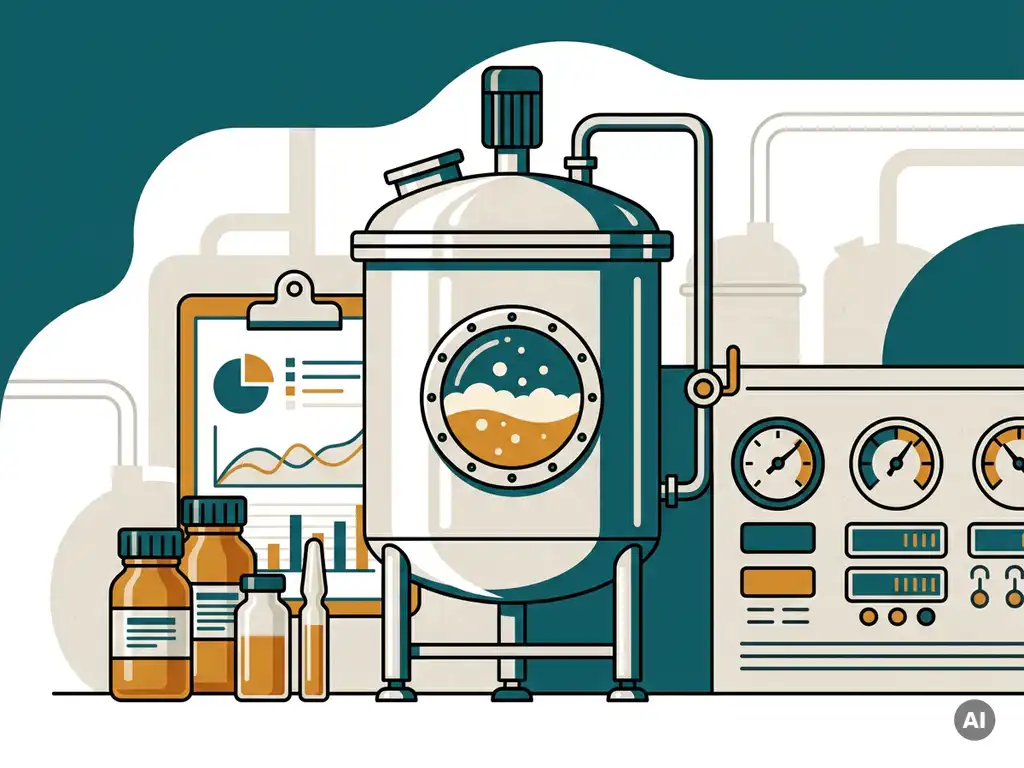
A fermentation process is robust enough for production when it consistently delivers acceptable yields, product quality, and microbial performance across repeated runs, even when key process parameters fluctuate within realistic operating ranges. Robustness is not a single test result but a demonstrated pattern of stability under variability. The sections below unpack what that means in practice, from defining the right parameters to knowing when your pilot data genuinely supports a scale-up decision.
What does process robustness actually mean in fermentation?
Process robustness in fermentation means that the microbial system produces consistent, acceptable outcomes even when operating conditions vary within a defined range. A robust fermentation process does not require perfect conditions to perform well. It tolerates realistic fluctuations in temperature, pH, substrate concentration, and dissolved oxygen without significant drops in yield, product quality, or microbial activity.
The distinction between a process that works and one that is robust is critical for anyone planning to move from lab to production. In a controlled lab environment, a process may perform reliably because every variable is tightly managed. At pilot or production scale, that level of control is rarely achievable. Equipment response times are slower, mixing is less homogeneous, and raw material quality can shift from batch to batch. A process that cannot absorb these variations will fail unpredictably at scale, which is precisely the kind of risk that undermines investor confidence and delays market entry.
Robustness is therefore a property of the process design, not just the microbial strain or recipe. It reflects how well the process has been understood, characterized, and stress-tested before moving forward.
Which process parameters matter most for robustness testing?
The parameters that matter most for fermentation process robustness testing are those that directly influence microbial growth, metabolism, and product formation, and that are likely to vary at larger scale. These typically include pH, temperature, dissolved oxygen, agitation, substrate feed rate, and inoculum quality. Identifying which of these are critical control points for a specific process is the foundation of any meaningful validation work.
Not all parameters carry equal risk. Some variables, like temperature in a well-insulated bioreactor, are relatively easy to control at any scale. Others, like dissolved oxygen in a large vessel with imperfect mixing, can drift significantly and affect microbial behavior in ways that are hard to predict without deliberate testing. The goal of parameter mapping is to distinguish between parameters that are merely operational and those that are genuinely process-critical.
For processes based on mixed microbial communities rather than pure cultures, this mapping becomes more nuanced. Community composition can shift in response to subtle changes in operating conditions, and those shifts may not be visible in bulk performance metrics until they have already affected product quality. This is why parameter selection for robustness testing should always be informed by a solid understanding of the microbial system being used, not just by generic fermentation guidelines.
Get in Touch
Let’s Talk Microbial Solutions
Book a conversation with Stijn, our CEO, or send us your request.
| Book an Appointment | Request Information |
How do you stress-test a fermentation process before scaling up?
Stress-testing a fermentation process before scale-up involves deliberately introducing controlled variations in critical parameters to observe how the process responds and recovers. This is done systematically at lab or pilot scale, using experimental designs that push the process beyond its expected operating range to identify failure modes and define the boundaries of acceptable performance.
Common stress-testing approaches include:
- Parameter perturbation studies: Deliberately shifting pH, temperature, or dissolved oxygen outside the target range for defined periods, then measuring how quickly and completely the process recovers.
- Substrate variation tests: Introducing variability in feedstock composition or concentration to simulate real-world supply inconsistency, particularly relevant when using side streams or agricultural residues as substrates.
- Inoculum robustness checks: Testing how sensitive the process is to variations in inoculum age, volume, or microbial composition at the point of seeding.
- Repeated batch or continuous run assessments: Running the process through multiple consecutive cycles to detect performance drift, contamination risk, or community instability over time.
The data from these experiments define what engineers call the design space of the process: the combination of parameter ranges within which the process reliably meets its performance targets. A well-characterized design space is the most credible evidence that a fermentation process is ready for the controlled variability of production scale. It also provides the technical foundation for regulatory submissions, investor documentation, and patent applications.
For companies without dedicated pilot infrastructure, this kind of systematic stress-testing is often the stage where external partnership adds the most value. Facilities equipped for microbial fermentation at pilot scale can run these experimental series faster and with better instrumentation than most internal R&D labs, compressing the timeline between concept and validated process.
What role does microbial community monitoring play in validation?
Microbial community monitoring plays a central role in fermentation process validation because it reveals what is happening inside the bioreactor at a biological level, not just what the bulk performance metrics suggest. Tracking community composition over time allows process engineers to detect shifts in microbial population structure before those shifts manifest as yield losses or quality failures.
For processes using defined pure cultures, monitoring typically focuses on contamination detection and growth kinetics. But for processes based on mixed microbial communities, which are inherently more complex and more dynamic, community monitoring is an essential process control tool rather than a supplementary diagnostic.
Modern molecular techniques make this kind of monitoring practical at the process development stage. Amplicon sequencing can profile the composition of a microbial community with high resolution, identifying which taxa are present, in what proportions, and how those proportions shift across operating conditions or over repeated runs. Quantitative PCR (qPCR) can track specific functional groups or indicator organisms in near real time. Together, these tools allow process developers to answer questions that bulk metrics cannot: Is the community stable under stress? Does it recover after perturbation? Are the organisms responsible for the desired transformation consistently dominant, or are they being outcompeted under certain conditions?
Incorporating community monitoring into validation work also strengthens the technical credibility of the process documentation, which matters when presenting results to investors, regulators, or licensing partners.
When is a fermentation process ready to move from pilot to production?
A fermentation process is ready to move from pilot to production when it has demonstrated consistent performance across multiple independent runs at pilot scale, when its critical process parameters and their acceptable ranges are documented, and when the process has been shown to recover predictably from realistic perturbations. No single run, however successful, is sufficient evidence of production readiness.
The practical criteria for this transition typically include:
- Reproducibility across runs: Key performance indicators, such as yield, product concentration, and microbial activity, fall within defined acceptance limits across at least three to five independent pilot runs under comparable conditions.
- Documented design space: The operating ranges within which the process meets its targets have been empirically established, not just assumed from lab-scale observations.
- Understood failure modes: Stress-testing has revealed how and why the process can fail, and mitigation strategies are in place for each identified risk.
- Scale-sensitive parameters addressed: Parameters known to behave differently at larger scale, such as mixing time, heat transfer, and dissolved oxygen gradients, have been assessed, and their impact on performance has been characterized.
- Microbial stability confirmed: Community or strain stability over the intended production run duration has been demonstrated, not just at a single time point.
It is also worth recognizing that pilot-to-production readiness is a risk management decision as much as a technical one. The level of evidence required depends on the consequences of failure at production scale, the regulatory context, and the commercial stakes involved. A process destined for a small-scale contract manufacturing run carries different validation requirements than one intended for continuous large-scale production.
Working with an experienced partner through the pilot validation phase can significantly reduce the risk of discovering process weaknesses only after committing to production infrastructure. Avecom’s background in mixed microbial process development, combined with aerobic and anaerobic fermentation capacity up to 2,000 liters, is specifically designed to support companies at this critical transition point, providing the data package needed to make the scale-up decision with confidence.
Related Articles
- How do you control process parameters in a pilot-scale bioreactor?
- What is a feasibility study for a fermentation process?
- Can a small biotech company access pilot-scale fermentation without building it?
- What are the main causes of sludge problems in wastewater treatment?
- How much does soil remediation typically cost?