

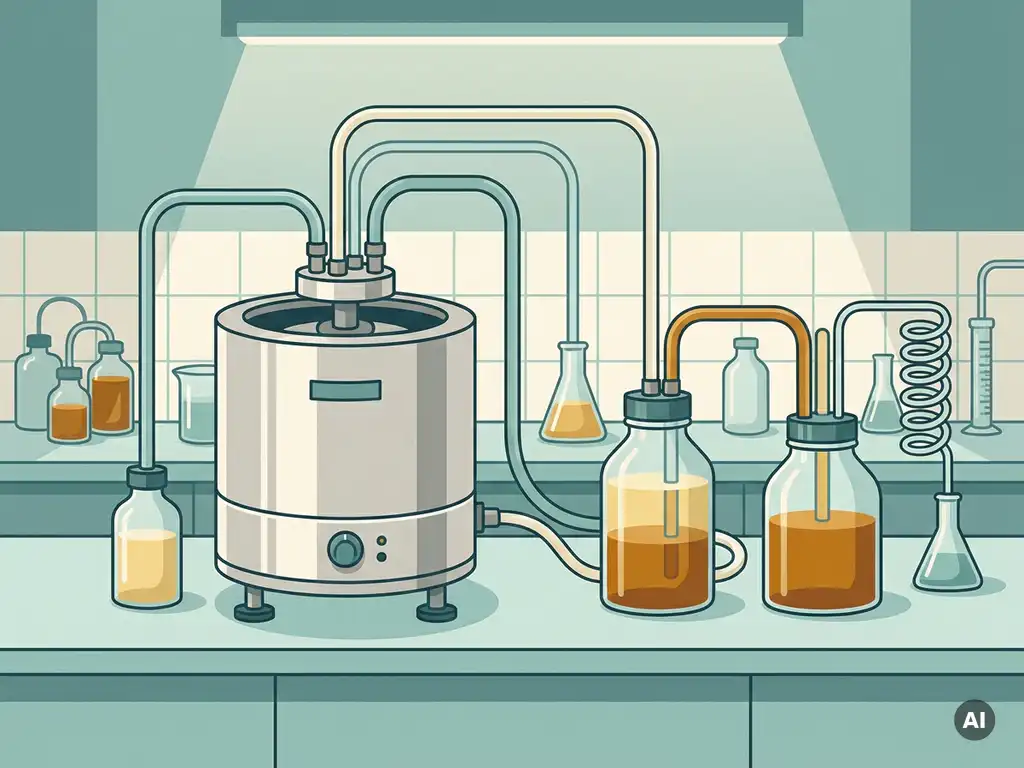
Downstream processing after fermentation refers to all the steps taken to separate, purify, and concentrate the target product from the fermentation broth once microbial activity has ended. It typically includes cell separation, product isolation, purification, and final formulation. The specific sequence and methods depend on whether the product is intracellular or extracellular, and on the purity standards required for the intended application. The sections below address the most common questions about how this process works in practice.
What steps happen immediately after fermentation ends?
Immediately after fermentation ends, the first priority is stabilizing the broth to prevent product degradation, contamination, or continued microbial activity. This typically means cooling the reactor contents and, where relevant, adjusting pH. From there, the broth enters a defined sequence: cell separation, product isolation, purification, and final conditioning or formulation.
The exact sequence varies depending on where the target product is located. If the product is secreted into the broth (extracellular), the liquid fraction is processed directly after removing the biomass. If the product is retained inside the cells (intracellular), the biomass itself must first be collected and then lysed to release the product before purification can begin.
In practice, the immediate post-fermentation steps also include sampling and quality checks. Measuring product titer, biomass concentration, and broth composition at this stage provides the baseline data needed to control the downstream steps that follow. Skipping or rushing this initial characterization is a common cause of yield losses later in the process.
What is the difference between upstream and downstream processing?
Upstream processing covers everything that happens before and during fermentation: strain selection, media preparation, inoculum development, and the fermentation run itself. Downstream processing covers everything that happens after the fermentation broth is harvested, from initial separation through to the finished product. Together, they form the complete bioprocess.
The distinction matters because the two phases have fundamentally different engineering challenges. Upstream processing is primarily about creating the right biological conditions for microbial growth and product formation. Downstream processing is primarily about physical and chemical separation, where yield losses accumulate with every step.
A decision made upstream, such as the choice of fermentation medium or the final cell density targeted, will directly affect how difficult and costly downstream processing becomes. Broths with high solid content, complex media components, or low product titers are significantly harder and more expensive to process. This is why well-designed microbial fermentation processes treat upstream and downstream as a connected system rather than two separate problems.
Get in Touch
Let’s Talk Microbial Solutions
Book a conversation with Stijn, our CEO, or send us your request.
| Book an Appointment | Request Information |
How does cell separation work in downstream processing?
Cell separation is the first major unit operation in downstream processing. It removes microbial biomass from the fermentation broth, either to recover the cells themselves (when biomass is the product) or to clarify the liquid for further purification (when the product is in the broth). The two primary methods are centrifugation and filtration, and the choice between them depends on cell size, broth viscosity, and scale.
Centrifugation
Centrifugation uses high rotational forces to sediment cells and other particulates out of the liquid phase. It is fast, scalable, and well suited to broths with relatively low viscosity. Industrial centrifuges can process large volumes continuously, making this the preferred option at production scale for many microbial systems. The resulting cell pellet can be further processed or dried, while the clarified supernatant moves to the next purification step.
Filtration
Filtration separates cells by passing the broth through a membrane or filter medium that retains the biomass. Microfiltration membranes with pore sizes in the range of 0.1 to 10 micrometers are commonly used for bacterial and yeast cells. Filtration is gentler than centrifugation and can be advantageous when cell integrity needs to be preserved, but membrane fouling and throughput limitations can make it more challenging to scale. Combinations of both methods are frequently used in practice, particularly when the broth contains fine particles or cell debris that a single step cannot fully remove.
What purification methods are used after cell separation?
After cell separation, the target product still exists alongside residual media components, proteins, metabolites, and other impurities. The purification methods applied depend on the product’s physical and chemical properties, the required purity level, and the intended end use. Common techniques include precipitation, chromatography, membrane filtration, and drying or concentration steps.
Precipitation involves adjusting conditions such as pH, salt concentration, or temperature to cause the target product to become insoluble and settle out of solution. It is a relatively low-cost approach used for bulk products where very high purity is not required. For higher-value products, chromatographic methods separate molecules based on size, charge, or affinity, achieving much greater resolution but at significantly higher cost and complexity.
Ultrafiltration and diafiltration membranes are frequently used to concentrate and buffer-exchange products after an initial purification step. For solid products such as microbial biomass or single-cell protein, spray drying or drum drying converts the concentrated liquid into a stable powder. Pasteurization is also applied in food and feed applications to ensure microbiological safety before the final product leaves the facility.
The number of purification steps required is one of the main drivers of total production cost. Each additional step introduces yield loss, processing time, and capital or consumable expense. Minimizing the number of steps while meeting product specifications is a central challenge in bioprocess design.
Why does downstream processing account for most of the production cost?
Downstream processing typically accounts for 50 to 80 percent of total production costs in microbial fermentation, depending on the product. This is because each separation and purification step involves capital-intensive equipment, consumes energy and reagents, and inevitably loses a fraction of the product. The cumulative effect of multiple sequential steps compounds these losses significantly.
Low product concentration in the fermentation broth is the single biggest cost driver. When a product is present at low titer, large volumes of broth must be processed to recover a meaningful amount of product, increasing the load on every downstream unit operation. This is why improving fermentation yield upstream has a direct and disproportionate impact on downstream costs.
The purity requirements of the final product also determine cost. Commodity products such as ethanol or organic acids require relatively simple separation. High-purity biologics or specialty ingredients require multiple chromatographic steps, each adding cost and reducing overall yield. For industrial applications where product purity requirements are moderate, selecting robust microbial systems that produce high titers of a relatively clean product is often the most effective strategy for keeping downstream costs manageable.
When should downstream processing be considered during fermentation development?
Downstream processing should be considered from the earliest stages of fermentation development, not after the upstream process has already been fixed. Decisions made during strain selection, medium design, and process parameter optimization all have direct consequences for how easily and cheaply the product can be recovered. Treating downstream as an afterthought is one of the most common and costly mistakes in bioprocess scale-up.
At the lab scale, it is worth running small-scale separation and purification experiments in parallel with fermentation optimization. This reveals early on whether the broth is difficult to filter, whether the product is stable under processing conditions, and what purification steps are likely to be needed. These insights feed back into upstream decisions, for example, choosing a medium formulation that reduces interfering compounds or targeting a fermentation endpoint that gives the best downstream yield.
During scale-up from lab to pilot, downstream processing often becomes the bottleneck that was not anticipated. Equipment that works at bench scale does not always translate directly to larger volumes, and broth rheology can change significantly with scale. Organizations that work with a contract fermentation partner benefit from access to pilot-scale downstream equipment alongside the fermenters, allowing both phases to be developed and validated together. Avecom’s fermentation development services include downstream processing capabilities such as centrifugation and pasteurization, precisely because separating the two phases during development creates problems that are expensive to solve later.
The practical recommendation is to define the target product specification, including purity, form, and safety requirements, before the fermentation process is finalized. Working backward from the required end product to the fermentation conditions is a more reliable path to a scalable, cost-effective process than optimizing upstream first and hoping the downstream will follow.