

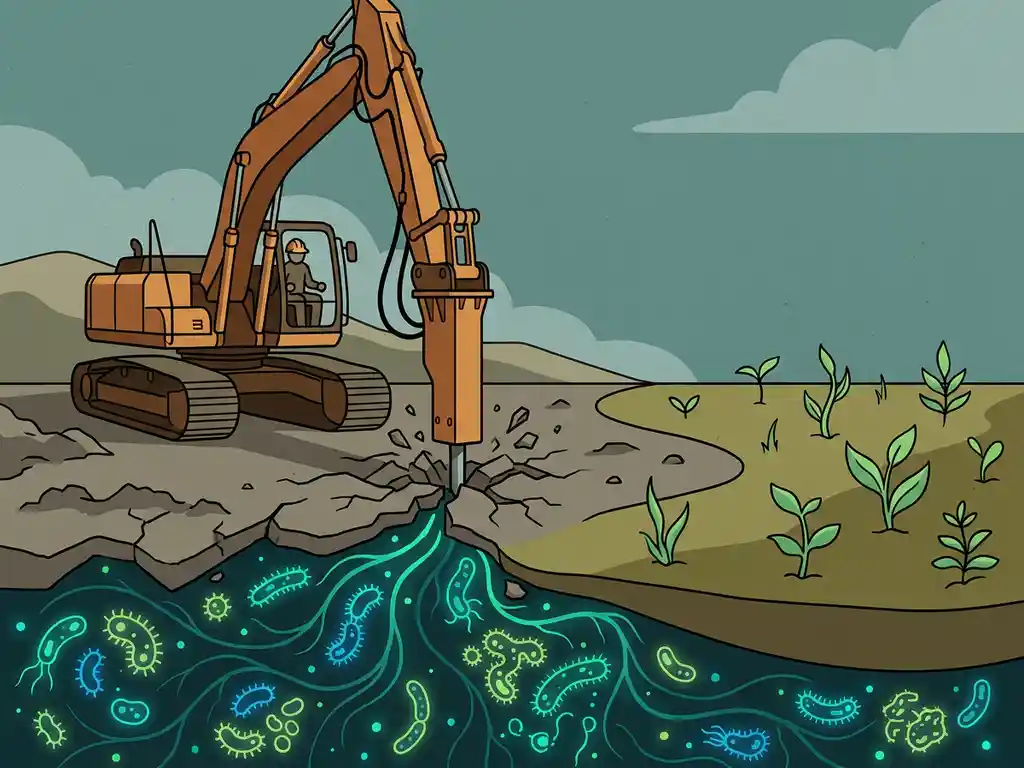
Yes, you can develop land that has contaminated soil, but you cannot simply build on it and ignore the problem. Legal frameworks in most countries require that contamination is assessed, reported, and remediated to a level that is safe for the intended land use before development can proceed. The good news is that excavation is not always the only path forward.
For brownfield developers, local authorities, and environmental project managers, the key question is not whether contamination blocks development, but which remediation approach is technically feasible and economically viable for the specific site. The sections below address the most common questions that arise once contamination has been discovered.
What types of soil contamination can block land development?
Soil contamination blocks land development when pollutant concentrations exceed regulatory thresholds for the intended land use, or when groundwater is affected in ways that pose unacceptable risks to human health or the environment. The contaminants most likely to create serious development obstacles are chlorinated solvents, heavy metals, petroleum hydrocarbons, and polycyclic aromatic hydrocarbons (PAHs).
Among these, volatile organochlorine compounds (VOCl) such as perchloroethylene (PCE) and trichloroethylene (TCE) are particularly problematic. These chlorinated solvents were widely used in dry cleaning, metal degreasing, and industrial processes, and they persist in soil and groundwater for decades. They migrate downward through the soil profile, contaminate deep aquifers, and resist breakdown under natural conditions without the right microbial environment.
Heavy metals such as lead, arsenic, cadmium, and chromium present a different challenge: they do not degrade at all and must either be removed or immobilized. Petroleum contamination from fuel storage or industrial spills is often more tractable, as many hydrocarbon compounds are biodegradable under the right conditions.
The type of contamination determines which remediation routes are technically available. Not every contaminated site requires the same approach, which is why accurate characterization of what you are dealing with is the essential first step.
Get in Touch
Let’s Talk Microbial Solutions
Book a conversation with Stijn, our CEO, or send us your request.
| Book an Appointment | Request Information |
What are the legal requirements before building on contaminated land?
Before building on contaminated land, the site must undergo a formal soil investigation, and any contamination found must be assessed against legally defined risk thresholds for the planned land use. In Belgium, this process is governed by VLAREBO and overseen by OVAM, the public waste authority. Development permits can be withheld or conditioned on completing a certified remediation process.
The legal pathway typically involves several stages:
- Exploratory soil investigation: A preliminary assessment to determine whether contamination is present and whether it poses a risk.
- Descriptive soil investigation: A detailed characterization of the extent, depth, and nature of the contamination, and its risk to human health, groundwater, and the environment.
- Remediation project: A formal plan, approved by the competent authority, describing how the contamination will be addressed and to what target values.
- Remediation execution and monitoring: Implementation of the plan, with ongoing monitoring to demonstrate that targets are being met.
- Conformity statement: Issued by the authority once remediation targets have been achieved, allowing the land transfer or development to proceed.
Skipping or shortcutting any of these stages creates legal and financial liability. Buyers, investors, and lenders increasingly require a clean conformity statement before completing transactions on brownfield sites.
Is excavation always required to remediate contaminated soil?
No, excavation is not always required to remediate contaminated soil. While dig-and-dump remains the most familiar approach, it is often technically impractical or prohibitively expensive, particularly on built-up sites, sites with deep contamination, or sites where groundwater is affected. In-situ remediation techniques, including biological methods, can address contamination without removing the soil.
Excavation becomes genuinely necessary in specific circumstances: when contamination is shallow and localized, when the contaminants are not amenable to in-situ treatment, or when time constraints make faster physical removal the only viable option. For many industrial brownfields, however, the contamination is too deep, too widespread, or located beneath existing structures to make excavation realistic.
The decision between excavation and in-situ treatment should be based on a proper feasibility assessment rather than default assumptions. Excavation moves the problem rather than solving it, since excavated material still needs to be treated or disposed of, often at significant cost. In-situ approaches, when applicable, treat contamination where it sits, which reduces disruption, transport costs, and the volume of waste generated.
How does biological soil remediation work?
Biological soil remediation works by stimulating or introducing microorganisms that break down contaminants in the soil and groundwater into less harmful or harmless compounds. For chlorinated solvents specifically, certain anaerobic bacteria are capable of a process called reductive dechlorination, where they use the chlorinated compound as an electron acceptor and progressively strip chlorine atoms from the molecule until it becomes ethylene, a non-toxic end product.
The process relies on the presence of the right microbial populations and the right geochemical conditions. In many contaminated sites, the indigenous microbial community either lacks the relevant organisms or exists in insufficient numbers to drive meaningful degradation. Two main approaches address this:
Biostimulation
Biostimulation involves adding electron donors, nutrients, or other amendments to the subsurface to create conditions that favor the growth of naturally occurring degrading organisms. This works when the right bacteria are already present but are not active at a meaningful rate.
Bioaugmentation
Bioaugmentation involves injecting specialized microbial consortia directly into the contaminated zone. This is the preferred approach when the indigenous community lacks the necessary organisms entirely. Avecom’s biological soil remediation service uses this approach for VOCl contamination, introducing well-characterized consortia of dechlorinating bacteria that have been cultivated and validated under controlled conditions.
Both approaches require careful site characterization to understand the hydrogeology, the existing microbial community, and the geochemical conditions. A microcosm test, conducted in the laboratory using actual soil and groundwater from the site, can determine whether biological degradation is feasible before any field intervention is committed to.
How long does biological remediation take compared to excavation?
Biological remediation typically takes longer than excavation in terms of the time from start to a clean site, but this comparison is often misleading. Excavation of a small, shallow, localized contamination can be completed in days or weeks. Biological remediation of the same site might take months to years. However, for the complex, deep, or extensive contamination scenarios where biological approaches are most relevant, excavation is either not feasible or would itself take years and cost far more.
For in-situ biological treatment of VOCl contamination in groundwater, realistic timelines range from one to several years depending on the extent of contamination, the depth of the plume, groundwater flow conditions, and the efficiency of the microbial degradation. These timelines are not fixed: they depend heavily on how well the system is designed and monitored.
It is also worth noting that biological remediation does not require halting site activity in the same way that excavation does. Development can sometimes proceed in phases while in-situ treatment continues in the subsurface, which changes the practical calculus for project planning significantly.
How do you know if bioremediation is working on your site?
You know bioremediation is working when molecular monitoring data shows active populations of degrading microorganisms in the target zone, and when contaminant concentrations in soil and groundwater are declining in line with the expected degradation pathway. Monitoring is not optional: it is the mechanism by which you demonstrate progress to regulators and protect yourself if the process underperforms.
Effective monitoring for biological remediation of chlorinated solvents combines two types of evidence:
- Chemical monitoring: Regular groundwater sampling to track concentrations of parent compounds (e.g. PCE, TCE) and their degradation intermediates (DCE, vinyl chloride, ethylene). A shift in the ratio of these compounds over time is a reliable indicator that reductive dechlorination is occurring.
- Molecular biological monitoring: Quantitative PCR (qPCR) and amplicon sequencing techniques to detect and quantify the specific organisms responsible for dechlorination in soil and groundwater samples. These tools can identify whether the right bacteria are present, whether they are active, and whether their populations are growing.
Molecular monitoring provides a level of diagnostic resolution that chemical data alone cannot offer. If concentrations are not dropping as expected, molecular data can reveal whether the problem is a lack of the right organisms, unfavorable geochemistry, or inadequate distribution of amendments through the subsurface. This allows the remediation approach to be adjusted rather than abandoned.
For project managers facing OVAM reporting obligations, this data also provides the structured, quantitative evidence that regulators require to confirm that a biological remediation project is on track. Avecom’s molecular monitoring tools are designed specifically to meet this need, offering qPCR-based analysis of microbial activity that can be reported in a format consistent with regulatory requirements.
If you are managing a site where contamination has been discovered and the conventional remediation route is not viable, the first practical step is a feasibility assessment. A microcosm test using your site’s own soil and groundwater can determine within weeks whether biological treatment is a realistic option, before any significant resources are committed. Avecom works with developers, municipalities, and industrial site owners across Europe to carry out exactly this kind of early-stage screening, providing the technical foundation for a remediation decision that holds up under regulatory scrutiny.
Related Articles
- How serious is contamination found on an industrial site?
- How do microorganisms break down soil contaminants?
- How do you choose the right remediation method for your site?
- When should you switch from aerobic to anaerobic wastewater treatment?
- What are the main causes of sludge problems in wastewater treatment?